Movement of Production Bases to the US
Easing of Green Subsidy Payment Regulations
The European Union (EU) has decided to provide subsidies at the same level as third countries such as the United States to prevent companies within the region from relocating overseas. This move comes as major European automakers like Germany's Volkswagen are actively shifting their production bases to the U.S., which offers various economic incentives. Following the U.S. Inflation Reduction Act (IRA) and China's aggressive subsidy policies, the EU has also revealed the true nature of its ‘domestic-first’ industrial policy. The domestic industry is expected to face significant repercussions as it encounters new challenges following the discriminatory measures of the U.S. IRA.
On the 9th (local time), the EU Commission announced a significant relaxation of subsidy regulations related to eco-friendly technologies until the end of 2025. This is a revision and expansion of the existing subsidy regulations previously named the ‘Temporary Crisis Framework,’ aiming to facilitate smooth funding support to prevent the overseas outflow of key eco-friendly companies, starting with batteries, which are central to the electric vehicle industry, as well as solar panels and carbon capture. Due to the differing economic conditions of the 27 member states, the EU had a stringent review process for granting subsidies to companies operating within its borders, but it has now decided to loosen these subsidy restrictions.
The newly introduced ‘matching subsidy’ system directly targets the U.S. IRA. The Wall Street Journal (WSJ) explained that this matching subsidy system exceptionally provides the same amount of subsidies that companies at high risk of shifting investments outside the EU due to the IRA can receive from the IRA itself. It pointed out that this subsidy regulation reform emerged as the movement to relocate electric vehicle and battery production bases from Europe to North America intensified in response to the U.S. IRA, which offers various economic supports for investments in the U.S.
Earlier, Volkswagen, Europe’s largest automaker, announced that it has completely suspended plans to establish a new battery factory in Eastern Europe and is considering building a plant in North America. Volkswagen’s move to North America is due to the subsidies it can receive from the U.S. government under the IRA. Volkswagen estimates that the subsidies it can receive from the U.S. government will amount to 9 to 10 billion euros (approximately 12 to 14 trillion won). However, Volkswagen emphasized that no final decision has been made regarding the North American construction and stated, "Appropriate conditions under the ‘Temporary Crisis Framework’ will be necessary to build a factory in Europe," indicating that it is watching the EU authorities’ policy changes.
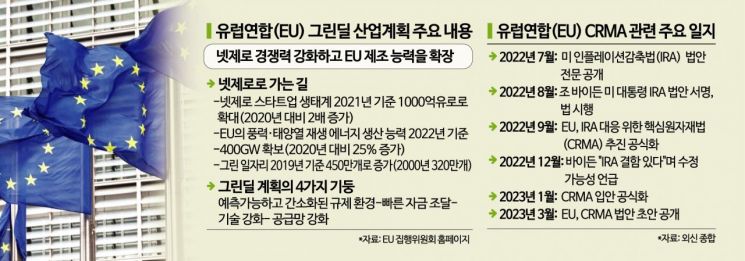
This measure is part of the EU’s ‘Green Deal Industrial Plan,’ a blueprint for fostering eco-friendly industries by providing subsidies and tax credit benefits to companies within the region. In response to the U.S. IRA, this plan, dubbed the ‘European version of the IRA,’ includes the Critical Raw Materials Act (CRMA), which aims to strengthen the supply chain of essential minerals and raw materials necessary for eco-friendly businesses such as electric vehicles. The EU is accelerating the implementation of additional measures, including the release of the CRMA draft on the 14th.
The CRMA is likely to include supply chain stabilization measures such as providing subsidies to companies producing raw materials locally or reducing dependence on specific countries like China. The EU, home to traditional automotive powerhouses such as Germany and France, is a region strongly committed to achieving carbon neutrality through the popularization of electric vehicles, making the establishment of a supply chain for key raw materials essential for electric vehicle and battery production absolutely critical.
Accordingly, the Korean battery industry, which has a high dependence on China for raw materials, is expected to face considerable impact. Depending on the strength and direction of the CRMA, domestic automakers such as Hyundai Motor and Kia may face increased pressure to produce eco-friendly vehicles locally. The industry has stated that it will closely monitor the situation as the detailed contents of the CRMA have not yet been disclosed.
Margrethe Vestager, EU Commissioner for Competition, said in a statement regarding the new measures, "They provide each member state with the option to grant subsidies quickly, clearly, and predictably," adding, "While ensuring a level playing field, this will enable member states to accelerate carbon-neutral investments at this critical time."
© The Asia Business Daily(www.asiae.co.kr). All rights reserved.

















