Liquidation of Cryptocurrency Bank Silvergate
SVB Financial Faces Bank Run Concerns
Bank Stocks Plunge Most Since Pandemic
US bank stocks plummeted at their steepest rate since the COVID-19 pandemic due to concerns over a bank run at 'SVB Financial,' a Silicon Valley specialized bank. Following the liquidation of cryptocurrency-focused bank 'Silvergate Capital' the previous day, the combined market capitalization of the four major US banks evaporated by approximately 70 trillion won in a single day amid overlapping negative news.
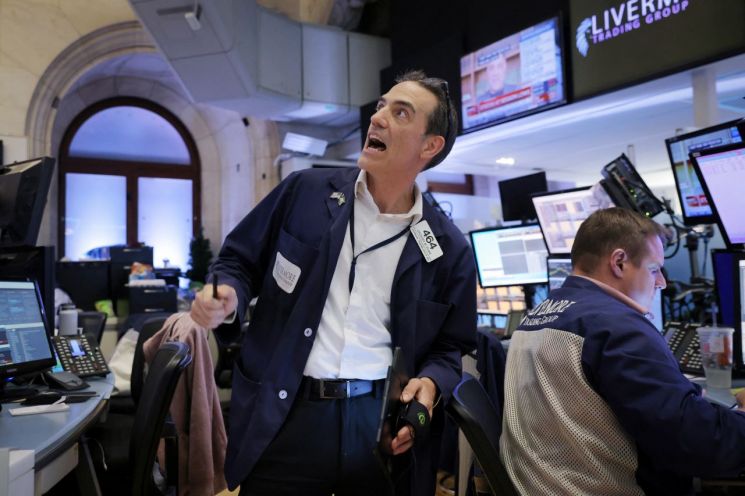
On the 9th (local time) at the New York Stock Exchange, SVB's stock price plunged 60.4% to $106.64. SVB, which had focused on lending to IT companies, announced the previous day that it suffered an $1.8 billion loss due to asset sales caused by a sharp decline in deposits, cutting its stock price by more than half. The increase in interest rates raised corporate financing costs, and as the IT sector, struggling amid recession fears, withdrew deposits, the bank's lending capacity was depleted. SVB decided to issue new common and preferred shares to raise $2.25 billion in capital.
The collapse of SVB's stock price also caused a sharp drop in shares of banks primarily lending to the IT sector. PacWest fell 25%, and First Republic dropped 17%. The filing for liquidation by Silvergate, a cryptocurrency-focused bank, with financial authorities the previous day further worsened investor sentiment. This bank had suffered massive losses and a bank run following the FTX bankruptcy. News of this caused Silvergate's stock price to plunge more than 42%.
The four major US banks were not spared from the sharp declines. JPMorgan Chase fell 5.4%, Bank of America and Wells Fargo each dropped 6.2%, and Citigroup declined 4.1%. As a result, these banks lost $52 billion in market capitalization in a single day. JPMorgan lost $22 billion, Bank of America $16 billion, Wells Fargo $10 billion, and Citigroup $4 billion. The fallout caused the Standard & Poor's (S&P) financial sector to fall 4.1%, marking its largest drop since June 2020, early in the pandemic.
The Wall Street Journal (WSJ) analyzed that the plunge in bank stocks was a result of the Federal Reserve's aggressive interest rate hikes. Due to high-intensity tightening, bond prices fell (bond yields rose), reducing the asset values of banks holding US Treasury securities. In the event of a bank run, banks may be forced to sell assets at a loss. According to the Federal Deposit Insurance Corporation (FDIC), domestic deposits at US banks increased by 38% from the end of 2019 to the end of 2021. However, loan growth during the same period was only 7%, forcing banks to invest surplus funds in bonds. Consequently, the amount of US Treasury securities held by US banks increased by 53% during this period, reaching $4.58 trillion.
Bill Smith, chairman and chief investment officer (CIO) of Smith Capital Management, which holds shares in Bank of America and JPMorgan, pointed out, "This incident is the first sign that cracks may be forming in the financial system."
© The Asia Business Daily(www.asiae.co.kr). All rights reserved.

















