19th Emergency Economic Deputy Meeting
Energy Efficiency Innovation and Conservation Enhancement Plan to Be Prepared This Month
Bang Gi-seon, First Vice Minister of the Ministry of Economy and Finance, stated on the 10th that "to stabilize prices and alleviate the trade deficit, it is necessary for all citizens to work together to reduce energy consumption."
On the same day, Vice Minister Bang presided over the '19th Emergency Economic Vice Ministers' Meeting and the 10th Economic Security Key Items (TF) Meeting' at the Government Seoul Office, making these remarks.
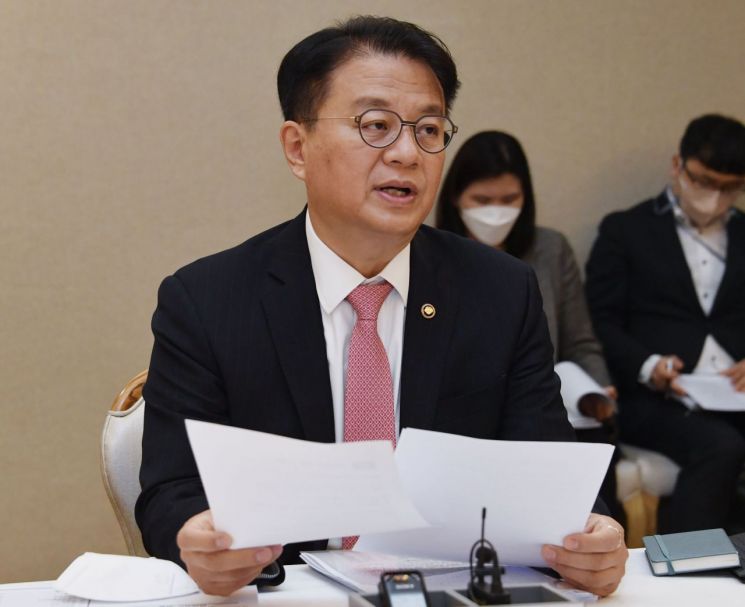 Bang Gi-seon, Vice Minister of the Ministry of Economy and Finance, is delivering opening remarks while presiding over the "19th Emergency Economic Vice Ministers' Meeting and the 10th Economic Security Core Items Task Force Meeting" held at the Government Seoul Office Building on the 10th.
Vice Minister Bang pointed out, "Although the recent rise in energy prices has somewhat slowed, the impact of the global energy crisis still remains a risk factor for our economy," adding, "Our country depends on imports for over 90% of its energy while having one of the highest consumption levels globally." As of August last year, the energy import dependency was 92%, and in 2020, total energy consumption ranked 10th worldwide.
Accordingly, the government plans to make the winter energy-saving efforts, which have been mainly promoted in the public sector, a year-round practice and expand it into a strong conservation movement involving the entire nation. Vice Minister Bang explained, "We are preparing an 'Energy Efficiency Innovation and Conservation Enhancement Plan' that includes tasks that can be practiced in daily life such as at home, school, and workplaces," and added, "We plan to announce it in March after today's meeting and further discussions."
On the same day, the Bank of Korea announced that the current account deficit for January was $4.5 billion. Regarding this, Vice Minister Bang said, "The January trade balance (-$12.65 billion) had a significant impact due to temporary causes, and the deterioration of the service balance caused by increased overseas travel also contributed," adding, "Since the trade deficit in February ($5.3 billion) is expected to shrink considerably compared to January, the current account is likely to improve to some extent. Although there will be volatility such as dividend payments in the first half of this year, an annual current account surplus in the $20 billion range is projected."
He continued, "The government will make every effort to maintain a stable surplus trend in the current account, which is a key indicator of external soundness," emphasizing, "We will actively seek measures to improve the service balance, such as revitalizing inbound tourism by leveraging the international tourism reopening atmosphere and boosting domestic travel."
So far, since initially selecting 200 key economic security items in December 2021, the government has been working to establish a stable supply chain foundation for these key items. However, due to recent technological changes and rapidly changing domestic and international conditions, the need for a comprehensive reorganization of key items is increasing. Accordingly, the government plans to proceed with restructuring by excluding some items with reduced supply chain risks and adding items of concern.
Vice Minister Bang stated, "We will proactively reflect essential materials and components of new industries such as bio and electric vehicles, as well as core industries like semiconductors and defense, into the key items," adding, "We will also add key raw materials and substances that enter the pre-stage of key items, for which a domestic production base has been established through achievements in materials, parts, and equipment, and focus on meticulous management at each value chain stage." Furthermore, the government will actively identify items with increasing public demand or those closely related to citizens' daily lives to proactively manage supply chain risks.
On the same day, Vice Minister Bang also emphasized the necessity of legislating key economic bills pending in the National Assembly. He said, "Expanding tax support to promote investment in national strategic technologies such as semiconductors, establishing a supply chain management system, introducing fiscal rules, and allowing additional extended work for workplaces with fewer than 30 employees are urgent legislative tasks that must be processed promptly to overcome the economic crisis and revitalize our economy," adding, "The government will strive to ensure swift legislative procedures through active explanations to the National Assembly."
© The Asia Business Daily(www.asiae.co.kr). All rights reserved.

















