"In the past, going together was a choice, but now if you go alone, you will die. We must go together."
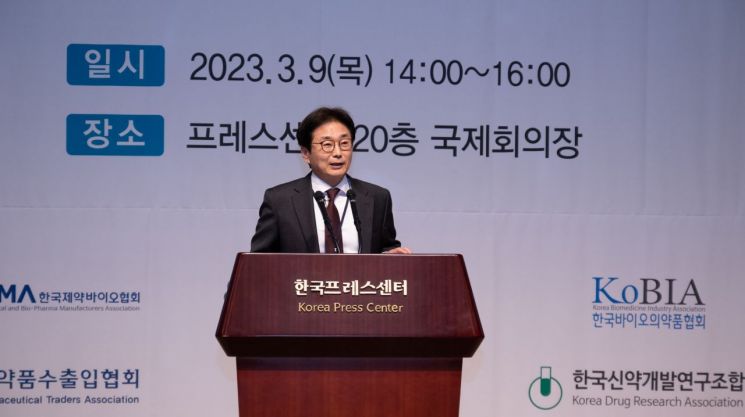 Professor Won Hee-mok, Special Appointment Professor at Seoul National University, is delivering the keynote speech at the 1st Forum of the Korea Pharmaceutical Bio Healthcare Association held on the 20th floor international conference hall of the Gwanghwamun Press Center in Seoul on the 9th.
 [Photo by Korea Pharmaceutical Bio Association]
Won Hee-mok, a special professor at Seoul National University who served as the chairman of the Korea Pharmaceutical and Bio-Pharma Manufacturers Association until last month, said this on the afternoon of the 9th at the ‘1st Forum of the Korea Pharmaceutical Bio Healthcare Alliance’ held at the Korea Press Center in Gwanghwamun, Seoul. His remarks emphasized that industries such as pharmaceuticals, bio, and healthcare must pursue ‘open innovation’ in line with the digital transformation trend. Open innovation refers to companies adopting technologies from outside while sharing internal resources externally.
According to Professor Won, the global digital healthcare market is expected to grow to 610 trillion won by 2027. As of 2021, the domestic digital healthcare market is about 1.3 trillion won, which is only 0.6% of the global digital healthcare market of 214 trillion won in the same year. Similarly, the domestic market share in other healthcare sectors is relatively small: pharmaceuticals (1.6%), medical devices (1.8%), next-generation diagnostics (0.7%), and medical imaging and information (0.4%).
In this context, Professor Won emphasized the need for convergence between digital and healthcare, citing a paradigm shift in future healthcare. He predicted, "Future healthcare will eliminate the constraints of time and space in health management," and added, "The medical system will also shift from a provider-centered to a consumer-centered model by utilizing MyData." He also advised active investment across industries for open innovation. Professor Won stressed, "The current trend is digitalization and convergence," and said, "Related industries must actively collaborate through technological, financial, and strategic investments based on these two keywords."
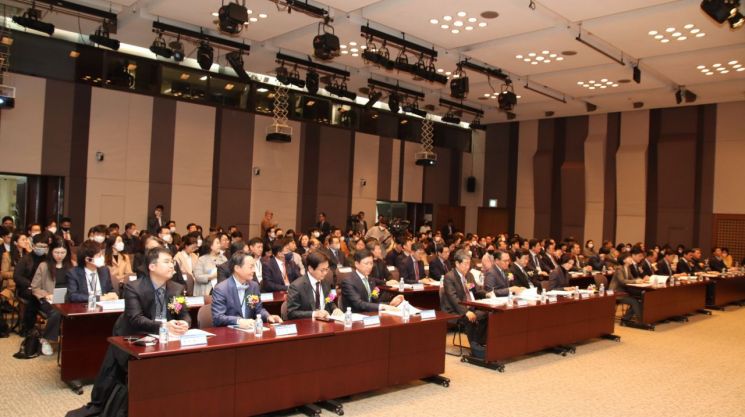 A view of the 1st Forum of the Korea Pharmaceutical Bio Healthcare Association held on the 20th floor international conference hall of the Gwanghwamun Press Center in Seoul on the 9th. [Photo by Korea Pharmaceutical Bio Association]
Following this, Kang Geon-wook, a professor at Seoul National University College of Medicine, who presented on ‘Medical MyData and Consumer Participation Customized Healthcare,’ emphasized that the sovereignty of medical MyData should be returned to consumers. He stated, "Although government authorities or large hospitals have created health record apps to allow viewing of medical or health checkup records, consumers cannot download the data, and some data are not accessible," and argued, "Like overseas cases, individuals should be able to download and utilize their medical data." He explained, "If this is realized, anyone will be able to download and use their medical information on their smartphones," and added, "Personalization of medical information can link digital healthcare to practical preventive treatment."
He also suggested transferring the current government and medical institution-centered medical MyData projects to the private sector to allow participation from big tech and other companies. Professor Kang advised, "Due to limited budgets, government medical MyData projects sometimes fail to properly manage services," and said, "The projects should be entrusted to large IT companies, while the government manages the quality of services."
Oh Doo-byung, director of the New Drug Development Division at the Korea Research Foundation’s National Research Headquarters, introduced new technologies such as digital bio, gene cell therapy, and AI-based new drug development under the theme ‘Paradigm Shift in New Drug Development in the Era of Bio Transformation.’ He pointed out the limitations of bio technology, including high costs, high risk of development failure, and long development times. He explained, "Bio technology is striving to overcome these limitations by integrating digital technologies such as AI and big data, leading to a paradigm shift." He presented digitalization, strategic technologization, and platformization as the three key words of the bio paradigm shift.
The Korea Pharmaceutical Bio Healthcare Alliance, which hosted this forum, was launched in January by six organizations: the Korea Pharmaceutical and Bio-Pharma Manufacturers Association, Korea Smart Healthcare Association, Korea Biopharmaceutical Association, Korea Pharmaceutical Importers and Exporters Association, Korea New Drug Development Research Association, and the Advanced Regenerative Medicine Industry Council. Together, these six organizations represent over 900 member companies in the domestic related industry. Starting with this forum, the alliance plans to hold forums alternately by each organization on a bimonthly basis.
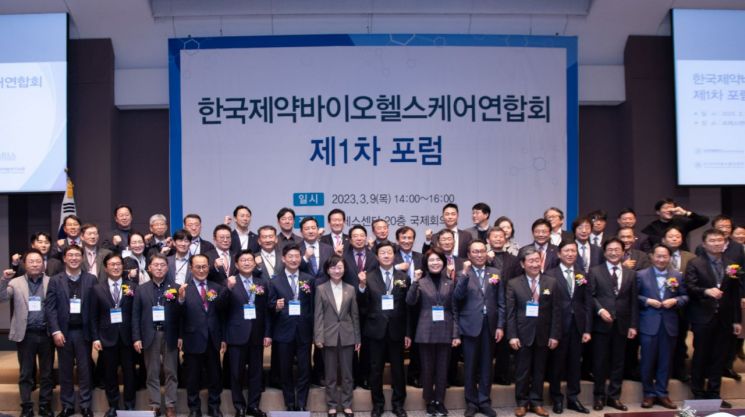 On the 9th, participants are taking a commemorative photo at the 1st Forum of the Korea Pharmaceutical Bio Healthcare Association held at the International Conference Hall on the 20th floor of the Gwanghwamun Press Center in Seoul. Photo by Korea Pharmaceutical Bio Association
© The Asia Business Daily(www.asiae.co.kr). All rights reserved.



















