[Aftermath of Forced Labor Solution]
Significant Differences from Chinese Forced Labor with Reconciliation and Compensation
1972 Japan-China Joint Declaration Different from Japan-Korea Claims Agreement
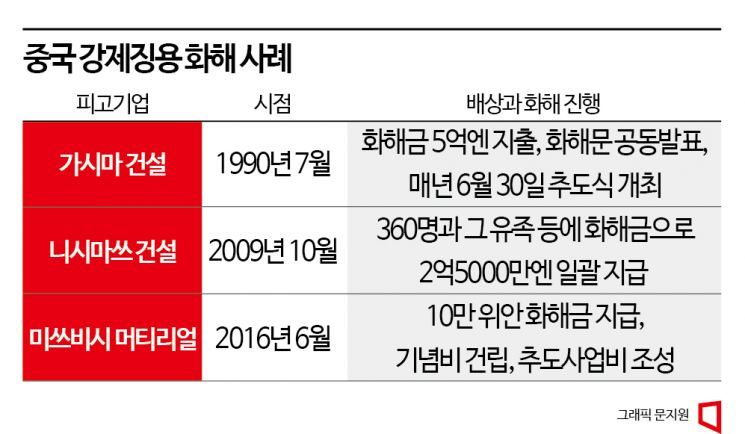
- Apology Statement by Mitsubishi Materials on Forced Mobilization and Forced Labor of Chinese Workers, June 2016 (Article 1 of the Settlement Agreement)
This is the apology statement announced by Mitsubishi Materials in 2016. It contains an apology and compensation for the victims of forced labor of Chinese workers. A settlement amount equivalent to 100,000 yuan per person was also paid. A memorial monument was established and commemorative activities were conducted. Previous cases of compensation for forced labor in China, such as the Hanaoka settlement (Kashima Construction, 2009) and Nishimatsu Construction (1990), followed similar procedures.
The procedure includes ① acknowledging the facts and responsibility and apologizing, ② providing economic compensation as evidence of apology, and ③ conducting commemorative activities. Of course, Japanese courts did not fully recognize compensation liability in lawsuits related to forced labor of Chinese workers. However, the rulings explicitly stated corporate responsibility in the 'additional remarks,' and responsibility, reconciliation, and compensation procedures were carried out at the private level.
Differences Between the 1972 Japan-China Joint Communique and the 1965 Korea-Japan Claims Agreement
Why is the resolution process for forced labor of Chinese workers different from that of Korea? Forced mobilization and forced labor of Chinese workers occurred for about one year from September 1944 to August 1945, with approximately 40,000 victims. The scope and period of forced labor of Koreans were much broader. About 7 million people were mobilized for forced labor from 1939 to 1945.
Experts point out that the difference in compensation between the two countries stems from the 'differences in colonial settlement and historical recognition' reflected in the 1965 Korea-Japan Claims Agreement and the 1972 Japan-China Joint Communique. In fact, the Japan-China Joint Communique signed in Beijing in 1972 explicitly states Japan's responsibility and apology for colonial rule. It includes the passage: "The Japanese side deeply reflects on and takes responsibility for the serious damage caused to the Chinese people through war in the past."
However, such content was not included in the 1965 Korea-Japan Claims Agreement. Instead, only differences in recognition regarding the legality or illegality of colonial rule were acknowledged. The clause stating "All treaties and agreements concluded between the Empire of Japan and the Korean Empire prior to August 22, 1910, are already null and void" was interpreted differently by the two countries. Japan interpreted the 1910 Korea-Japan Annexation Treaty as valid at the time of conclusion but nullified after defeat, while Korea viewed it as null from the outset. This issue remains a sharp point of contention between the two countries even 58 years after diplomatic relations were established.
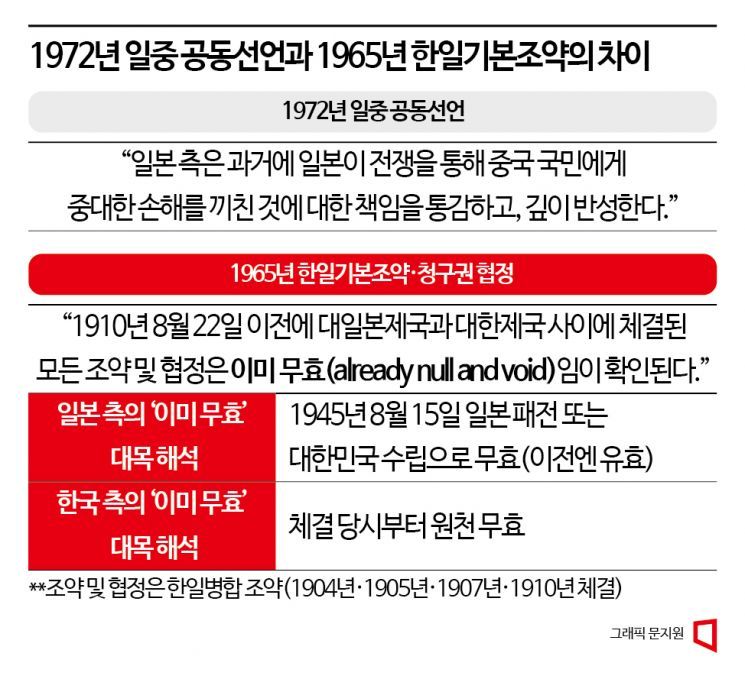
China, after normalizing diplomatic relations, properly addressed the first step regarding colonial settlement in the treaty and obtained Japan's apology, but Korea did not. Because of this, the issue continues to surface in rulings related to forced labor compensation.
The 2018 Supreme Court Ruling Recognized 'Illegality'... Apology at Korea-Japan Summit Requires 'Direct Succession' Expression
The 2018 Korean Supreme Court ruling ordered direct compensation from Japanese war crime companies and explicitly stated the 'illegality' of colonial rule in the judgment. It revived the issue of the illegality of colonial rule, which had been settled as 'Agree to Disagree' in the 1965 Korea-Japan Claims Agreement after 53 years. The court's ruling essentially stated that 'colonial rule was illegal, so war crime companies must compensate.' However, the Ministry of Foreign Affairs exempted Japanese war crime companies from compensation responsibility, reversing the outcome and drawing criticism that efforts to amend and supplement the 1965 Korea-Japan Claims Agreement have regressed.
Lee Jang-hee, Professor Emeritus at Hankuk University of Foreign Studies, stated, "The Constitution, which values the succession of the Provisional Government established by the March 1st Movement, regards the Japanese colonial period itself as illegal. (The Yoon Suk-yeol administration's decision on third-party subrogation payment) denies the core values of the Constitution and is sufficient grounds for a constitutional complaint."
Therefore, experts mention that at this month's Korea-Japan summit, Prime Minister Kishida should make a statement apologizing for the illegality and injustice of colonial rule. In fact, the Kim Dae-jung?Obuchi Declaration announced on October 8, 1998, contained supplementary content on colonial settlement that was not included in the 1965 Korea-Japan Claims Agreement. The 'Korea-Japan Joint Declaration' at that time stated, "We humbly accept the historical fact that the Korean people suffered various damages and pains through colonial rule and express our sincere reflection and heartfelt apology."
Choi Eun-mi, Research Fellow at the Asan Institute for Policy Studies, said, "If Prime Minister Kishida inherits past statements at the Korea-Japan summit, there should be explicit language expressing the will to apologize and specifying which parts are being inherited." However, Hosaka Yuji, Professor at Sejong University, pointed out, "The executive branch made a decision that directly contradicts the 2018 Supreme Court ruling recognizing the illegality of colonial rule, making it seem as if all past issues were resolved only by Japan. The possibility of Japan making an explicit and further apology through the summit is low. Ultimately, the conflict may continue only within Korea."
© The Asia Business Daily(www.asiae.co.kr). All rights reserved.
![Clutching a Stolen Dior Bag, Saying "I Hate Being Poor but Real"... The Grotesque Con of a "Human Knockoff" [Slate]](https://cwcontent.asiae.co.kr/asiaresize/183/2026021902243444107_1771435474.jpg)

















