Approval requires support from 180 assembly members
If the president vetoes, 200 members must agree
Up to 240 days needed until plenary session submission
On the 9th, the Democratic Party of Korea (DPK) initiated the push for a 'dual special prosecutor' by proposing a special prosecutor law to investigate allegations of stock manipulation involving First Lady Kim Keon-hee and Deutsche Motors. The DPK plans to persuade the Justice Party to designate the bill as a fast-track (rapid processing agenda) within March. As this would be the first time in constitutional history that a forced investigation is pursued against a First Lady, strong opposition from the ruling government party is expected, making the path to passing the special prosecutor law challenging.
Opposition: "Designate and process dual special prosecutor bills as fast-track within March"
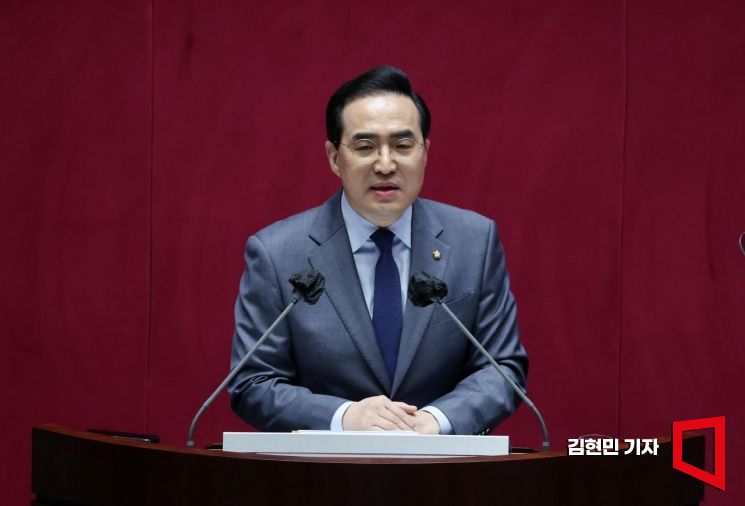 Park Hong-geun, floor leader of the Democratic Party of Korea, is delivering a negotiation group representative speech at the plenary session of the National Assembly held in Yeouido, Seoul on the 13th. Photo by Kim Hyun-min kimhyun81@
After former Deutsche Motors Chairman Kwon Oh-soo was indicted last month on charges of stock manipulation and received a suspended prison sentence in the first trial, the DPK intensified efforts to push the special prosecutor law. Floor leader Park Hong-geun declared in last month’s National Assembly negotiation group representative speech, "We will definitely enforce a 'people’s special prosecutor' regarding First Lady Kim’s stock manipulation allegations."
The DPK plans to designate the special prosecutor bills for First Lady Kim and the Daejang-dong 5 billion Club as fast-track agendas in the March National Assembly session. Kim Sung-hwan, chairman of the Policy Committee, explained at a press briefing on the 7th, "Our party’s policy is to designate the so-called dual special prosecutor bills as fast-track rapid processing agendas within March," adding, "We will coordinate with the Justice Party and strive to have them processed in the plenary session on either the 23rd or 30th."
Blocked Judiciary Committee, Persuade the Justice Party
The reason the DPK pulled out the fast-track card is because the likelihood of passing the bill through the Legislation and Judiciary Committee is slim. The special prosecutor law falls under the jurisdiction of the Judiciary Committee, where Kim Do-eup, a member from the People Power Party, can delay the review to block the bill. If 11 out of 15 Judiciary Committee members (three-fifths) approve, the committee itself can designate the bill as a fast-track agenda, but among the 10 DPK members, Assemblyman Cho Jeong-hoon of the Transition Korea Party opposes the Kim Keon-hee special prosecutor bill. Although the Speaker of the National Assembly can unilaterally submit the bill to the plenary session, this is also not easy.
Therefore, the DPK explains that fast-track designation is inevitable to pass the bill. However, challenges remain. According to the National Assembly Act, a resolution requires the approval of at least 180 members out of 299 total members, which is three-fifths. Currently, the DPK holds 169 seats, and even adding seven independent lawmakers with DPK leanings and Basic Income Party Assemblyman Yong Hye-in who supports the dual special prosecutor, they cannot reach 180 seats. Thus, cooperation from the Justice Party’s six seats is indispensable.
Accordingly, the DPK plans to persuade the Justice Party to push the special prosecutor law through a broad opposition coalition. Although the Justice Party also supports the special prosecutor initiative, the two parties have not reconciled differences regarding the appointing body for special prosecutor members and the scope of investigations, resulting in each party having separately proposed special prosecutor bills. The DPK faces the task of finding an appropriate compromise to secure the Justice Party’s cooperation.
Up to 8 months until plenary session, 200 votes needed if President Yoon vetoes
Even if the bill is successfully designated as a fast-track agenda, difficulties are expected until actual passage. Once designated as a rapid processing agenda, the special prosecutor bill undergoes review in the standing committee (Judiciary Committee) for up to 180 days, after which it can be submitted to the plenary session 60 days later. Since the standing committee is the Judiciary Committee, the 90-day period for structural and legal review is waived. Therefore, it can take up to 240 days, or about 8 months, before the bill is submitted to the plenary session. This has led to the phrase 'slow track' rather than 'fast track' due to the considerable time required.
Moreover, if President Yoon Seok-yeol exercises his veto, the National Assembly must vote again, requiring a quorum of more than half of all members and a two-thirds majority of those present to override. If all 299 members attend, 200 votes are needed. Because such a high level of consensus is required, few bills have passed via fast-track so far. Examples of bills designated and processed as fast-track include the Special Act on Social Disaster (amendments for investigating social disasters and building a safe society), the Kindergarten Three Laws (amendments to the Early Childhood Education Act, Private School Act, and School Meals Act), and election reform bills (amendments to the Public Official Election Act).
© The Asia Business Daily(www.asiae.co.kr). All rights reserved.


















