Once a foul-smelling, fly-infested 'Garbage Mountain'
Now a 180m Seoul-style Giant Ferris Wheel Landmark Will Be Built
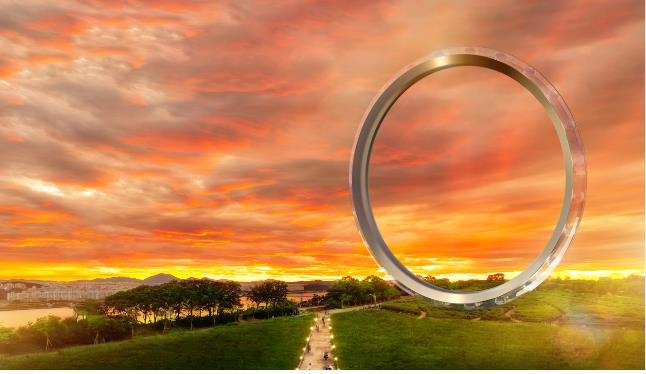
Seoul City will build the world's second-largest Ferris wheel, 'Seoulling,' at Sky Park in Sangam-dong, Mapo-gu, by 2027. It will be approximately 180 meters tall, making it the second-largest in the world after the Ain Dubai Ferris wheel in the United Arab Emirates, which stands at 257 meters.
Sky Park, where Seoulling will be located, was originally a landfill site. A place once avoided by people is being reborn as a new landmark symbolizing Seoul's future.
The island turned into a 'garbage mountain': The original state of Sky Park
Nanji Landfill was a site where Seoul's garbage was buried for 15 years from 1978 to 1993. Nanji Island was an island developed like Yeouido in the lower reaches of the Han River. However, due to the rapid population growth in Seoul during the 1960s and 1970s and the increase in waste volume, it was designated as a landfill. Part of this area is now Sky Park.
The landfill covered 577,000 pyeong (approximately 1.9 million square meters) out of Nanji Island's total area of 823,000 pyeong, where almost all types of waste generated in Seoul, including household garbage, construction debris, and industrial waste, were buried.
Initially, the plan was to landfill only up to the international standard height of 45 meters, but the construction of a new metropolitan landfill was delayed, resulting in two 'garbage mountains' reaching 95 meters in height. Later, in 1991, the Gimpo Metropolitan Landfill was established. Landfilling at Nanji was halted only in 1993 when the site reached saturation and its limits.
Nanji, turned into a garbage mountain, became uninhabitable. Due to the long-term accumulation of waste, the area was filled with foul odors, dust, and flies, and environmental pollution was severe due to methane gas and leachate emitted from decomposing garbage. Poor people collecting scrap materials gathered in the area, forming a slum.
The transformation of Nanji into its current ecological park form was accelerated by the 2002 Korea-Japan World Cup. After confirming the joint hosting of the World Cup in 1996, the Seoul World Cup Stadium was decided to be located in Sangam-dong in 1998. To coincide with the World Cup, Seoul City quickly promoted the stabilization and park development of the Nanji landfill.
Currently, Nanji consists of five parks: Peace Park, Sunset Park, Sky Park, Nanji Hangang Park, and Nanji Stream Park, transforming into places for leisure and relaxation for Seoul citizens.
City and residents clash over resource recovery facility: "A giant Ferris wheel on a garbage mountain? Absurd"
Seoul City plans to build the Seoul-style Ferris wheel 'Seoulling' at Nanji, which has been transformed from a garbage island into a park, by 2027. Unlike typical Ferris wheels, Seoulling features an innovative design without spokes, shaped like a ring that evokes a futuristic city.
The city explained that Sky Park offers views of the Han River, downtown Seoul, Namsan, and Bukhansan natural scenery, and is considered the optimal location to realize policy intentions related to carbon neutrality and climate change, reflecting Seoul's aspirations despite its past as a landfill.
Underneath the Ferris wheel, an experiential exhibition hall (in the form of an elevator) will be created to showcase the history and significance of Nanji as a landfill by allowing visitors to observe the landfill sediment layers. An underground passage will connect it to the nearby World Cup Park to improve accessibility.
However, some residents have expressed negative opinions about the construction of Seoulling. Currently, the city and Mapo-gu residents are in conflict over the plan to build an additional Mapo Resource Recovery Facility (waste incineration plant). This has led to interpretations that Seoul City announced the Seoulling project as a concession in exchange for the resource recovery facility.
Residents opposing Seoulling in Mapo-gu argue, "Building a giant Ferris wheel on top of a garbage mountain is an unrealistic and absurd idea," adding, "It is intended to appease opposition to the incineration plant and cannot be an effective measure."
© The Asia Business Daily(www.asiae.co.kr). All rights reserved.
![Clutching a Stolen Dior Bag, Saying "I Hate Being Poor but Real"... The Grotesque Con of a "Human Knockoff" [Slate]](https://cwcontent.asiae.co.kr/asiaresize/183/2026021902243444107_1771435474.jpg)
















