Apartment prices in Songpa-gu have turned to an upward trend for the first time in 11 months, making it the only district among the 25 districts in Seoul to do so. Seoul apartment prices have reduced their decline for four consecutive weeks, centered on the Gangnam 3 districts (Seocho, Gangnam, and Songpa-gu). This is attributed to the depletion of urgent sale properties in major complexes with high preference despite a strong wait-and-see sentiment.
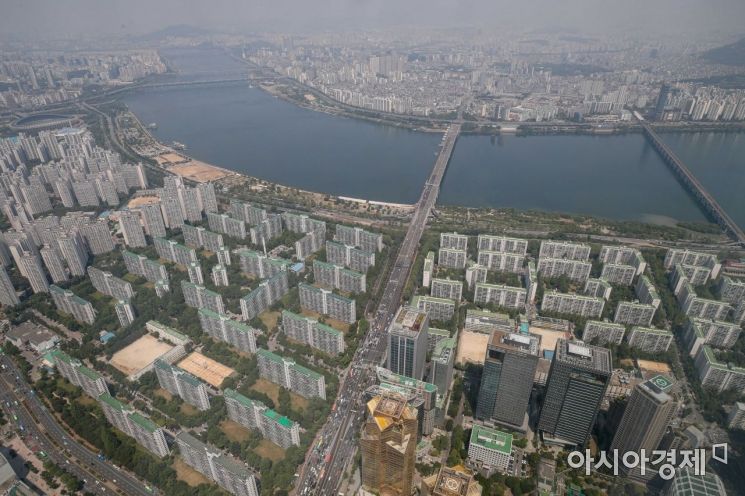 View of apartments from Lotte World Tower Seoul Sky in Songpa-gu, Seoul / Photo by Jinhyung Kang aymsdream@
According to the weekly apartment price trend announced by the Korea Real Estate Board on the 9th, Seoul apartment prices fell by 0.21% in the first week of March (as of the 6th), narrowing the decline compared to the previous week (-0.24%).
The Real Estate Board explained, "While transactions continue mainly for urgent sale properties, a gradual price increase is appearing. However, the wait-and-see stance among buyers remains due to expectations of further declines, and the gap between buyers' and sellers' desired prices has not narrowed."
Among the 25 autonomous districts in Seoul, the Gangnam 3 districts minimized the decline. Songpa-gu (0.03%) was the only district to rise, while Seocho-gu and Gangnam-gu fell by 0.0% and 0.10%, respectively. Following last week, the southeastern area, which includes the Gangnam 3 districts and Gangdong-gu (-0.15%), had the lowest decline rate at 0.05%.
Other districts such as Dongjak-gu (-0.14%), Seongbuk-gu (-0.17%), Nowon-gu (-0.18%), Seongdong and Eunpyeong-gu (each -0.19%), and Mapo-gu (-0.20%) experienced smaller declines than the Seoul average. On the other hand, Jongno and Yongsan-gu (each -0.23%), Jungnang-gu (-0.24%), Dongdaemun-gu (-0.31%), Gwanak-gu (-0.33%), and Dobong-gu (-0.39%) saw an expanded decline compared to the previous week due to reasons such as inventory accumulation.
Gyeonggi Province (-0.49%) saw a larger decline than the previous week. Suji-gu in Yongin (-0.87%) declined mainly in Pungdeokcheon, Dongcheon, and Jukjeon-dong, while Siheung-si (-0.72%) saw price drops in large complexes in Baegot, Jeongwang, and Eunhaeng-dong. Incheon (-0.36%) maintained the same decline for three consecutive weeks. Seo-gu (-0.58%) experienced notable declines mainly in Wondang, Dangha, and Cheongna-dong, and Jung-gu (-0.45%) saw declines mainly in Jungsan, Unnam, and Unseo-dong, which include Yeongjong Sky City, all significantly affected by accumulated supply.
The five major metropolitan cities in the provinces fell by 0.42%, with the decline rate increasing compared to the previous week. Except for Daegu (-0.43%), Busan (-0.46%), Gwangju (-0.27%), Daejeon (-0.44%), and Ulsan (-0.42%) all saw expanded declines. Sejong fell by 0.30%.
Apartment jeonse (long-term lease) prices nationwide fell by 0.46%, with the decline rate slowing. Among 17 cities and provinces, jeonse prices in seven areas including Seoul (-0.58%), Gyeonggi (-0.60%), Incheon (-0.52%), Busan (-0.49%), Daegu (-0.63%), Daejeon (-0.49%), and Ulsan (-0.67%) fell more than the national average.
The Real Estate Board stated, "In Seoul, although transactions at lower prices are occurring due to concerns about prolonged inventory accumulation influenced by regional supply volumes, additional decline contracts are gradually decreasing, and jeonse inquiries are slightly increasing after the depletion of urgent sale properties."
© The Asia Business Daily(www.asiae.co.kr). All rights reserved.

















