2022 Pasture Management Survey Results
Ministry of Agriculture, Food and Rural Affairs: "Will Increase Utilization of Unused Pastures"
The area of grasslands, recognized as a major carbon sink, decreased by 376 hectares last year. This was due to the conversion of unused grasslands for agricultural land and various development projects.
The Ministry of Agriculture, Food and Rural Affairs announced the '2022 Grassland Management Survey Results' containing this information on the 9th.
The grassland management survey is conducted annually under the Grassland Act to understand the management status of grasslands nationwide and to promote the efficient use and revitalization of grasslands based on the results.
In 2022, the total grassland area nationwide was 32,012 hectares, a decrease of 376 hectares (1.2%) compared to the previous year. Although 62 hectares were newly created for forage crop cultivation and livestock feeding purposes, 438 hectares were excluded from grasslands due to grassland conversion and forest restoration. The nationwide grassland area, which was 66,301 hectares in 1995, has been decreasing annually due to conversion for agricultural and fishery land, various development projects, and forest restoration.
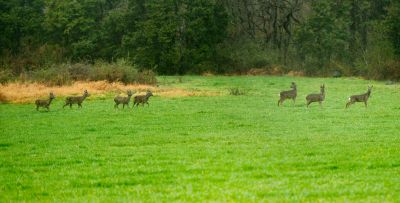
Analysis of the 438 hectares excluded from grasslands in 2022 showed that 211 hectares were converted from grasslands, mostly for agricultural purposes (132 hectares), and also for urban planning facilities and roads. Additionally, 227 hectares were released from grassland status due to forest restoration, loss of grassland function, and lack of management.
42% of grasslands, amounting to 13,425 hectares, are used as grazing grasslands. This is followed by forage crop fields (7,092 hectares) and livestock barns and auxiliary facilities (1,010 hectares). Furthermore, unused grasslands increased by 999 hectares from the previous year, totaling 10,485 hectares.
The Ministry of Agriculture, Food and Rural Affairs plans to conduct a full on-site survey in the first half of this year to identify the locations and future usability of unused grasslands, disclose the results, and provide related information to livestock farmers wishing to use grasslands to increase grassland utilization rates.
The ministry has designated 55 'Pasture Ecological Livestock Farms' nationwide, where grasslands are created on unused or idle land to realize organic livestock farming and animal welfare. Procedures for selecting additional support recipients are underway this year. Furthermore, by expanding support projects such as grassland creation, access road construction, and establishment of experience and tourism facilities, the ministry plans to revitalize pasture ecological livestock farms, contributing to the creation of an eco-friendly livestock environment and the production of safe livestock products.
Jung Kyung-seok, Director of the Livestock Environment Resources Division at the Ministry of Agriculture, Food and Rural Affairs, said, "Grasslands, classified as carbon sinks, are lands that play a role in reducing greenhouse gases and are very important for establishing a sustainable livestock industry base. However, due to the decrease in grassland utilization, forest restoration and conversion are increasing." He added, "To increase the utilization of unused grasslands, we plan to actively expand grassland creation support projects for livestock farmers and strengthen the disclosure of information on unused grasslands."
© The Asia Business Daily(www.asiae.co.kr). All rights reserved.

















