Companies that deceived consumers by falsely claiming high content of expensive ingredients such as Cheonma, Nokyong, and Hong Sam, which are known to be good for health, have been extensively caught.
The Ministry of Food and Drug Safety announced on the 9th that it conducted a focused crackdown on 24 companies manufacturing liquid teas using ingredients like Cheonma, Nokyong, Sansam, and Hong Sam, and identified 12 companies for prosecution.
The detected companies were found guilty of ▲not indicating ingredient content ▲falsely indicating ingredient content ▲displaying the Good Manufacturing Practice (GMP) mark, which is only allowed on health functional foods.
Nine food manufacturing and processing companies produced liquid teas using extracts containing trace amounts (blend ratio or solid content 0.07~13.5%) of Cheonma, Sansam, Nokyong, etc., and to conceal this, they labeled the main product surface only with terms like 'Cheonma extract 90%', 'Nokyong extract 90%', 'Domestic 生 Nokyong' without indicating the solid content or blend ratio, leading to their detection.
Additionally, three companies were caught for violations such as falsely labeling and selling liquid tea products made with 6.7% Hong Doraji as containing 46%, displaying the GMP mark on general food liquid teas, and storing four types of ingredients including expired blueberry concentrate.
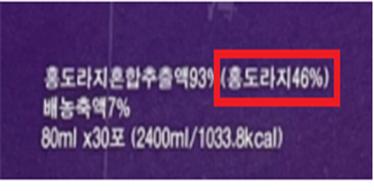 Liquid tea containing Hongdoraji caught by the Ministry of Food and Drug Safety. The product, which contains about 6.7% Hongdoraji, was labeled as 46%, resulting in detection.
 [Photo by Ministry of Food and Drug Safety]
The detected manufacturers sold products costing 4,000 to 21,000 KRW per box (approximately 80ml vinyl packaging, 30 packets per box) to distributors and online shopping malls, and the distributors mainly sold these products at promotional centers targeting elderly consumers for up to 360,000 KRW per box, amounting to approximately 32.1 billion KRW in sales.
The Ministry of Food and Drug Safety advised that to prevent damage from deceptive illegal activities occurring at food promotional centers, consumers purchasing foods with extracted ingredients such as liquid teas should always check the actual content of ingredients, including solid content and blend ratio. When purchasing health functional foods, consumers should verify the health functional food certification mark and functional information on the product label and confirm on the 'Food Safety Korea' website whether the product is registered as a health functional food before buying.
An official from the Ministry of Food and Drug Safety stated, "We have taken measures to correct all labeling issues of the relevant products," and added, "We will continue to strengthen crackdowns on illegal activities that deceive consumers to create an environment where the public can safely consume food."
© The Asia Business Daily(www.asiae.co.kr). All rights reserved.

















