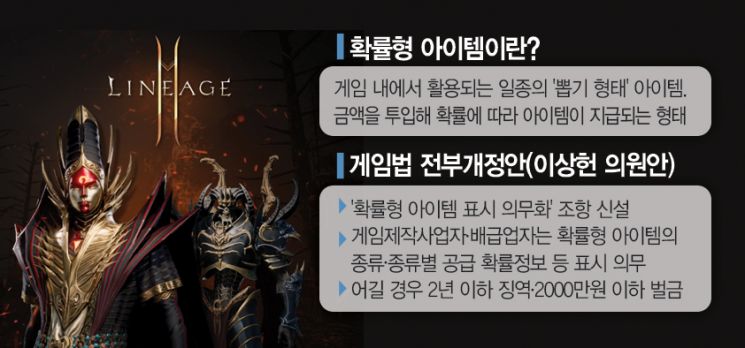
The gaming industry, which had relied solely on 'probability-based items,' has begun to take a difficult and challenging path to find new revenue sources. The National Assembly stepped in to strengthen regulations on probability-based items. Users also expressed frustration with the random draws. A consensus has emerged among game companies that change is necessary.
Struggling to Find New Revenue Models
On the 27th of last month, a partial amendment to the Act on the Promotion of the Game Industry passed the National Assembly plenary session. The amendment focuses on 'disclosure of probability information.' It requires game companies to display the types and probability information of probability-based items on the game itself, websites, advertisements, and so on. This is to prevent hiding or manipulating probabilities.
Users welcomed this. Until now, probability-based items were subject to self-regulation, with game companies voluntarily disclosing probabilities. However, in 2021, it was revealed that some game companies manipulated probabilities. Many users were also disappointed by the structure where winning depended more on how much money was spent rather than gaming skill.
The concerns of game companies can be seen in the new releases pouring out this year. Nexon declared '3NO (No P2W, No capsule-type items, No probability)' with the release of 'KartRider: Drift' in January. This aims to prevent wins or losses from being determined by the presence or absence of probability-based items such as random draws. In fact, the paid items released so far do not differ in performance from free items.
NCSoft, preparing to release the first half’s new title 'Throne and Liberty (hereafter TL),' is also struggling to apply a new revenue model instead of probability-based items. Especially since it plans to enter the North American market, where aversion to probability-based items is stronger, it is highly likely to introduce a subscription model such as a 'season pass.' This system allows players to receive rewards based on game progress, such as completing tasks or attendance days, by paying a fixed amount.
Game Companies Giving Up Inducing Spending
Probability-based items have already become a core element in some games. Massively Multiplayer Online Role-Playing Games (MMORPGs) are a representative example. Instead of abandoning probability-based items, game companies have chosen to reduce spending inducement to avoid criticism.
Currently, all game companies have stopped 'BJ (one-person media host) promotions.' This marketing method involved BJs playing games with advertising fees received from game companies. BJs showed themselves advancing ahead of other users with expensive items, inducing general users to spend money. However, fairness issues arose, and some users even protested.
A new marketing method emphasizing fairness has emerged to replace BJ promotions. Nexon introduced the 'Creator Support Program' with the release of 'HIT 2' last year. It is a marketing method replacing 'BJ promotions.' Users can directly choose the creator they support and enter a dedicated code; when purchasing items in the game, a portion of the amount is accumulated as support points for the creator.
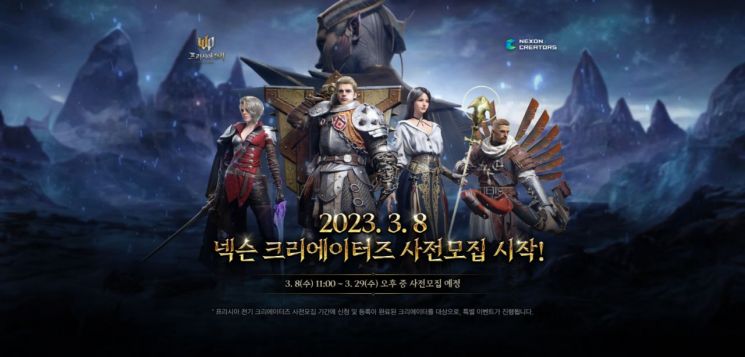
Nexon officially launched the 'Creator Support Program' as a service called 'Nexon Creators' this year. The service will expand to the new release 'Prasia Jeongi,' launching on the 30th.
© The Asia Business Daily(www.asiae.co.kr). All rights reserved.
![Clutching a Stolen Dior Bag, Saying "I Hate Being Poor but Real"... The Grotesque Con of a "Human Knockoff" [Slate]](https://cwcontent.asiae.co.kr/asiaresize/183/2026021902243444107_1771435474.jpg)

















