Spring Dry Weather and Strong Winds Increase Wildfire Risk
Massive Wildfires in East Coast Areas Including Donghaean, Yangyang, Goseong, Sokcho
"Avoid Burning Near Forests and Report Wildfires Immediately"
Concerns about large-scale spring wildfires are rising as dry weather continues. It has been one year since the Donghaean wildfire, which turned the Donghaean coastal area of Gangwon into ashes, occurred.
On the 8th, the Ministry of the Interior and Safety, together with the Ministry of Agriculture, Food and Rural Affairs, the Korea Forest Service, the National Police Agency, and the National Fire Agency, issued a "National Address on Wildfire Prevention," announcing that from January 1 to the 5th of this month, 194 wildfires have already occurred, which is 1.5 times more than the average number of 127. In particular, more than 10 wildfires per day have been recorded since the beginning of this month.
On the same day, wildfires broke out in the hills of Hapcheon-gun, Gyeongnam, Buyeo-gun, Chungnam, and Buk-gu, Daegu, causing nearby residents to evacuate urgently. The day before, wildfires also occurred in Sancheong-gun, Gyeongnam, Dangjin-si, Chungnam, Geumjeong-gu, Busan, and Chilgok-gun, Gyeongbuk, prompting forest authorities to carry out firefighting operations.
Large wildfires tend to concentrate in spring. Record-breaking massive wildfires such as the Donghaean wildfire in April 2000 that burned the thousand-year-old Naksansa Temple, the Yangyang wildfire in April 2005, and the Goseong-Sokcho wildfire in April 2019 mostly occurred in spring. The Donghaean wildfire that swept through Gangneung, Donghae, and Samcheok last year also broke out in March.
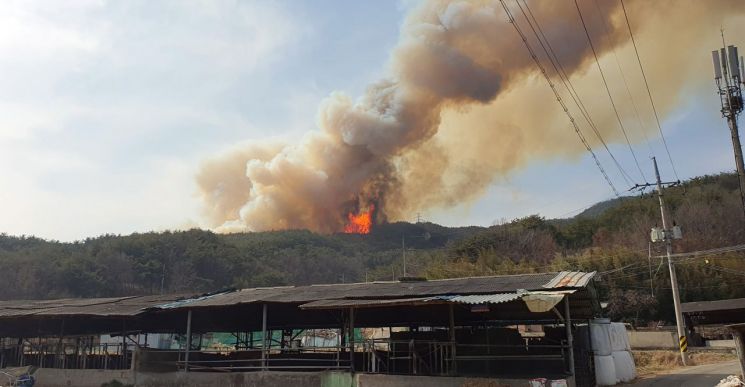 At 1:59 PM on the 8th, a fire and smoke occurred in the hills around Wolpyeong-ri, Hapcheon-gun, Gyeongnam. [Image source=Yonhap News, Hapcheon-gun, Gyeongnam]
The main reason for frequent spring wildfires is the dry weather. When dry weather with low precipitation continues and strong winds blow, small sparks can easily turn into large wildfires. Fires caused by burning agricultural waste or trash can spread with the wind and escalate into large wildfires that engulf forests. In Gangwon Province, the Yangganjipung?a local wind blowing from Yeongseo to Yeongdong, characterized by high temperature, dryness, and wind speeds reaching up to 25 meters per second?can rage fiercely.
The government plans to operate a special wildfire prevention period until the 30th of next month and strengthen crackdowns on illegal burning, which is a major cause of wildfires. According to the Enforcement Decree of the Forest Protection Act, which came into effect on November 15 last year, burning is completely prohibited within 100 meters of forest areas, and violators will be fined up to 1 million won.
Furthermore, if a wildfire occurs intentionally, the offender may face imprisonment of up to 15 years. Even if caused by negligence, wildfire offenders may be subject to imprisonment of up to 3 years or a fine of up to 30 million won, making it a criminal offense.
To prevent wildfire damage, the government urges the public to ▲ refrain from burning near forests ▲ avoid entering closed hiking trails and restricted areas ▲ refrain from carrying lighters or burners ▲ be cautious when smoking in or near forests ▲ and report any wildfire sightings to fire authorities immediately.
© The Asia Business Daily(www.asiae.co.kr). All rights reserved.
![Clutching a Stolen Dior Bag, Saying "I Hate Being Poor but Real"... The Grotesque Con of a "Human Knockoff" [Slate]](https://cwcontent.asiae.co.kr/asiaresize/183/2026021902243444107_1771435474.jpg)
















