Kishida "Inheriting the Awareness of Past Cabinets"
Statement Made Without Apology
Action Reflects Conservative Public Opinion Awareness
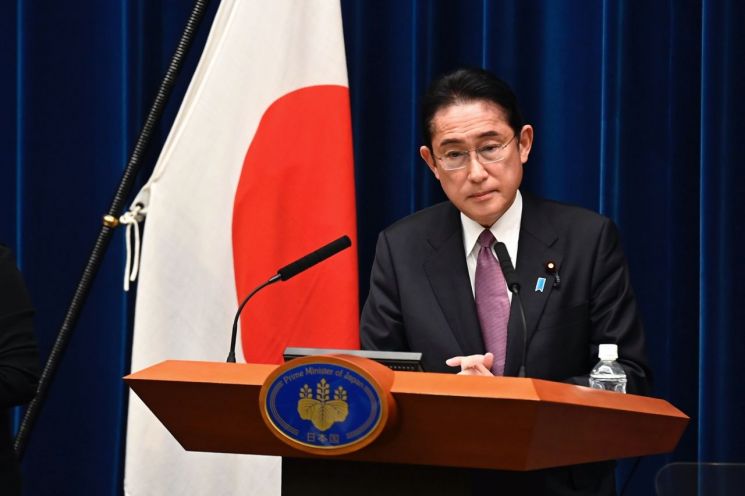
Japanese Prime Minister Fumio Kishida's reluctance to explicitly express direct apologies such as "reflection and apology" regarding Japan's past colonial rule is largely analyzed as an effort to avoid provoking the conservative faction within Japan. The concern is that if the domestic conservative camp reacts strongly to the Kishida Cabinet's apology, it could ignite worsened public opinion in South Korea.
On the 8th, the Asahi Shimbun explained that Prime Minister Kishida's repetition of the existing stance without a new apology to the victims of forced labor was a strategy to avoid a vicious cycle surrounding historical awareness. Earlier, on the 6th, Kishida stated, "(Regarding the recognition of Japan's forced labor and aggressive war) we have inherited the stance of past cabinets as a whole and intend to continue doing so." Foreign Minister Yoshimasa Hayashi also held a press conference on the same day, saying, "Regarding historical awareness, including the Japan-South Korea Joint Declaration, we are inheriting the stance of past cabinets."
This means that Japan intends to uphold the 1998 "Kim Dae-jung-Obuchi" Joint Declaration, which contains a comprehensive apology for Japan's past colonial rule and aggressive war, as well as the 1995 "Murayama Statement."
However, following Prime Minister Kishida's announcement, voices criticizing the Japanese government for using ambiguous expressions to convey its position have continued within South Korea's political circles and public opinion. The criticism is that the Japanese government is approaching the improvement of Japan-South Korea relations with a lukewarm attitude, without even mentioning the words "reflection" and "apology." On the 7th, Joo Ho-young, floor leader of the People Power Party, said at a floor strategy meeting, "Foreign Minister Yoshimasa Hayashi's remarks are disappointing," and demanded a more proactive response from the Japanese government.
The Asahi Shimbun viewed the reason the Japanese government does not clearly express an apology as being due to awareness of the conservative faction's perspective. If Prime Minister Kishida were to directly use the word "apology" toward the victims of forced labor, there is a high possibility of strong backlash, especially from the conservative faction within Japan. The Japanese government is concerned that if the conservative backlash is reported through the media, it could further provoke worsened public opinion in South Korea.
In fact, the Japanese side is closely monitoring South Korean public opinion and media, fearing that Japan-South Korea relations will not improve. On the same day, Nihon Keizai Shimbun analyzed the front pages of South Korean newspapers dated the 7th and reported on the tone of South Korean media regarding compensation for forced labor victims. Nihon Keizai explained, "Currently in South Korea, there is a prominent view that unless Japan actively responds and properly persuades the victims, Japan-South Korea relations cannot be resolved," adding, "Progressive newspapers are criticizing the government's decision."
The Asahi Shimbun explained, "The Japanese government added the phrase 'including the Japan-South Korea Joint Declaration' to convey the meaning contained in existing declarations to the South Korean side without specific expressions such as reflection and apology," and added, "The Japanese government used this strategy to avoid backlash from public opinion on both sides."
© The Asia Business Daily(www.asiae.co.kr). All rights reserved.
![Clutching a Stolen Dior Bag, Saying "I Hate Being Poor but Real"... The Grotesque Con of a "Human Knockoff" [Slate]](https://cwcontent.asiae.co.kr/asiaresize/183/2026021902243444107_1771435474.jpg)
















