Companies with habitual delivery delays and penalty charges succeed again in securing additional projects
Kim Jong-gil, Seoul City Council member, “An evaluation system reflecting companies’ delivery delay status must be established”
Amid the ongoing procurement project for new subway cars worth 1.8653 trillion KRW to modernize the aging trains on Seoul Subway Lines 1 to 8, the ordering agency, Seoul Metro, has been unable to receive the trains on time and has only been imposing massive delay penalties.
According to data submitted by Seoul Metro to Kim Jong-gil (People Power Party, Yeongdeungpo 2), a member of the Seoul Metropolitan Council’s Transportation Committee, out of the total 3,613 subway cars on Lines 1 to 8, 1,286 cars (35.6%) have received a performance evaluation grade D, indicating urgent need for replacement or refurbishment.
In response, Seoul Metro is conducting a subway car modernization project worth 1.8653 trillion KRW in seven phases by 2026 to replace the aging trains. However, among 582 cars whose delivery deadlines have passed, 382 cars were not delivered on time, with some delays lasting up to 677 days.
Notably, companies that were penalized with massive delay charges for delays up to 677 days during phases 3 to 5 have again succeeded in winning contracts for phases 6 and 7, leading Kim Jong-gil to analyze that a domino effect of continuous delays is inevitable.
For phase 3, Dawonsys, which won the contract for 196 cars on Lines 2 and 3 worth 154.9 billion KRW, experienced delivery delays for all contracted units, with delays ranging from 202 to 677 days. For phase 4, Woojin Industrial Systems, which secured 336 cars on Lines 5 and 7 worth 373.1 billion KRW, had delays of 345 to 568 days for 136 cars.
Dawonsys, which failed to deliver all phase 3 units on time, also succeeded in winning the phase 5 contract and is currently experiencing additional delays for 50 cars.
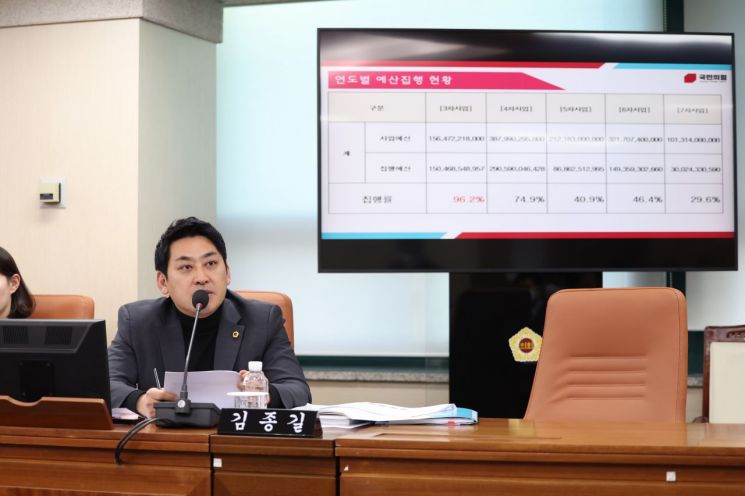
Despite the companies’ delivery delays, Seoul City’s budget is being steadily executed. For phase 3, where delays occurred across the entire volume, 150.4 billion KRW out of the 156.4 billion KRW budget has already been spent. For phases 4 (387.9 billion KRW) and 5 (269.7 billion KRW), 290.5 billion KRW and 86.8 billion KRW have been paid respectively.
Even for phases 6 and 7, where no cars have been delivered yet, 46.4% and 29.6% of the budgets have already been executed respectively.
Kim Jong-gil pointed out that the root cause of these habitual delivery delays is a joint failure between companies that overbid beyond their production capacity and Seoul Metro’s desk-bound administration without an appropriate evaluation system.
According to data submitted by Seoul Metro, there were no evaluation criteria for delivery delays up to phase 6, and even for phase 7 where criteria were newly established, the maximum penalty for delay was only -2 points (for delays over 240 days).
In fact, the technical evaluation scores of Dawonsys, Woojin Industrial Systems, and Hyundai Rotem, which participated in the phase 7 bidding, were 91.46, 92.36, and 92.4 points respectively, undermining the purpose of the ‘two-stage separated specification and price simultaneous bidding system’ and effectively making it no different from a lowest-price bidding system.
Kim Jong-gil emphasized, “The ultimate victims of this cycle of dumping bids and roll-over contracts are the 10 million Seoul citizens who have to commute on aging subway cars. Seoul Metro must urgently introduce an evaluation system that comprehensively reflects bidders’ annual production capacity and overall delivery delay status.”
© The Asia Business Daily(www.asiae.co.kr). All rights reserved.
![Clutching a Stolen Dior Bag, Saying "I Hate Being Poor but Real"... The Grotesque Con of a "Human Knockoff" [Slate]](https://cwcontent.asiae.co.kr/asiaresize/183/2026021902243444107_1771435474.jpg)
















