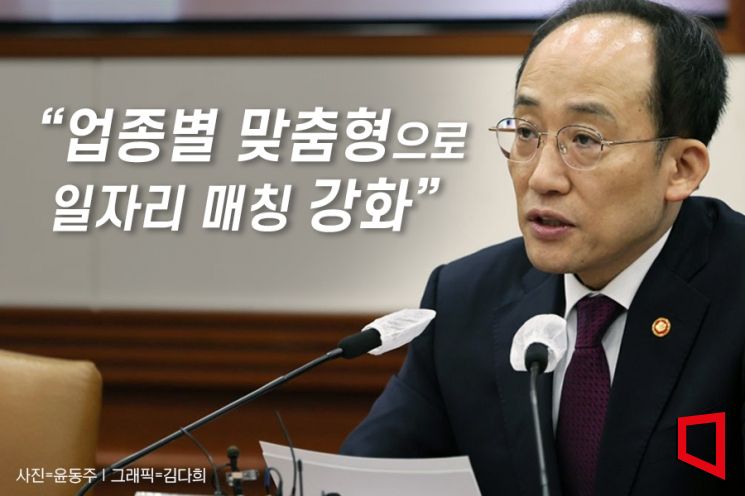
The government plans to spend more than 70% of this year's approximately 15 trillion won job budget in the first half of the year, considering the economic and employment slowdown. In particular, the direct job projects aimed at stabilizing the livelihoods of vulnerable groups will be expanded by 14,000 people compared to last year, with a total of 1,044,000 people to be hired this year.
On the 8th, Deputy Prime Minister and Minister of Economy and Finance Choo Kyung-ho chaired an emergency economic ministers' meeting at the Government Seoul Office and announced this plan. He said, "The perceived employment slowdown may feel more significant as the reduction in the increase of employed persons coincides with the economic slowdown."
Regarding this year's employment situation, Deputy Prime Minister Choo explained, "The increase in employed persons is expected to slow significantly from 820,000 last year, which was more than twice the usual annual increase, to 100,000 this year, returning the number of employed persons to the long-term trend level."
On the factors behind the slowdown in the increase of employed persons, he said, "It is due to a combination of factors including the statistical base effect from last year's strong employment, demographic changes such as aging, and economic slowdown." He added, "Despite recent concerns about employment slowdown, labor market imbalances persist with an increase in vacant jobs in the industrial field. We will strengthen job matching by expanding domestic workforce inflow and flexibilizing the use of foreign labor tailored to each industry."
He stated, "Considering the economic and employment slowdown conditions, more than 70% of the 14.9 trillion won job budget will be spent in the first half of this year. In particular, the direct job projects for stabilizing the livelihoods of vulnerable groups will be expanded by 14,000 people compared to last year, with a total of 1,044,000 people to be hired this year." He continued, "To quickly support those who need jobs and income at the beginning of the year, 828,000 hires, a higher level than last year, were completed by the end of February. We aim to hire more than 924,000 people in the first quarter and will execute the budget as quickly as possible."
Appointment of Responsible Officers for Six Major Industries Facing Labor Shortages
The government also plans to appoint responsible officers in charge at the relevant ministries for six major industries facing labor shortages?manufacturing, logistics and transportation, health and welfare, food service, agriculture, and overseas construction?and promote the resolution of vacant jobs.
Deputy Prime Minister Choo emphasized, "In the shipbuilding industry, we will train 2,000 production workers such as welders and painters this year and expand customized education including professional workforce training through the Future Talent Development Center. We will temporarily establish a quota of about 5,000 foreign workers in the shipbuilding industry and supply immediately deployable personnel through vocational training in collaboration between primary and subcontractors."
He added, "In the health and welfare sector, a promotion system pilot project will be conducted for care workers with more than five years of service to diversify career development paths, and in the logistics industry, support for the establishment of automation facilities will be expanded to reduce workers' workload." Starting this year, employment will be permitted not only for loading and unloading tasks allowed for visiting compatriots (H-2 visa holders) but also for sorting work, and plans to allow employment in this area are under review.
Expansion of Hope Savings for New Entrants in the Shipbuilding Industry
Deputy Prime Minister Choo also announced that as a follow-up measure to the shipbuilding industry coexistence agreement signed last month between shipbuilding primary and subcontracting companies and the government and local governments, a coexistence package support project will be promoted. He said, "Although ship orders have significantly increased recently, due to poor treatment of subcontracted workers, a shortage of 14,000 production workers is expected by the end of this year. Based on the sincere implementation of the agreement between primary and subcontractors, we plan to actively support resolving labor shortages and management difficulties."
Deputy Prime Minister Choo said, "To improve the treatment of shipbuilding workers, we will greatly expand the Hope Savings project for new entrants and newly establish an asset-building support project for workers employed at subcontractors, operating it temporarily for two years. We will also continue efforts to reduce the gap in working conditions between primary and subcontracted workers by strengthening financial support so that the joint labor welfare fund doubles over three years."
The 'Shipbuilding Industry Hope Savings' project for new entrants at partner companies, which was piloted last year, will be further expanded. This project helps workers form assets totaling 6 million won by having the worker pay 1.5 million won, the local government pay 1.5 million won, and the government pay 3 million won over a one-year term. Previously, only workers under 45 years old were eligible, but going forward, the age requirement will be removed, and the target areas will be expanded to include Busan and Gunsan in addition to Ulsan and Geoje.
Furthermore, he added, "To immediately alleviate urgent management difficulties, measures such as extending the deferral of employment and industrial accident insurance premium payments for six months until the end of the year and temporarily allowing employment insurance support only for workplaces that have faithfully paid overdue insurance premiums will be implemented alongside institutional support."
© The Asia Business Daily(www.asiae.co.kr). All rights reserved.

















