Overdue Loan Balance 5.4 Trillion Won in December Last Year, Increased by About 1 Trillion Won Since September
Rapid Interest Rate Hike Increases Burden on Vulnerable Borrowers
Commercial Banks' Mortgage and Credit Loan Rates Around 6%
Overdue Balances Expected to Rise Further This Year
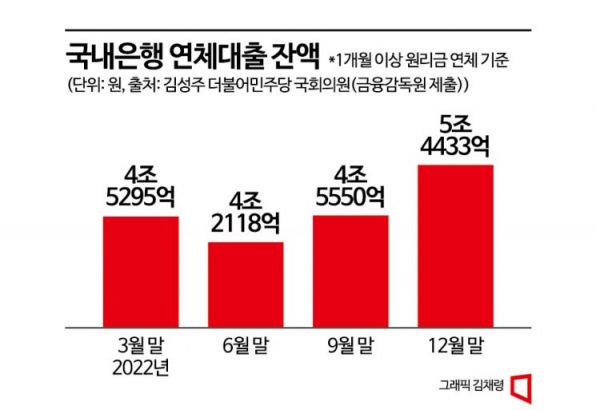
The outstanding balance of overdue loans at domestic banks increased by about 1 trillion won within three months. It appears that cases of principal and interest delinquency have risen, particularly among vulnerable borrowers, as loan interest rates surged sharply in the second half of last year.
According to data received by Kim Sung-joo, a member of the Democratic Party of Korea, from the Financial Supervisory Service on the 8th, the outstanding balance of overdue loans (based on principal and interest overdue for more than one month) was recorded at 5.4433 trillion won as of the end of December last year. This accounts for about 0.25% of the total loan balance (2,160.2 trillion won).
Comparing the overdue loan balance, it increased by about 1 trillion won from 4.555 trillion won at the end of September last year, three months prior, and the delinquency rate also rose by 0.04 percentage points. At the end of June last year, the overdue loan balance was 4.2118 trillion won, showing a clear upward trend over time. A representative from a commercial bank explained, "In the fourth quarter of last year, bond yields rose and the base interest rate also increased significantly, pushing the upper limit of mortgage and unsecured loans above 7%. As interest rates rose sharply, the delinquency rate also increased accordingly."
Among these, internet-only banks, which mainly handle loans for medium- and low-credit borrowers, also saw a significant increase in overdue balances. At the end of December last year, the balance was 291.6 billion won, about three times higher than 106.2 billion won at the end of March of the same year. This is interpreted as the interest burden on medium- and low-credit borrowers having increased accordingly.
So far, the banks' loss absorption capacity is not insufficient. As of the end of September last year, domestic banks' loan loss provisions stood at 21.7 trillion won, about 2 trillion won more than 19.6 trillion won at the end of March of the same year. Nevertheless, with warning signals triggered by the delinquency rate this year, domestic banks are expected to build up more provisions. Last month, Lee Bok-hyun, Governor of the Financial Supervisory Service, said, "We should closely examine the adequacy of loan loss provisions and capital capacity and encourage the expansion of loss absorption capacity so that banks can faithfully perform their core function of supplying funds even in future crisis situations."
This year, with interest rates continuing to soar and the economy worsening, the delinquency rate is expected to keep rising. As of the 7th, the interest rates at the five major banks (KB, Shinhan, Hana, Woori, NH) for mortgage loans (variable rate, lower to upper bound) ranged from 4.53% to 6.39%, and the six-month unsecured loan rates ranged from 5.36% to 6.64%. A commercial bank official said, "Although rates have come down compared to early this year due to pressure from financial authorities, compared to the low-interest period during the COVID-19 crisis, rates have risen by about 3 to 4 percentage points, so customers still feel the rates are high. Since interest rates have been rising for over a year, the financial strength of vulnerable borrowers and insolvent companies will now start to show signs of exhaustion, and the delinquency rate is expected to rise."
© The Asia Business Daily(www.asiae.co.kr). All rights reserved.

















