Verification of the Actual Structures of Government Offices in the Joseon Dynasty
Hapcheon County in Gyeongnam announced on the 8th that through an excavation conducted as part of the urban regeneration project at the site of the ‘Hapcheon Samga-myeon Resident Customer Harmony Center Construction Project,’ the actual remains of the Samga Eupseong Asa (衙舍: government office building during the Joseon Dynasty) confirmed in local maps from the late Joseon period were identified.
The excavation, carried out by Samgang Cultural Heritage Research Institute since December last year, revealed 16 building sites, 1 elevated building site, 2 pedestrian facilities (步道施設), 1 stone platform (石壇), 1 well, 4 fences, and 2 drainage channels.
Accordingly, Hapcheon County and Samgang Cultural Heritage Research Institute plan to hold two on-site briefing sessions for local residents and the general public at the excavation site (622-7 Geum-ri, Samga-myeon) on the 10th at 10:30 AM and 1:30 PM to introduce the excavation results.
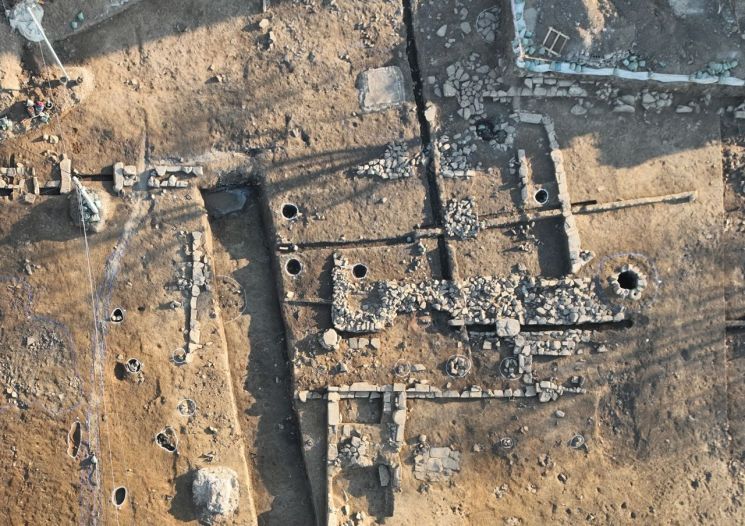 Excavation site of Joseon Dynasty government office building relics at Samga Eupseong, Hapcheon-gun, Gyeongnam.
Through this excavation, a building site presumed to be the Dongheon (east government office) was identified, and evidence was secured to prove its relationship with the currently remaining Samga Giyangru (岐陽婁).
Giyangru is a pavilion building with a hipped-and-gabled roof, three bays wide and two bays deep, designated as a tangible cultural asset of Gyeongsangnam-do. It is estimated to have been built before the mid-Joseon period and, located south of the Dongheon, is believed to have served as the gate pavilion (樓門) of the Samga-hyeon government office.
The building sites were confirmed in a straight line as recorded in the late Joseon local maps: Giyangru (outer gate) → Building site No. 9 (inner gate: main gate of Dongheon) → Building site No. 1 (Dongheon: the building where the local magistrate executed administrative affairs during the Joseon Dynasty).
Additionally, since Giyangru, Asa, and Sachang (舍倉, government granary) are marked, Building site No. 1 is presumed to be the central building aligned with Giyangru and the Dongheon site of Asa.
A stele was excavated from a modern disturbance pit located 20 meters north of Giyangru, and the investigation confirmed that the stele’s excavation site is related to Asa.
This stele, called ‘Sipaegyo Gubi’ (a stele demanding correction of market abuses), measures 73 cm in length, 42 cm in width, and 16 cm in thickness. Although small, detailed inscriptions are engraved on both the front and back.
The ‘Sipaegyo Gubi’ excavated through this excavation is highly valuable as primary material for studying the economic history of the Hapcheon region during the late Joseon period. In particular, the discovery of the inscription on the ‘Sipaegyo Gubi’ is a unique case nationwide and an especially important achievement.
County Governor Kim Yoon-cheol stated, “We will create opportunities to share the value of the excavated relics with local residents and widely publicize the research results on their historical significance. In the future, along with the excavation results, we plan to expand the designation as a cultural asset after completing the detailed survey of Samga Eupseong currently underway. This will be reflected in Hapcheon County’s basic plan under the Historical and Cultural Zone Maintenance Act and used as a foundation to promote the Gaya Historical and Cultural Zone maintenance project.”
© The Asia Business Daily(www.asiae.co.kr). All rights reserved.

















