Deposit Without Victim Consent Is Invalid
Direct Repayment Possible Through Concurrent Debt Assumption
On the 6th, the government proposed a solution using the 'third-party payment' method, in which domestic foundations pay the judgment amounts on behalf of the victims of forced labor under Japanese colonial rule who received a final compensation ruling from the Supreme Court. President Yoon Suk-yeol stated in his opening remarks at the Cabinet meeting held at the Yongsan Presidential Office on the morning of the 7th that this was "a result of seeking a solution while respecting the victims' positions." However, the victims and civic groups have strongly opposed the measure. They argue that this solution ignores the intent of the Supreme Court ruling and is unconstitutional, demanding its withdrawal.
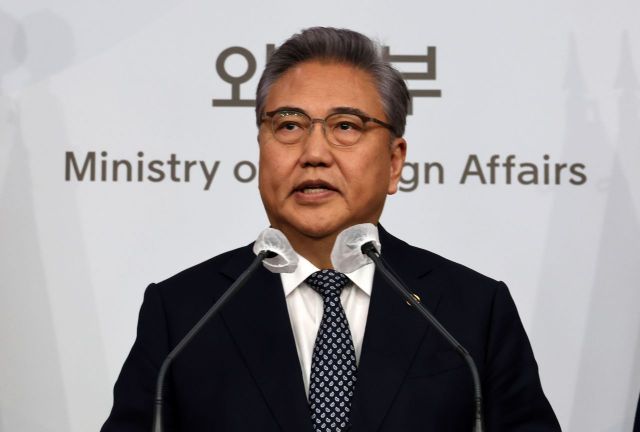 Foreign Minister Park Jin is announcing a solution for compensation for forced labor victims during Japanese colonial rule on the 6th at the Ministry of Foreign Affairs in Jongno-gu, Seoul. Photo by Dongju Yoon doso7@
So, is the government's proposed solution unconstitutional or illegal? Experts generally interpret that it is difficult to see it that way. First, we need to look back at the circumstances following the Supreme Court ruling. In the 2018 Supreme Court decision, 15 victims of forced labor became creditors, and Japanese companies such as Mitsubishi Heavy Industries and Nippon Steel & Sumitomo Metal Corporation became debtors. The court recognized that the victims retained their individual claims for damages and that the Japanese companies were obligated to compensate them. However, the Japanese companies did not pay, and the judiciary, citing diplomatic and political reasons, did not enforce compulsory execution against Japanese companies in Korea. Japan imposed export restrictions on key semiconductor materials citing the Supreme Court ruling as justification.
The Yoon Suk-yeol administration appears to have sought a political solution to this issue, which had reached a stalemate between South Korea and Japan. The government, as a third party, will pay the money on behalf of the Japanese companies. Regardless of whether this method is right or wrong, it does not deny the creditors' claims for compensation recognized by the Supreme Court, so it is difficult to see it as an act that clearly contradicts the Supreme Court ruling.
However, there is a valid point in questioning why the government is making the payment on behalf of the Japanese companies when the Supreme Court ruling's core was recognizing the Japanese companies' liability for compensation. Particularly, the government's statement that it does not plan to exercise subrogation rights against the Japanese companies after the third-party payment strengthens the argument that the government's measure contradicts the intent of the Supreme Court ruling. Professor Jeong Wan of Kyung Hee University Law School explained, "The Supreme Court ruling applies only to the parties involved in the civil lawsuit and is separate from the executive branch's political actions. Of course, policies that deviate from the intent of the Supreme Court ruling can send a political message that they are unconstitutional."
Government Pays on Behalf but Does Not Deny Compensation Claims... Victims Can File Administrative Lawsuits
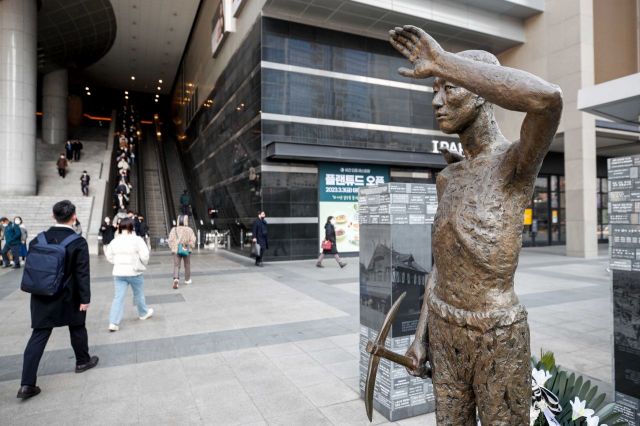 Citizens are passing by the Statue of Forced Laborers installed at Yongsan Station Plaza in Seoul on the 6th, as the government is about to officially announce a solution for compensation for forced labor victims during the Japanese colonial period. Photo by Jinhyung Kang aymsdream@
Even if there are no legal issues, victims have options. One is filing an administrative lawsuit. An administrative lawsuit can be filed when a government action causes harm. The victims have had their right to receive money from the Japanese companies recognized by the Supreme Court and want to exercise that right. However, if the government's third-party payment extinguishes that right, the victims can claim they have suffered damages. Whether directly receiving money from Mitsubishi or Nippon Steel & Sumitomo Metal constitutes a legal interest could become a legal issue.
If victims are concerned that the government might proceed with the third-party payment process while an administrative lawsuit is ongoing, they can apply for provisional execution together. If the court accepts the provisional execution, the government must halt the third-party payment process. From the government's perspective, having proposed a solution to the forced labor issue, it could find itself unable to act and forced to wait for the court's decision.
Even if Government Pays Judgment Amount, No Effect If Creditor Refuses
If victims do not file administrative lawsuits and the government quickly proceeds to pay the victims, does that mean compensation has been made? The key issue here is the interest relationship in third-party payment. Article 469 of the Civil Act broadly allows third-party payment in paragraph 1, stating, "A third party may also make payment of a debt," but restricts it in paragraph 2, stating, "A third party without interest in the debt cannot make payment against the debtor's will."
In other words, if a third party has an interest in the debt relationship, payment can be made through deposit or other means, but if there is no interest, payment cannot be made against the debtor's will. The government, as a third party, must prove that it has an interest in the debt relationship between the victims and the Japanese companies. If it fails to prove this, even if the government deposits the judgment amount to the victims, if the creditors (victims) claim that they will receive money from the debtor Japanese companies, the debt payment is nullified. Even if the government makes a deposit for third-party payment, if the victims refuse, the deposit has no effect.
Government and Japanese Companies May Choose 'Concurrent Debt Assumption' to Share Debt Burden
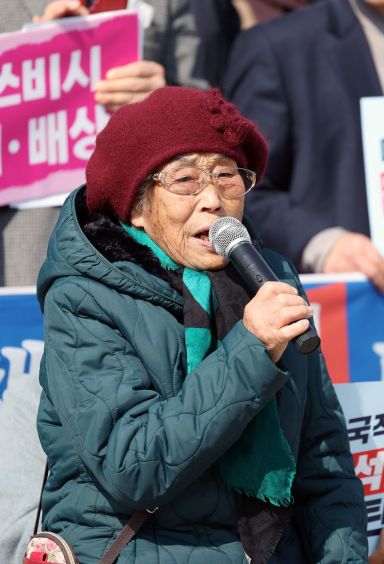 On the 6th, when the government's solution to the forced mobilization issue, centered on third-party compensation, was announced, victim Yang Geum-deok, an elderly woman, was making a statement condemning the government plan at the 5.18 Democracy Square in Dong-gu, Gwangju.
 [Photo by Yonhap News]
However, there is a method where the government concurrently assumes the debt of the Japanese companies and makes the payment. Judge A, a sitting judge, said, "Currently, the government seems to be trying to include a contract to assume the judgment debt from the Japanese perpetrator companies to resolve the situation. At this stage, deposit is difficult, but if the perpetrator companies agree to the debt assumption by the foundation established by the government, deposit becomes possible. Once deposited, victims can no longer enforce compulsory execution."
Debt assumption includes two types: discharge-type debt assumption (Article 454 of the Civil Act), where the original debtor is released and only the assumer bears the debt, and concurrent debt assumption, where the debtor and the assumer agree to bear the debt jointly. Discharge-type debt assumption requires the creditor's consent to be effective, but concurrent debt assumption, which is not disadvantageous to the creditor, can be established without the creditor's consent.
Judge A said, "Before making a third-party payment, the government plans to obtain the perpetrator companies' consent to concurrently assume the debt. If that happens, the government can make the payment not as a third party but directly as the debtor."
There are concerns that a situation similar to the 2015 South Korea-Japan comfort women agreement may repeat. Because the solution lacks justification and is legally unstable, it could lead to political confusion. Professor Jeong predicted, "There is a major flaw in that the victims' intentions were not reflected from the start. Since the next administration could invalidate this solution, the conflict is likely to continue for a long time."
© The Asia Business Daily(www.asiae.co.kr). All rights reserved.



















