Office for Government Policy Coordination '2022 Youth Life Survey'
Average Housing Price in Seoul Metropolitan Area 700 Million KRW, Youth Average Income 21.62 Million KRW
Youth's Top Source for Housing Funds: 'Parents and Relatives'
Most Needed Housing Policy: 'Purchase Loan'
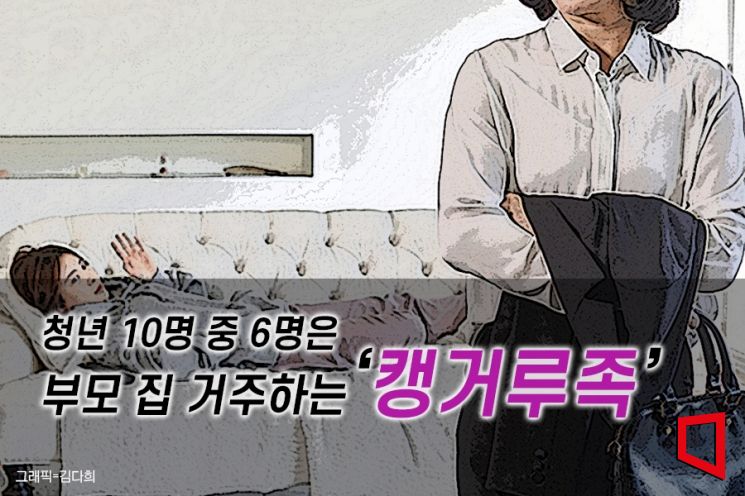
Six out of ten young people live with their parents due to living expenses, according to a survey. Most stated that they would become independent once they find employment or accumulate assets, but their income and financial assets were far from sufficient to cover housing costs. The primary source of funds for securing housing was not banks but parents, and more than half of the youth responded that government loan policies for home purchases or jeonse deposits are necessary.
On the 7th, the Office for Government Policy Coordination shared statistics from the ‘2022 Youth Life Survey’ with the President and Cabinet members and discussed directions for youth policies. This survey was conducted on 15,000 households of youth aged 19 to 34 in accordance with the Youth Basic Act enacted in 2020. It is the first time the government has investigated and officially published statistics on the overall life of the youth demographic.
House price is 700 million KRW but annual income is 21.62 million KRW... Ultimately turning to parents for help
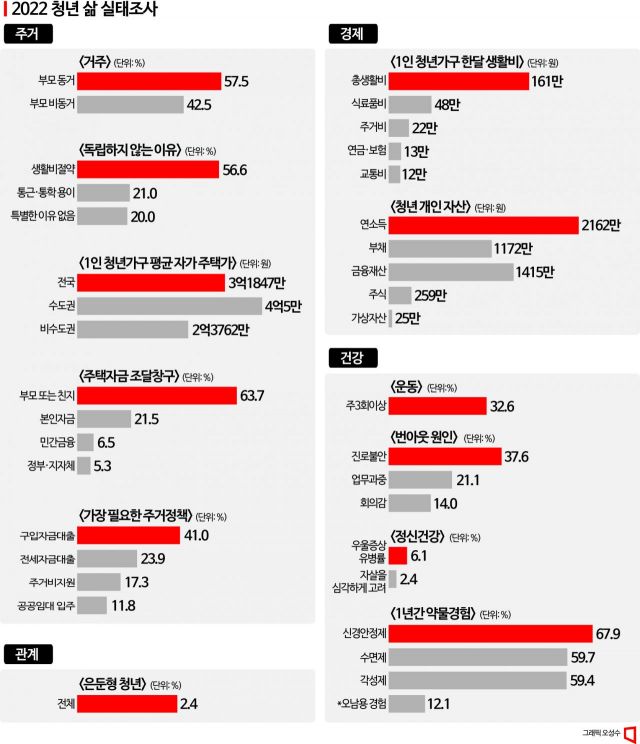
According to the survey, 57.5% of young people are counted as household members living with their parents or others. The rate was higher in the capital area at 59.7% compared to 55.0% in non-capital areas. Among them, 67.7% responded that they have no plans to become independent from their parents. The most common reason, at 56.6%, was to save on living expenses. Another 21.0% said it was because commuting to work or school is convenient. When asked when it would be appropriate to become independent, 27.8% chose ‘after asset formation,’ and 27.2% chose ‘after employment.’
The problem is that due to high housing prices, even if they find employment, it is difficult to save the funds needed to secure housing. The average price of owner-occupied homes where youth reside nationwide is 529.66 million KRW. The capital area is 734.77 million KRW, more than twice the 323.76 million KRW in non-capital areas. However, this figure includes homes provided by parents. Narrowing down to single-person youth households, the average is about 318.47 million KRW nationwide and about 405 million KRW in the capital area.
Compared to housing prices, the income and asset levels of young people are extremely low. The average annual income of an individual youth is 21.62 million KRW. Personal financial assets amount to about 14.15 million KRW, stocks about 2.59 million KRW, and virtual assets about 250,000 KRW. If they want to save 100 million KRW, they would have to save every penny without spending for about five years. Monthly living expenses were 1.61 million KRW, making it practically impossible for the youth generation to accumulate the basic capital for home ownership solely through earned income.
Therefore, young people filled the gap in insufficient income and financial assets by turning to their parents for help. The top source of funds for buying or renting a home was ‘parents or relatives,’ accounting for 63.7% overall. Those who cited their own funds were 21.5%, and private financial institutions only 6.5%. Government and local governments accounted for 5.3%, the lowest excluding other categories. Due to low income, it is difficult to borrow sufficient money from formal banks, and government loans are also insufficient in scale, resulting in this outcome.
As a result, young people appealed that ‘loans’ are the most urgent housing policy. The most needed housing policy was home purchase loans at 41.0%, followed by jeonse deposit loan policies at 23.9%. Housing cost support was 17.3%, and public rental housing was 11.8%. Song Kyung-won, Director of Youth Policy at the Office for Government Policy Coordination, said, “It is difficult to give a definite answer on expanding youth loans immediately,” but added, “We will consult with the Ministry of Land, Infrastructure and Transport and the Financial Services Commission to determine what policies are needed.”
Youth drug misuse at 12.1%. Hikikomori (social withdrawal) at 2.4%
Along with economic and housing statistics, indicators on health, human relationships, social perception, and work environment, which were difficult to confirm until now, were also disclosed. Among youth, 33.9% experienced burnout in the past year, about one in three. The main cause of burnout was career anxiety at 37.6%, followed by work overload at 21.1%, and feelings of futility at 14.0%. The prevalence of depressive symptoms was 6.1%, and 2.4% seriously considered suicide in the past year. Youth who needed but did not receive professional counseling were 5.6%, with the most common reason being the burden of cost (27.5%).
Among youth who have used major drugs, 59.7% used sleeping pills, 67.9% used tranquilizers, and 59.4% used stimulants in the past year. The rate of misuse or abuse among drug users was 12.1%. Typically, using drugs without a prescription ‘to feel good’ or ‘to relax’ is classified as misuse or abuse. However, the rate of lifelong drug use did not exceed 5%.
Statistics on vulnerable youth, which had been criticized for lack of data despite being a social issue, were also surveyed and announced for the first time. The proportion of socially withdrawn youth called ‘hikikomori’ was 2.4%. Excluding pregnancy, childbirth, and disability, 1.3% went out only for hobbies, 1.0% only to nearby convenience stores, and 0.1% only left their rooms. The main reason for withdrawal was difficulty finding employment at 35.0%, followed by difficulties in human relationships at 10.0%, and school dropout at 7.9%. Youth with family caregiving responsibilities accounted for 0.6%.
The ‘help group’ was overwhelmingly family compared to acquaintances, public institutions, or private organizations. Over 90% named family (multiple responses allowed) as the group they could rely on when needing a large sum of money, lacking living expenses, or when they or their family were ill.
Social trust score 5.2... Birth intention rate: males 70%, females 55%
The satisfaction score youth gave to their own lives was 6.7 out of 10. Happiness was slightly higher at 6.9, but the social trust score was low at 5.2. Particularly in the perception of conflict, 79.1% said there is much conflict based on income, the highest proportion. Generational conflict was 76.5%, and gender conflict was 72.3%.
In perceptions of marriage and childbirth, there was a marked difference between males and females despite both being youth. Among unmarried youth, 75.3% said they plan to marry in the future, with 79.8% of males and 69.7% of females, a difference of over 10 percentage points. Regarding intentions to have children, only 63.3% responded affirmatively. Males were at 70.5%, 15.2 percentage points higher than females at 55.3%.
The average length of continuous employment for youth was 31.6 months. The longest tenure at the current workplace was over three years for 35.6%, but those with less than one year accounted for 32.7%, a significant portion. The most important factor when changing jobs or seeking employment was wages at 48.5%, surpassing job stability (12.8%) and long-term career planning (8.4%).
The government plans to design necessary youth policies based on these statistics. Visit Kyoo, Director of the Office for Government Policy Coordination, said, “This survey is the first comprehensive and multifaceted investigation of the lives of Korean youth under the Youth Basic Act,” and evaluated, “It will serve as an important foundation for designing policies for the future development of Korean youth and the Republic of Korea.”
© The Asia Business Daily(www.asiae.co.kr). All rights reserved.


















