U.S. Strategic Asset Deployment Checked... Criticism of ROK-U.S. Joint Exercises
"Interception of Strategic Weapons in International Waters Considered Declaration of War"
Typical Pretext Building... High-Intensity Provocations Possible
North Korea has fiercely condemned the large-scale South Korea-U.S. joint military exercises starting on the 13th of this month as "war rehearsals." While reacting sensitively to the continuous deployment of U.S. strategic assets on the Korean Peninsula, it has also engaged in typical justification tactics by blaming South Korea and the U.S. for the deterioration of the situation. There are also observations that North Korea may carry out high-intensity provocations during the South Korea-U.S. joint exercises period.
In a statement released on the 7th through the Korean Central News Agency, Kim Yo-jong, Deputy Director of the Workers' Party, said, "We are closely monitoring the military movements of the U.S. forces and the South Korean puppet military," and claimed, "We are in a constant state of readiness to strike accurately, swiftly, and overwhelmingly at any time depending on our judgment." This is the fourth statement Kim Yo-jong has issued this year and the first in half a month since the 20th of last month.

Kim Yo-jong said, "The provocative military actions of the U.S. and South Korea, which have crossed the line to an extent that cannot be overlooked and are proceeding in an extremely insane manner, along with all kinds of rhetorical expressions, undoubtedly create a conditional necessity for us to respond through something." This is another reiteration of North Korea's argument that its military provocations are due to the South Korea-U.S. joint exercises.
Kim Yo-jong's derogatory remarks such as "insane trends" or "provocative military actions" appear to be aimed at countering the recent successive deployments of U.S. strategic assets on the Korean Peninsula. The U.S. long-range bomber B-52H (Stratofortress), capable of carrying nuclear weapons, conducted training with South Korean Air Force fighters over the West Sea the day before, and on the 3rd, the B-1B strategic bomber, which North Korea fears the most, was deployed.
In particular, the statement showed anger at South Korean media reports containing remarks by U.S. Indo-Pacific Command Commander John Aquilino about "shooting down North Korean intercontinental ballistic missiles (ICBMs) if launched over the Pacific." Regarding this, Kim Yo-jong threatened, "If military responses such as interception accompany our strategic weapons tests, it will undoubtedly be regarded as a clear declaration of war."
Additionally, the North Korean Ministry of Foreign Affairs also issued a statement on the same day under the name of the Director of the Foreign Press Department, condemning the South Korea-U.S. joint exercises as "war rehearsals" and demanding their suspension. While urging the international community to join "peace-loving efforts," it also warned of "intense physical clashes" targeting South Korea and the U.S. South Korea and the U.S. will conduct the Freedom Shield joint exercises from the 13th to the 23rd.
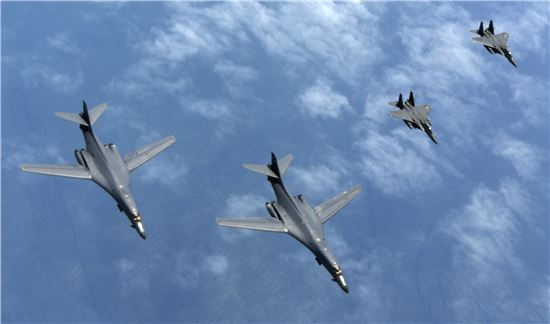 US Strategic Bomber B-1B Lancer
North Korea's continuous critical statements are analyzed as typical "blaming the South." It is believed that while opposing the joint exercises, North Korea is accumulating justification for military provocations and intends to shift responsibility for the worsening situation onto South Korea and the U.S. There is also speculation that North Korea, fearful of the use of U.S. strategic assets, is provoking a high-level response from the South through strong rhetoric to gather intelligence and make assessments.
Professor Lim Eul-chul of the Institute of Far Eastern Studies at Kyungnam University said, "The North Korean leadership is likely struggling with the difficulty of constantly responding to the routine deployment of U.S. strategic assets on the Korean Peninsula," adding, "Considering the overlapping situations of food shortages, financial difficulties, and material shortages, proportional responses seem unlikely. Therefore, there is a strong possibility that they will showcase nuclear combat capabilities that guarantee maximum deterrence at minimal cost."
Yang Wook, a research fellow at the Asan Institute for Policy Studies, said, "North Korea has expressed the position that the South Korea-U.S. joint exercises themselves are invasion drills against them and that they could retaliate," adding, "However, the use of U.S. strategic submarines is a tremendous fear and a significant concern for North Korea. There is also a strategy to provoke a response from our side through high-level commentary or controversy and then make intelligence assessments."
© The Asia Business Daily(www.asiae.co.kr). All rights reserved.

















