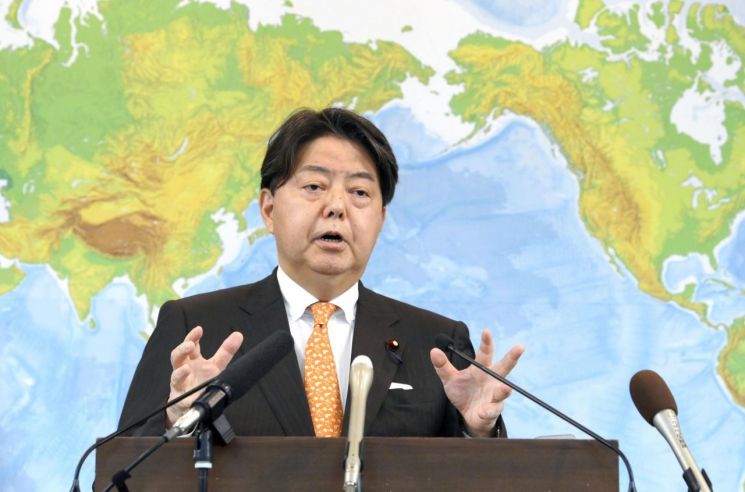
Foreign Minister Hayashi Yoshimasa on the 6th described the compensation plan for victims of forced mobilization during the Japanese colonial period announced by the South Korean government as "a measure to restore the very difficult Japan-Korea relationship to a healthy state."
At a press conference held that day, Foreign Minister Hayashi stated, "Japan and South Korea are important neighboring countries that must cooperate to address various challenges in the international community."
Regarding the South Korean government's demand for a sincere response from Japan, he added, "We confirm that we are fully inheriting the regional cabinet's stance on historical awareness, including the Japan-Korea Joint Declaration."
This is interpreted as a commitment to uphold the 1998 'Kim Dae-jung-Obuchi' Joint Declaration, which contains a comprehensive apology for Japan's past colonial rule and aggressive wars, as well as the 1995 'Murayama Statement.'
Prime Minister Kishida also attended the House of Councillors Budget Committee on the same day and commented on the South Korean government's measures, saying, "It is evaluated as an effort to restore bilateral relations to a healthy state." He further expressed his intention, stating, "I want to maintain close communication with President Yoon Suk-yeol going forward and develop Japan-Korea relations."
On the same day, the South Korean government announced a tripartite compensation plan regarding the forced labor victims during the Japanese occupation, in which a domestic foundation will raise donations to compensate the victims instead of Japanese wartime companies. Accordingly, Japanese defendant companies such as Mitsubishi Heavy Industries and Nippon Steel will not participate in compensating the victims.
© The Asia Business Daily(www.asiae.co.kr). All rights reserved.

















