Our government has expressed concerns that the subsidy payment criteria under the U.S. 'CHIPS Act' increase uncertainty and may infringe on corporate management rights. The government plans to strengthen negotiations with the U.S. Department of Commerce to prevent such damages during the subsidy agreement process with Korean companies.
On the 6th, Lee Chang-yang, Minister of Trade, Industry and Energy, told reporters at the Government Complex Sejong, "Domestic companies, the semiconductor industry, and the government have concerns about the conditions of the (CHIPS Act)." He explained, "There are quite a lot of subsidy payment conditions, which are extensive and vary across defense, economy, educational services, and excess profit recovery."
Earlier, on the 28th of last month, the U.S. Department of Commerce announced the subsidy payment criteria under the CHIPS Act, stating that companies receiving subsidies of $150 million (about 200 billion KRW) or more from the U.S. government must return up to 75% of the subsidy if profits exceed expectations. In addition, sensitive corporate information disclosure was required, such as preferential subsidy benefits for semiconductor companies allowing facility access.
Minister Lee said, "Companies are most concerned about issues related to business secrets or the leakage of technical information that affect the essence of management rights," adding, "We are closely consulting with companies on confidentiality clauses and will prioritize the parts that companies consider most problematic in negotiations with the U.S."
He also pointed out, "Generally, these conditions are completely different from the subsidies we provide for foreign investment," and "It is not easy for companies to evaluate each condition one by one, so considerable effort and time will be needed to determine how to respond."
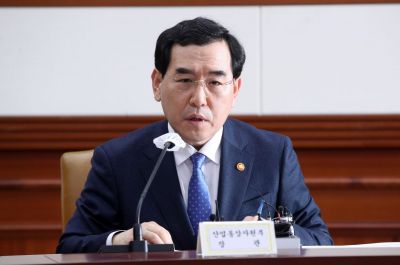 Minister Lee Chang-yang of the Ministry of Trade, Industry and Energy is speaking at the Emergency Economic Ministers' Meeting held at the Government Seoul Office in Jongno-gu, Seoul on the 3rd. Photo by Hyunmin Kim kimhyun81@
The high investment costs in the U.S. are also a point of concern. Minister Lee explained, "With interest rates rising significantly and inflation continuing, the cost of investing in the U.S. has become quite high," adding, "In this situation, various burdens such as educational services are included, which will further increase the cost of investing in the U.S."
Minister Lee stated, "The U.S. semiconductor law was enacted last August, and since then, our government has been in continuous consultation. We will work with the U.S. government to ensure that the uncertainties in the payment conditions and the burdens on companies are largely alleviated and resolved during the actual agreement process with companies."
However, he said that if unreasonable semiconductor support provisions unfavorable to Korea are not eased, the judgment on investment value will be up to the companies themselves. He added, "We expect companies to analyze and evaluate the subsidy payment criteria and consider response measures, and ultimately, the decision on investment will be made by companies during the consultation process with the U.S. government."
Finally, regarding the question of whether the CHIPS Act is a second Inflation Reduction Act (IRA), he clearly stated that he does not agree. Minister Lee explained, "The government has responded to the controversy over discrimination in electric vehicle subsidies under the IRA, and recently, the Ministry of Trade, Industry and Energy has assessed that the benefits are greater in other industrial sectors such as solar power, batteries, and wind power than the burden on companies."
Regarding the semiconductor strategic industry tax credit bill currently pending in the National Assembly, Minister Lee said, "Investment is the lifeblood of semiconductors, and this law must be passed promptly to maintain semiconductor industry investment and overcome difficult times," adding, "If the semiconductor industry rebounds after the second half of this year, it will be in a position to greatly benefit, but missing the legislative timing will have a significant impact."
© The Asia Business Daily(www.asiae.co.kr). All rights reserved.
![A Woman Who Jumps Holding a Stolen Dior Bag... The Mind-Shaking, Bizarre Con of a "Human Knockoff" [Slate]](https://cwcontent.asiae.co.kr/asiaresize/183/2026021902243444107_1771435474.jpg)
















