Ministry of Agriculture, Food and Rural Affairs, Major Vegetable Supply and Demand Trends and Outlook
"Agricultural and Livestock Product Prices Show Downward Stabilization Since Last Year's Chuseok"
The Ministry of Agriculture, Food and Rural Affairs forecasted on the 6th that prices of vegetables such as chili peppers, cucumbers, and onions will stabilize from this month due to improved weather conditions and the full-scale shipment of spring produce.
On the same day, the ministry released the "Supply and Demand Trends and Outlook for Major Vegetables" report containing these details.
According to Statistics Korea, the consumer price index in February rose by 0.3% compared to the previous month and by 4.8% compared to the same month last year. Among these, agricultural and livestock products fell by 0.7% compared to the previous month and rose by 0.02% compared to the same month last year.
In particular, compared to the same period last year, prices of green chili peppers (34.2%), green onions (29.7%), tangerines (14.3%), chicken (16.4%), cucumbers (27.4%), and onions (33.9%) rose sharply.
Radishes maintained a stable supply situation until mid-January this year, but due to cold waves and frequent rainfall in the Jeju region from January 24 to 28, shipment volumes decreased, resulting in slightly higher consumer prices in February compared to the previous year. Jeju winter radishes are harvested and stored until mid-April and shipped until June. If production is difficult in the fields (approximately 1,162 hectares) damaged by the cold wave at the end of January, the shipment volume from March to June is expected to be about 209,000 tons, approximately 28% less than the average (288,000 tons).
The Ministry of Agriculture, Food and Rural Affairs has proactively stockpiled 5,000 tons of radishes in preparation for the winter cold wave in December last year. If supply and demand become unstable between mid-March and mid-April, the stockpiled volume will be released intensively to stabilize supply and demand. Additionally, to prepare for possible price increases in April and May due to a shortage of stored winter radishes, about 2,000 tons will be additionally purchased and stockpiled in March. Furthermore, to prepare for supply instability from June to August, contract cultivation will be promoted on Jeju farms, where spring cultivation has been minimal, on up to 100 hectares (about 7,500 tons).
In the case of napa cabbage, despite a decrease in winter cultivation area by 11.1% compared to the average year, favorable weather conditions led to a 6.6% increase in production, resulting in lower consumer prices in February compared to the previous year. Stored winter napa cabbage will be shipped from March to early May, and with increased production and sustained low prices, stored volumes are expected to rise, so cabbage prices are forecasted to remain lower than the previous and average years after March.
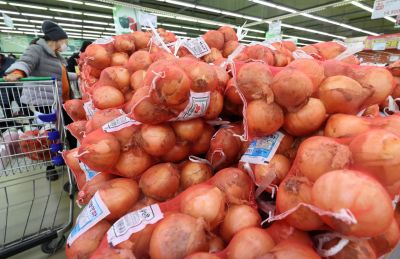
Onions are currently experiencing sustained high prices due to a 15.6% decrease in the production of mid-late maturing varieties in 2022 compared to the average year and a 25.4% decrease compared to the previous year. The cultivation area for 2023 is expected to increase by 3.8% from the previous year to 17,986 hectares, with early maturing varieties covering 2,956 hectares (6.3% increase from the previous year) and mid-late maturing varieties covering 15,030 hectares (3.3% increase from the previous year). For early maturing varieties, favorable weather conditions are expected to increase production by more than 7% compared to the previous year, reaching about 216,000 tons. The ministry is encouraging early shipment of early maturing onions by providing shipment promotion subsidies. In Jeju, early maturing onions usually start shipping around March 15 in an average year, but this year shipments began in earnest from March 8, and prices are expected to stabilize quickly.
In the case of garlic, production decreased by 11.6% in 2022 compared to 2021 due to poor crop conditions, but peeled garlic prices in February remained similar to the previous year due to reduced consumption and other factors. The cultivation area for 2023 garlic is about 25,000 hectares, approximately 4% higher than the previous year. Although some regions experienced cold damage due to the winter cold wave, the damage is not severe, and growth conditions are expected to be similar to average years.
For greenhouse vegetables, a cold wave in late January combined with reduced sunlight hours in mid-February delayed the growth of Cheongyang chili peppers and cucumbers, reducing shipment volumes and raising prices. Cheongyang chili peppers are warm-loving crops that require nighttime temperatures of 18?20°C, so the cold wave had a significant impact. Considering that it takes about three weeks from flowering to harvest under suitable growth conditions, shipment volumes are expected to gradually recover after mid-March. Although the expansion of shipment volumes for zucchini and cucumbers has been delayed due to recent large day-night temperature differences, their short growth cycle of 7?10 days and increasing sunlight hours suggest prices will gradually stabilize from mid-March. The ministry plans to continue guidance, promotion, and crop management centered on regional agricultural cooperatives to maintain warmth and prevent cold damage caused by late frost and cold waves in March through spring.
The Ministry of Agriculture, Food and Rural Affairs is continuously promoting discount support events to alleviate consumers' perceived price burdens along with stabilizing prices through expanded supply of major vegetable items. The March discount event will select discounted items weekly, focusing on greenhouse vegetables, which have higher prices compared to average and previous years, thus imposing a greater burden on consumers. The discounted items until the 8th include six types: onions, carrots, Cheongyang chili peppers, lettuce, cucumbers, and strawberries.
In this discount support event by the ministry, consumers can receive a 20% discount (30% at traditional markets) when purchasing fresh agricultural and livestock products through various distribution channels such as large and small supermarkets, regional agricultural cooperatives (Hanaro Mart), eco-friendly stores, local agricultural product direct stores (local food), traditional markets, and online malls.
Kim Jong-gu, Director of Distribution and Consumption Policy at the Ministry of Agriculture, Food and Rural Affairs, stated, "Since last Chuseok, agricultural and livestock product prices have maintained a downward stabilization trend. Although some vegetable prices are currently high due to recent cold waves and insufficient sunlight, we expect gradual stabilization with improved weather and full-scale spring production shipments after March. We will continuously monitor the supply and demand situation of agricultural products and, in case of instability, expand supply by releasing stockpiled volumes and securing additional cultivation areas. We will also continue discount support to ease consumer burdens and do our best to stabilize agricultural product supply and prices."
© The Asia Business Daily(www.asiae.co.kr). All rights reserved.

















