Deputy Prime Minister and Minister of Economy and Finance Choo Kyung-ho stated on the 6th, "Unless there is a special external shock, the trend of slowing inflation is expected to become more pronounced in the future."
In his opening remarks at the Emergency Economic Ministers' Meeting held at the Government Seoul Office on the same day, Deputy Prime Minister Choo said, "The consumer price index in February recorded 4.8% year-on-year, entering the 4% range for the first time in 10 months since April last year (4.8%), showing signs of a resumption of the previously paused inflation slowdown trend." He analyzed, "Petroleum products turned to a year-on-year decline (-1.1%) for the first time since February 2021 (-6.3%) due to the stabilization of international oil prices, and agricultural, livestock, and fishery products are showing stability thanks to falling livestock prices. Personal services and rents have also seen a gradual decrease in their rate of increase since the second half of last year."
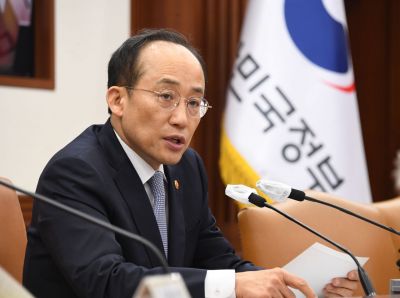 Deputy Prime Minister and Minister of Economy and Finance Choo Kyung-ho is presiding over the Emergency Economic Ministers' Meeting held at the Government Seoul Office in Jongno-gu, Seoul, on the 6th, delivering opening remarks.
However, Deputy Prime Minister Choo emphasized, "Since the inflation level remains high and the burden on people's livelihoods is significant, the government will make every effort to accelerate the inflation slowdown." He added, "First, public utility charges will be managed as stably as possible under a freeze policy in the first half of the year to minimize the burden on the public." He also requested, "As the government is making efforts such as lowering tariffs on food raw materials to stabilize prices of major food items, related industries are also asked to absorb price increase factors as much as possible through cost reduction measures like productivity improvement."
He also reported on the rapid execution of the first quarter budget. Deputy Prime Minister Choo explained, "We have established and are pursuing an execution target of a total of 383 trillion won, the largest ever, by mobilizing all available resources in the first half, including fiscal spending, public institution investments, and private investment projects." The government executed a total of 100.2 trillion won by the end of February. Fiscal spending accounted for 92.4 trillion won, public institution investments 7.4 trillion won, and private investment projects 400 billion won. Deputy Prime Minister Choo stated, "We will make every effort to accelerate execution from March, when conditions improve such as the lifting of winter construction suspensions, and focus on detailed execution management of essential livelihood support projects to help economically vulnerable groups."
He also announced plans to expand the unit of overtime work management to half-year and annual periods as part of the working hours system reform. The allowable period for the selective working system will be extended to three months, and a working hours savings account system will be introduced. Deputy Prime Minister Choo said, "We will expand the management units of overtime work hours, currently limited to weekly, to monthly, quarterly, half-yearly, and yearly units to strengthen choices in the industrial field." He added, "The allowable period for the selective working system, where workers can freely decide their commuting times, will be extended from one month to three months. Reflecting industrial field demands, even within three months of flexible working hours, pre-determined working hours can be changed retroactively to enhance flexibility." He further stated, "We will also expand systems that guarantee sufficient rest periods, such as introducing a working hours savings account system where workers can choose between overtime pay and additional leave."
© The Asia Business Daily(www.asiae.co.kr). All rights reserved.
![Clutching a Stolen Dior Bag, Saying "I Hate Being Poor but Real"... The Grotesque Con of a "Human Knockoff" [Slate]](https://cwcontent.asiae.co.kr/asiaresize/183/2026021902243444107_1771435474.jpg)











