Government Announces 'Working Hours System Reform Plan'
Labor-Management Agreement Allows Choice of 69 or 64 Hours per Week
11-Hour Continuous Rest Is Optional, Not Mandatory
Calculation Period for Flexible Work System Extended from 1 to 3 Months... Four-Day Workweek Possible
Encouragement of Long-Term Leave for 'Jeju One-Month Living'
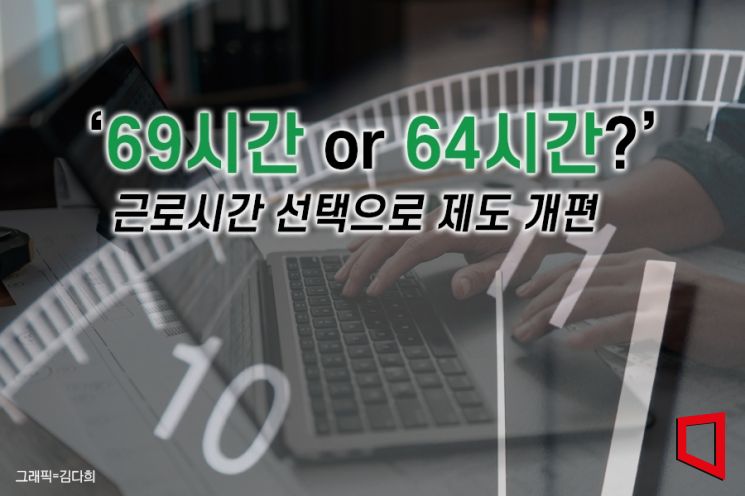
The government, which is pushing to ease the '52-hour workweek' regulation, has decided to reform the system to allow choosing between a maximum weekly working hours of 69 hours or 64 hours. If an '11-hour continuous rest' period between working days is guaranteed, the weekly limit is 69 hours; if not, it is 64 hours. The intention is to move away from the rigid working hours system, allowing workers to work more when busy and less when not. Additionally, the government plans to revise the employee representative system so that labor and management can choose the working hours system through mutual agreement, and to promote a public campaign encouraging workers to take long-term leave without feeling pressured.
However, the labor sector opposes this flexible working hours plan, arguing that it could increase 'crunch time labor' and worsen workers' health. Particularly, there are criticisms that if the '11-hour continuous rest'?which was mentioned as a measure to protect workers' health?is not guaranteed, the government is effectively allowing workers to work continuously for three or four days without rest. Since changing the working hours system requires amending the Labor Standards Act, and given strong opposition from the labor sector and the major opposition party, the Democratic Party of Korea, it is expected to be difficult to pass in the current National Assembly session.
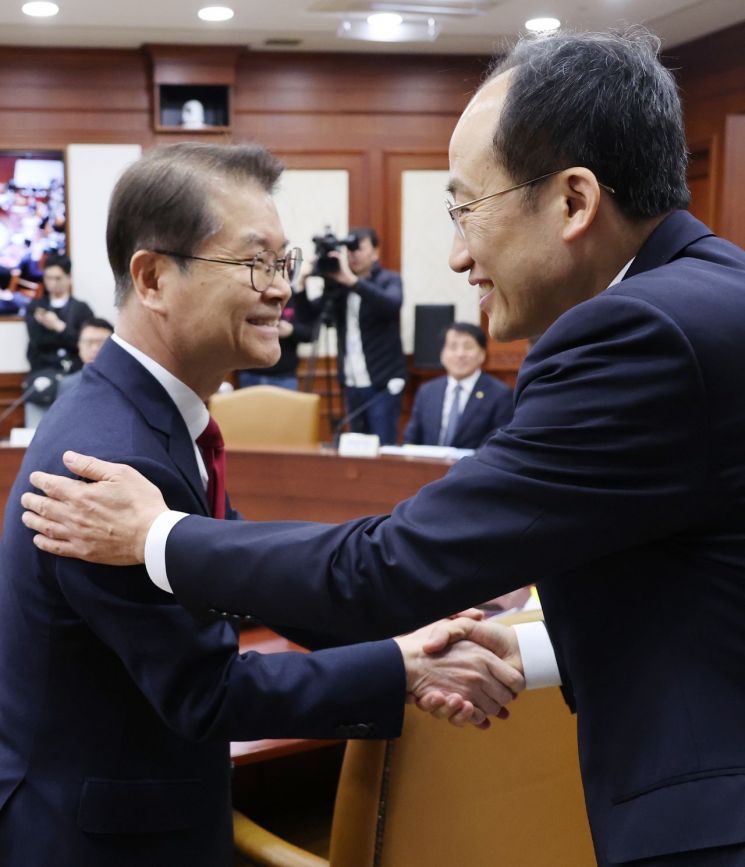 Deputy Prime Minister and Minister of Economy and Finance Choo Kyung-ho is attending the Emergency Economic Ministers' Meeting held at the Government Seoul Office on the 6th and greeting Minister of Employment and Labor Lee Jeong-sik.
 [Photo by Yonhap News]
How Will the Working Hours System 'Options' Change?
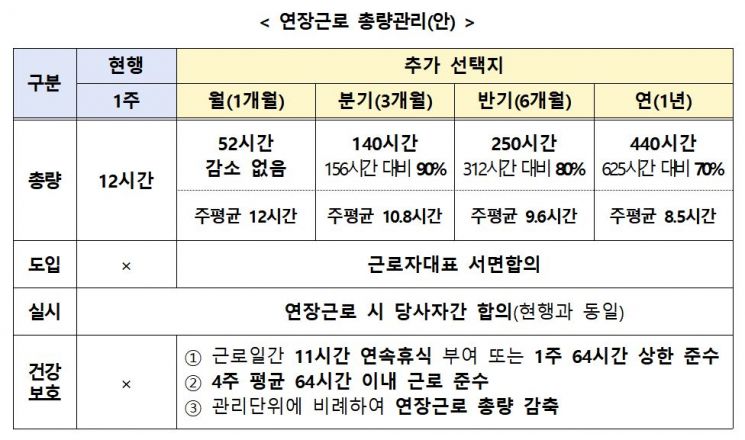
On the 6th, the government announced a 'Working Hours System Reform Plan' jointly with related ministries. Previously, based on recommendations from the Future Labor Market Research Group composed of experts in December last year, the government gathered opinions from various stakeholders and discussed easing the 52-hour workweek regulation, one of President Yoon Suk-yeol's campaign promises. The core of the announced government plan is to expand the management units of working hours, currently limited to a maximum of 52 hours per week (40 regular hours + 12 overtime hours), to monthly (52 hours), quarterly (140 hours), semiannual (250 hours), and annual (440 hours) units, allowing concentrated work in specific weeks.
Labor and management can choose a working hours system suitable for their company through mutual agreement. First, instead of working more than 64 hours per week, workers can receive an 11-hour continuous rest period between working days. In this case, workers can work up to 11.5 hours per day, calculated as 13 hours (24 hours - 11 hours) minus 30 minutes of break time for every 4 hours worked according to the Labor Standards Act. Assuming a 6-day workweek, this allows a maximum of 69 hours of work per week.
Alternatively, workers can work up to 64 hours per week without the 11-hour continuous rest period. In this case, weekly working hours are still limited, but daily working hours become flexible. For example, as long as the '64 hours per week' limit is met, a worker could work 24 hours for two consecutive days and then work 16 hours (64 hours - 48 hours) over the remaining five days. Initially, the government strongly considered mandating the 11-hour continuous rest to protect workers' health, but accepted the business sector's concerns and made it optional for labor and management.
The Ministry of Employment and Labor explained, "Countries in the European Union such as Germany and France widely adopt 11-hour continuous rest between working days, but they allow exceptions through labor-management consultation depending on circumstances. In contrast, our Labor Standards Act only recognizes exceptions in cases equivalent to natural disasters, making it difficult to comply in other emergencies. Therefore, we added the option of a maximum 64 hours per week (excluding the 11-hour continuous rest) to effectively protect health rights according to workplace conditions."
 Citizens are hurrying on their way to work on the streets of Gwanghwamun, Seoul. Photo by Hyunmin Kim kimhyun81@
Concentrated Work When Busy... What About Total Working Hours?
The government, considering concerns that extending the management unit of overtime from 'weekly' to 'quarterly' or longer could lead to excessive long working hours, decided to impose an obligation to comply with a '4-week average of 64 hours' if the management unit is quarterly or longer. The 4-week average of 64 hours is the standard for recognizing overwork as an industrial accident. This means that while overtime can be concentrated during busy periods when managed quarterly, workers must not exceed an average of 64 hours per week over four weeks.
Additionally, to reduce actual working hours, the government plans to proportionally reduce the total amount of overtime allowed according to the management period. That is, if managed monthly, the total working hours remain the same as the current 52 hours per week; if managed quarterly, it reduces to 140 hours (a 10% reduction); semiannually, 250 hours (20% reduction); and annually, 440 hours (30% reduction). Converted to average weekly working hours, this corresponds to 12 hours for monthly, 10.8 hours for quarterly, 9.6 hours for semiannual, and 8.5 hours for annual management units.
Labor Opposes, Business Welcomes... Government Says "No Overwork Will Occur"
The labor sector argues that the government is worsening workers' health by pushing for flexible working hours in response to business demands. South Korea is notorious among OECD countries for long working hours, and allowing 69-hour workweeks or 64-hour workweeks without guaranteed continuous rest could exacerbate worker overwork.
The Labor Standards Act stipulates that "weekly working hours shall not exceed 40 hours" in principle, so the idea of choosing between 69 and 64 hours per week as a health protection measure is considered illogical by some. The Federation of Korean Trade Unions recently commented, "Providing 11 hours of continuous rest is the only measure to protect workers' health," and criticized the government plan as "contrary to the International Labour Organization (ILO) standard, which considers 55 hours per week as the threshold for long working hours."
However, the government emphasizes that since overtime in one week means no overtime in another, the total working hours do not increase. For example, if a worker works 69 hours (40 regular + 29 overtime) in the first week and 63 hours (40 regular + 23 overtime) in the second week, they have used up the limited 52 hours of overtime, so in the third and fourth weeks, they only need to work the regular 40 hours. The Ministry of Employment and Labor pointed out, "Considering the recent five-year trend where average weekly working hours do not exceed 40 hours, it is inappropriate to generalize 69 or 64 hours per week."
The business sector welcomed the plan. The Korea Employers Federation stated, "This working hours reform plan is significant as a starting point for labor reform to improve outdated legal systems that have held back our economy," and added, "We hope this amendment will resolve difficulties caused by the rigid and uniform current working hours system, such as restrictions on flexible responses to increased workloads and various time selection rights in the workplace."

Unions Decide My Working Hours?... Increasing Employee 'Representation'
The government plans to revise the employee representative system so that labor and management can democratically agree on the working hours system. Under the Labor Standards Act, when deciding major working conditions such as working hours, the employer and employee representative must reach a written agreement. However, the current law does not specify procedures or methods for selecting employee representatives, causing confusion in workplaces. Going forward, fair selection procedures, authority, and responsibilities of employee representatives will be established to strengthen democratic legitimacy and representation. If a majority labor union exists, the union is recognized as the employee representative; if not, the employee committee member of the labor-management council is recognized; if neither exists, an employee elected by vote is recognized as the representative.
When deciding working conditions that apply only to specific occupations or groups (partial workers) with different working patterns within a company, the opinions of those workers must be reflected. For example, in a company with a majority union of production workers, when deciding working conditions applicable only to research staff, the union cannot decide alone but must listen to the opinions of research workers. If the opinions of partial workers and the employee representative differ, the labor relations commission will make a judgment, allowing direct negotiation with the employer.
Unreasonable break time regulations will also be revised. According to the current Labor Standards Act, employers must provide at least 30 minutes of break for 4-hour workdays and at least 1 hour for 8-hour workdays. This causes problems where part-time or half-day workers who work only 4 hours cannot leave immediately due to break regulations and must stay an additional 30 minutes. The government plans to introduce a procedure allowing workers to apply for a 30-minute break exemption when working 4 hours a day, enabling them to leave immediately and expanding their options.
Encouraging Long-Term Leave Like 'Living in Jeju Island for a Month'
Under the principle of 'work when necessary, rest freely according to work done,' the government plans to activate long-term leave for workers. Although a compensatory leave system that grants leave instead of wages for overtime, night, and holiday work is already introduced, its adoption rate is low due to lack of specific operational standards. Therefore, the government will replace the compensatory leave system with a 'Working Hours Savings Account System' and establish legal standards for accumulating, using, and settling overtime, night, and holiday work. Combining annual leave and saved leave will allow workers to take long-term leave, such as 'living in Jeju Island for a month' or sabbaticals, according to the government's vision.
To prevent workers from hesitating to take long-term leave due to workplace pressure, a public campaign to promote long-term leave will also be launched. Saved leave will be accumulated in hourly units and used at the worker's desired time as a principle. The Ministry of Employment and Labor emphasized, "Since it is accumulated in hourly units, it can be used flexibly for rest, self-development, childcare, or other needs. We will spread a culture that leave is an opportunity for rest and recharging."
'Monday, Tuesday, Wednesday, Thursday, One Day Off, One Day Off'... Will a 4-Day Workweek Become Possible?
The government will strengthen the flexible working hours system to facilitate the spread of a 4-day or 4.5-day workweek desired by workers. Using the flexible working hours system, workers can freely choose working days and commuting times, but the current legally allowed maximum adjustment period is one month (three months for research and development), which is short and limiting. Currently, for new product and technology research and development (R&D) work, a total working time is set over a three-month adjustment period, and workers decide their daily working hours themselves. However, the industry complains that since overtime cycles last at least six months, it is difficult to utilize this system.
Going forward, to strengthen workers' time sovereignty, the adjustment period for the flexible working hours system will be extended to three months for all industries (six months for research and development). This will allow workers to concentrate work during specific times or periods and freely use the remaining time, making it easier to implement a 4-day workweek or staggered commuting hours. Additionally, the government plans to expand telecommuting and remote work through financial support and consulting, and increase incentives for companies selected as excellent in work innovation to encourage perceived reductions in working hours and work-life balance.
Legislative Notice Starts Today... Lee Jeong-sik Calls It a "Historic Progress"
The Ministry of Employment and Labor will start a 40-day legislative notice period for the legislative items of the reform plan from today and submit the amendment bill to the National Assembly in June or July. Non-legislative items will be implemented immediately this year through research projects. Minister Lee Jeong-sik said, "This government legislative proposal is a historic progress that returns time sovereignty over working hours to labor and management, befitting South Korea's status as the world's 10th largest economy," emphasizing, "It will bring benefits such as a 4-day workweek, sabbaticals, and staggered commuting hours to workers, and provide companies with more flexibility in workforce management."
© The Asia Business Daily(www.asiae.co.kr). All rights reserved.



















