Located in the southernmost Punta Arenas
Windy conditions ideal for wind energy generation
Production of synthetic fuels through this
Can be used directly in internal combustion vehicles
Economic viability still insufficient
Vientos fuertes. It means 'strong winds' in Spanish. On the 24th of last month (local time), one could feel the Vientos fuertes at the Porsche Haruoni pilot plant in Punta Arenas, the southernmost city of Chile. From the factory entrance, the flags of the operator HIF (Highly Innovative Fuels) and the Chilean national flag were fluttering as if about to break. When getting out of the vehicle, it was hard to keep balance. It was even impossible to hear the voice of the person next to me. Although my face turned red from the sunlight, I had no choice but to button up my collar.
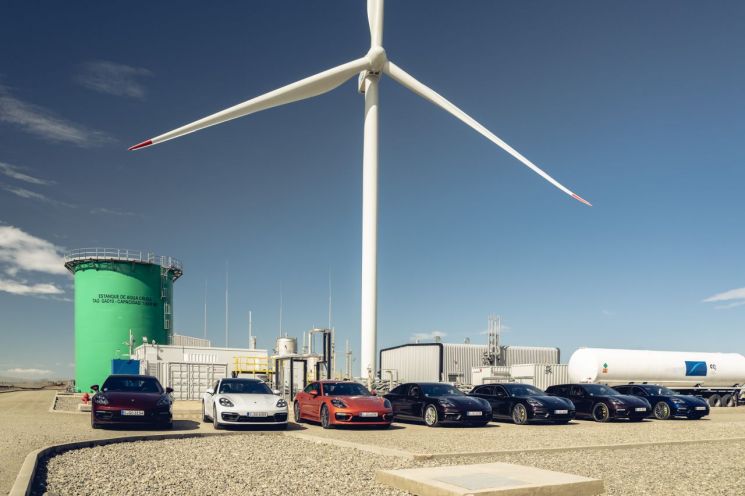
There is a towering wind turbine here. It is visible even from the airport about 5 km away. The turbine kept spinning while driving to the factory. Besides that, there were numerous facilities with twisted silver pipes. Apart from the factory facilities, the surrounding landscape was filled only with an endless horizon. What is happening here?
Last year, the German automobile company Porsche established a pilot plant for producing renewable synthetic fuel (e-fuel). They embarked on developing eco-friendly fuel, feeling responsible for carbon emissions. Through the blueprint of "If everyone stays still, there is no progress. Progress comes through starting," they claim to be pioneers of renewable energy.
E-fuel is a renewable energy fuel that can be directly injected into existing internal combustion engine vehicles. Since it has the same components as conventional gasoline, exhaust gases are emitted during vehicle operation. However, a significant amount of carbon dioxide is captured from the air during the fuel production process. For this reason, it is classified as a carbon-neutral fuel.
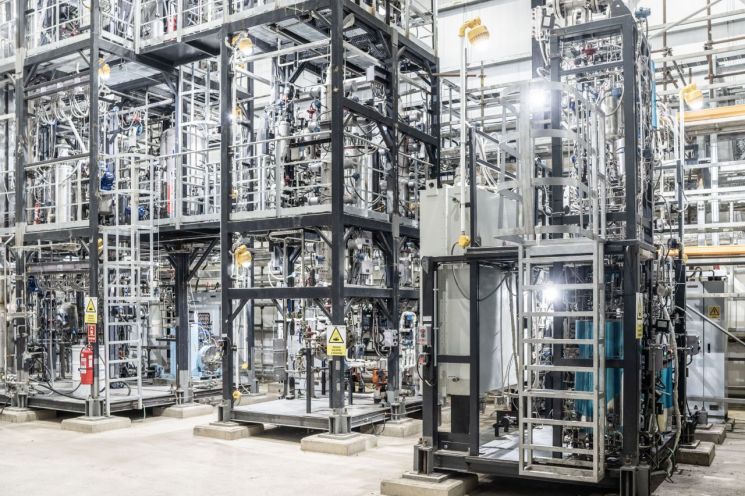
The e-fuel production process begins by obtaining energy from wind power generation. This energy is combined with groundwater and water supplied from the city. Then, through an electrolysis process applying pressure, hydrogen molecules (H2) are produced. The produced hydrogen, along with filtered carbon dioxide captured from the surrounding air, is put into a compressor to make e-methanol. Afterward, through a specific process, it is converted into e-gasoline. The produced hydrogen is not used as fuel for hydrogen vehicles. Porsche's intention is to convert it into gasoline and use it directly in existing internal combustion engines.
The reason Porsche built the plant in Punta Arenas is because of the wind. For carbon neutrality, electricity production must also use eco-friendly energy. Porsche chose wind power generation. The Patagonia region, where Punta Arenas is located, experiences strong winds about 270 days a year. The basic wind speed is 15 to 20 km/h, and in winter, it can reach up to 120 km/h. Thanks to this, the wind turbines keep spinning without rest.
Porsche invested 74 million dollars (about 100 billion KRW) in this plant. The factory size is 57,000 square meters, equivalent to eight soccer fields. It produces 350 tons of e-methanol annually and ultimately produces 130,000 liters of e-fuel using it. Porsche plans to export the e-fuel produced at the factory to Europe through the Punta Arenas port.
However, the economic feasibility of e-fuel is still insufficient. First, a mass production system has not been established. By 2027, three plants plan to produce 715.05 million liters of e-fuel monthly. In contrast, South Korea's petroleum consumption in December last year was 7.78705 billion liters. The production volume is only about 10% of a single country's consumption.
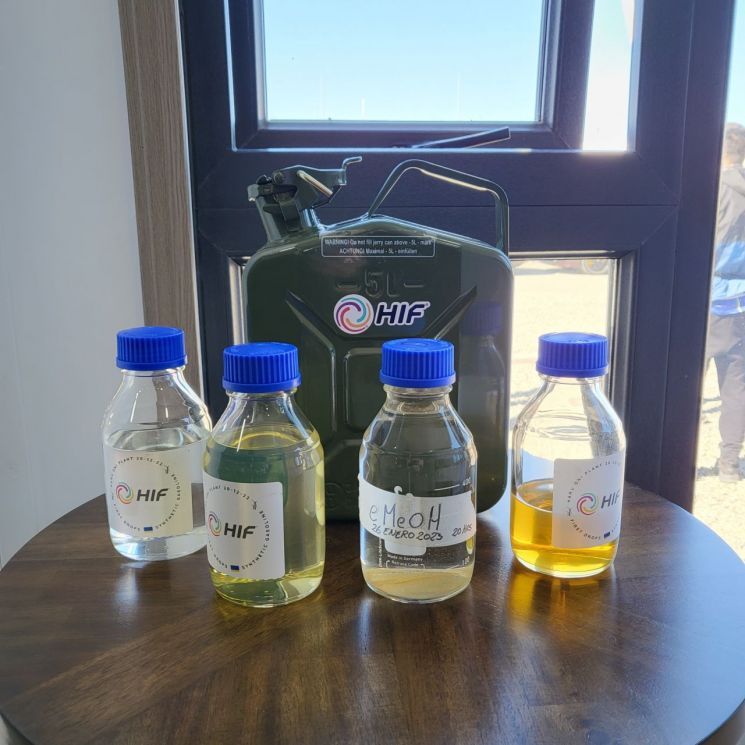
Also, it seems that a lot of costs are still invested in e-fuel production. When asked about the production cost per liter, the company did not provide information, saying "It is confidential." Marcos Marquez, Porsche's e-fuel project manager, stated, "Synthetic gasoline cannot yet be as cheap as crude oil," but added, "From a mid-term perspective, if large-scale production is realized, a price below 2 dollars per liter could be possible."
© The Asia Business Daily(www.asiae.co.kr). All rights reserved.


















