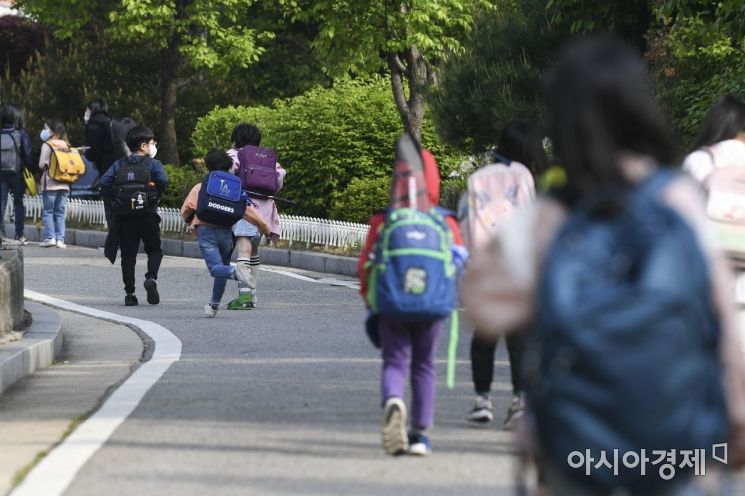
 On the 2nd, when normal attendance was resumed at all schools nationwide, students are attending school at Gwangjang Elementary School in Gwangjin-gu, Seoul. 2022.05.02 Photo by Joint Press Corps
As the COVID-19 outbreak showed signs of subsiding even after the adjustment to indoor mask-wearing to level 1, the government has formalized discussions on the 'endemic' phase of the infectious disease. The remaining measures, such as mask-wearing in transportation facilities, hospitals and clinics, and infection-vulnerable facilities, as well as the mandatory 7-day isolation upon confirmation, are planned to be lifted. The government aims to establish a roadmap for returning to normal life by the end of March, considering the global stabilization of the COVID-19 situation and the possibility that the World Health Organization (WHO) may lift the Public Health Emergency of International Concern (PHEIC) by the end of April.
Experts agree that “there will likely be no outbreaks severe enough to threaten medical response capacity” and that “discussions on returning to normal life are timely.” There was no domestic spread variable caused by China’s COVID-19 outbreak, and with the formation of antibodies among the public, the likelihood of large-scale cluster infections in the community as before is low. The COVID-19 variable is expected to be around ‘late March to early April,’ when schools reopen and outbreaks typically begin, but experts believe this will only result in a temporary increase.”
Professor Eom Jung-sik of the Department of Infectious Diseases at Gachon University Gil Medical Center said, “The endemic phase of COVID-19 should be understood not as safety from COVID-19, but as a situation where the virus remains a constant threat without large epidemic waves.” However, since the fatality rate of the most recent seventh wave (0.08%) has significantly decreased compared to the first wave in 2020 (2.1%), it is time for COVID-19 to be managed within the general healthcare system like other infectious diseases.
The current mandatory 7-day isolation upon COVID-19 confirmation may be changed to a recommendation in the future. There is also talk of shortening the isolation period. Regarding this, Professor Kim Tak of the Department of Infectious Diseases at Soonchunhyang University Bucheon Hospital said, “Considering the 7-day viral shedding period of the COVID-19 virus, shortening the period lacks medical evidence and is therefore inappropriate,” adding, “The ultimate reason for lifting isolation is to allow people to freely engage in community activities without administrative enforcement as is currently done, so converting the mandate to a recommendation is reasonable.” Professor Kim also noted, “Switching to a 5-day isolation recommendation upon confirmation, like with influenza, does not align with the characteristics of the infectious disease.”
Once COVID-19 enters the routine management system, patients will bear a larger share of costs for testing, treatment, and hospitalization. For example, if a COVID-19 critical patient’s total medical bill for an 11-day hospitalization was 16 million KRW, 3 million KRW of that will now be paid by the patient. This raises concerns about blind spots in COVID-19 care among low-income high-risk groups. Professor Baek Soon-young, emeritus professor at the Catholic University College of Medicine, said, “The government must set clear directions when COVID-19 transitions to routine healthcare,” and added, “Consideration should be given to temporarily supporting treatment and hospitalization costs focused on high-risk groups.”
© The Asia Business Daily(www.asiae.co.kr). All rights reserved.
!["The Woman Who Threw Herself into the Water Clutching a Stolen Dior Bag"...A Grotesque Success Story That Shakes the Korean Psyche [Slate]](https://cwcontent.asiae.co.kr/asiaresize/183/2026021902243444107_1771435474.jpg)
















