The Ministry of Agriculture, Food and Rural Affairs recently announced on the 5th that to resolve the difficulties dairy farmers face in managing calves caused by the recent decline in transactions of dairy calves for beef production and to maintain the production base of the beef industry, livestock farmers who raise male dairy calves for beef will receive support of 50,000 KRW per head through the Milk Fund and Beef Fund.
Dairy calves are raised differently depending on their gender. Generally, female calves are raised mainly by dairy farmers as they are needed for future milking, whereas male calves cannot be milked and are therefore raised for meat. For this reason, male dairy calves for beef are raised by dairy farmers who raise both dairy and beef cattle, livestock farmers specializing in beef cattle, or those raising both Hanwoo and beef cattle. Most male dairy calves for beef are traded at the colostrum weaning stage (1 week old) or milk replacer weaning stage (2 months old). When dairy farmers sell calves, it counts as income for them and helps reduce milk production costs.
However, transactions of male dairy calves for beef decreased due to increased feed costs caused by rising international grain prices and exchange rates in 2022, a decline in beef prices following the drop in Hanwoo prices, and reduced military meal supply, all of which increased uncertainty in the beef market. As livestock farmers reduced the intake of male dairy calves for beef, not only did transactions decrease, but transaction prices also fell. Furthermore, the decline in transactions of male dairy calves for beef has caused dairy farmers difficulties in managing calves and raised concerns about maintaining the production base of the beef industry.
To address these issues, the Ministry of Agriculture, Food and Rural Affairs, after several discussions with the Milk Fund, Beef Fund, and others, decided to support livestock farmers who raise male dairy calves for beef. This support for raising male dairy calves for beef is limited to male calves, excluding female calves, to maintain the milk production base, and a total of 10,000 male dairy calves for beef will receive 50,000 KRW per head. To this end, the Milk Fund will support 5,000 heads in March, and the Beef Fund will support 5,000 heads in April.
Livestock farmers wishing to receive support must submit an application form to the delegated agency in charge of the Livestock Traceability System (local livestock cooperative) and report the transfer of the traceability number after raising male dairy calves for beef. The application submission period for livestock farmers is one week from March 6, and if the number of applications is low, the submission period will be extended.
Kim Jeong-wook, Director of Livestock Policy at the Ministry of Agriculture, Food and Rural Affairs, said, "We hope that this support for raising male dairy calves for beef will help stabilize the dairy and beef industries quickly," and added, "The Ministry will continue to monitor the prices of dairy calves at production sites and maintain ongoing consultations with stakeholders for industry development."
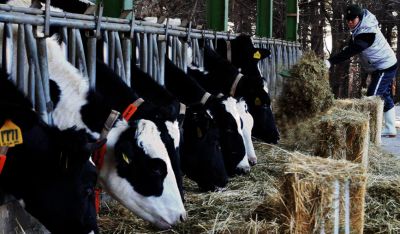 "Eat plenty of fresh hay and take responsibility for the development of the dairy industry and the health of the people this year." Wishing that the country's economy will prosper like a cow symbolizing wealth in the new year, and that all citizens will have a healthy year, our reporter Jo Gang-wook is carefully feeding hay to the dairy cows at Gwangjin Farm.
 Photo by Lee Jae-moon moon@asiae.co.kr
© The Asia Business Daily(www.asiae.co.kr). All rights reserved.
![Clutching a Stolen Dior Bag, Saying "I Hate Being Poor but Real"... The Grotesque Con of a "Human Knockoff" [Slate]](https://cwcontent.asiae.co.kr/asiaresize/183/2026021902243444107_1771435474.jpg)










