Lee Jae-myung, leader of the Democratic Party of Korea, stated on the 5th that the U.S. Chips and Science Act (CSA) is "the second looming dark cloud after the Inflation Reduction Act (IRA)" and expressed the Democratic Party's intention to play a role.
On the same day, Lee wrote on Facebook, "We must not miss the golden time for the Korean economy again," and added, "Since there is no distinction between ruling and opposition parties when it comes to national interest, the Democratic Party will do everything it can."
He analyzed, "The U.S. has announced the subsidy payment criteria for the Chips and Science Act, causing a big stir. It essentially demands trade secrets from our companies, sets conditions for subsidy returns if investing in China, and includes provisions to recover excess profits. In a situation where the trade deficit is rapidly increasing due to a decrease in exports to China, if our companies give up the Chinese market, which accounts for 40% of semiconductor exports, unimaginable hardships will come to our export economy."
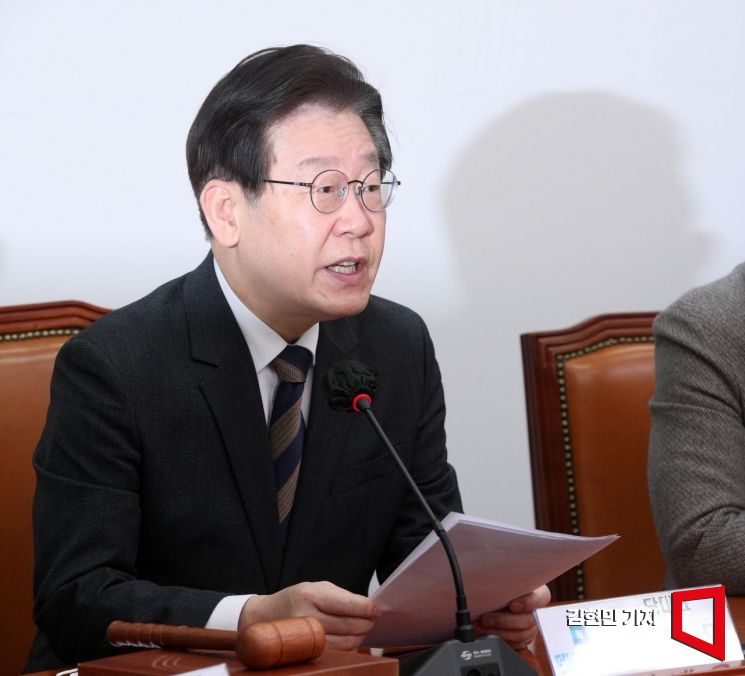 Lee Jae-myung, leader of the Democratic Party of Korea, is speaking at the Supreme Council meeting held at the National Assembly in Yeouido, Seoul on the 3rd. Photo by Kim Hyun-min kimhyun81@
Lee argued that the government should step in rather than leaving it solely to companies. He said, "In the short term, we must persuade the U.S. government and Congress to prevent our companies from suffering unilateral sacrifices. The U.S. government decided last year to postpone semiconductor export controls to China for Samsung Electronics and SK Hynix factories for one year, and the government must actively engage in negotiations to extend this."
He continued, "Furthermore, since the U.S. government is expected to soon announce detailed regulations on the guardrail (investment restriction) provisions, we must take the lead in negotiations to ensure that our companies' interests and opinions are reflected as much as possible in those detailed regulations."
Lee proposed, "In the long term, it is urgent to reorganize trade strategies suitable for the rapidly changing economic and industrial environment. If we stubbornly follow the U.S.'s blockade against China, it could bring great harm contrary to national interests. We must also expand investment in the non-memory semiconductor industry to strengthen international competitiveness."
© The Asia Business Daily(www.asiae.co.kr). All rights reserved.
![Clutching a Stolen Dior Bag, Saying "I Hate Being Poor but Real"... The Grotesque Con of a "Human Knockoff" [Slate]](https://cwcontent.asiae.co.kr/asiaresize/183/2026021902243444107_1771435474.jpg)
















