KT Faces Political Headwinds
Presidential Office Stresses "Transparent Governance"
Fair Trade Commission Launches Broad Pressure on Finance and Telecom Sectors
President Yoon Suk-yeol's call to strengthen the Stewardship Code (the principle of fiduciary responsibility) for so-called "ownerless companies" is spreading across the financial and industrial sectors. While the presidential office faces criticism for "excessive intervention" and "overreaching management involvement," it maintains that its stance is about "fair and transparent governance." However, concerns about political interference are expected to persist for the time being.
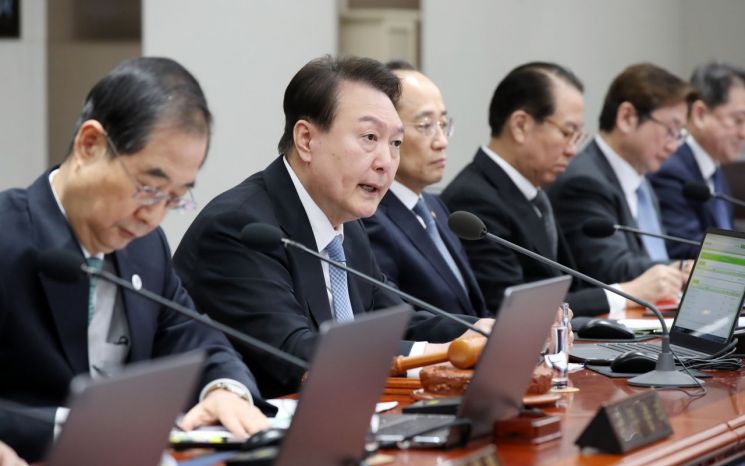
On March 3, a senior official from the presidential office addressed the controversy over management intervention during KT's CEO selection process, cautioning against overinterpretation and stating that the intent was to "maintain balance in line with fairness and transparency." The official reiterated the Yoon administration's commitment to a "company-centered market economy" and emphasized that if moral hazard occurs, the public ultimately bears the cost.
Previously, KT's Governance Committee narrowed down the list of CEO candidates from 33 to 4 on February 28. All remaining candidates are either current or former KT employees. Notably, Yoon Jin-sik, former Minister of Commerce, Industry and Energy and a member of President Yoon's presidential campaign, as well as Kim Ki-yeol, former KTF Vice President, both considered strong contenders, were eliminated. Other figures with ties to the ruling party, such as Kwon Eun-hee (former Head of KT Networks Business Division), Kim Sung-tae (Advisor to the Presidential Digital Platform Government Committee), and former National Assembly member Kim Jong-hoon (former Chief Negotiator for Trade at the Ministry of Foreign Affairs and Trade), also failed to pass the screening stage.
In response, members of the National Assembly's Science, ICT, Broadcasting and Communications Committee from the People Power Party held a press conference, criticizing the process as a "league of their own." The presidential office also weighed in, stating, "If fair and transparent governance is not achieved, moral hazard will arise within the organization, and the public will inevitably suffer the consequences."
This is rooted in President Yoon's policy direction, which calls for increased transparency in the governance of "ownerless companies." In a policy briefing with the Financial Services Commission at the Blue House State Guest House in January, President Yoon emphasized the need to advance the governance of privatized public enterprises and major financial holding companies. He believes that establishing transparent governance and allowing management to operate within this structure can better align the costs and benefits of companies and society as a whole.
The "transparent management" directive targeting KT is also likely to extend to POSCO. The National Pension Service holds an 8.5% stake in POSCO Group, and historically, changes in political power have led to repeated resignations of top management. This time appears to be no different. Although POSCO Chairman Choi Jeong-woo's term expires in March next year, political circles and the National Pension Service are casting a wary eye. Many interpret President Yoon's remarks during the recent Financial Services Commission briefing as being aimed squarely at POSCO. This sentiment was already evident at the New Year's meeting of business leaders hosted by the president earlier this year, which both KT CEO Koo Hyun-mo and Chairman Choi did not attend. Analysts noted that the heads of these companies openly expressed their discomfort at that time.
The impact on the financial sector is even more pronounced. Following President Yoon's criticism of "excessive profit-taking," not only management but also outside directors are being replaced. The heads of Shinhan Financial Group and Woori Financial Group have already stepped down in succession. President Yoon is also reported to have pointed out that bank executives and outside directors are effectively enabling "self-renewal" of management through mutual cooperation. In response to renewed controversy over excessive intervention, the presidential office maintains that its involvement is "fair." Since banks operate as de facto oligopolies under government licenses, they have a public character and must fulfill corresponding social responsibilities.
This government stance is unlikely to change easily. With President Yoon's continued criticism, the Fair Trade Commission is also taking action. The FTC's Cartel Investigation Bureau has launched on-site inspections of six banks-Shinhan, KB Kookmin, Hana, Woori, NH Nonghyup, and Industrial Bank of Korea. The telecommunications industry, which President Yoon identified as another example of "harmful monopolies," has also undergone market surveillance inspections. A presidential office official stated, "The goal is to establish transparent governance, not external pressure, and to have management operate within this structure," adding, "It is also the government's role to ensure that the public does not suffer harm."
© The Asia Business Daily(www.asiae.co.kr). All rights reserved.
![Clutching a Stolen Dior Bag, Saying "I Hate Being Poor but Real"... The Grotesque Con of a "Human Knockoff" [Slate]](https://cwcontent.asiae.co.kr/asiaresize/183/2026021902243444107_1771435474.jpg)
















