Russia's domestic economy is cooling one year after its invasion of Ukraine. Amid strengthened Western sanctions against Russia, the contraction in consumption is lasting longer than during the COVID-19 pandemic in 2020.
According to Bloomberg on the 1st (local time), Russian retail sales in January this year fell by 6.6% on an annualized basis, marking the 10th consecutive month of decline. Bloomberg explained that this decrease in consumption has lasted longer than during the onset of COVID-19 in 2020.
Olga Belenkaya, an economist at the Russian investment firm Pinam, said, "Retail sales were one of the economic sectors hit hardest last year," adding, "Domestic and foreign bank deposits amounted to 5.7 trillion rubles (about 99 trillion won) last year, similar to the pandemic onset in 2020, and have doubled compared to 2021."
Last year, the Russian economy performed much better than initially feared. The gross domestic product (GDP) growth rate fell by only 2.1%, significantly exceeding the government's previous forecast of -12%. This was due to expanded exports of energy resources such as oil and natural gas, which minimized the impact of the war.
However, the purchasing power of Russians is also declining. Real wages in Russia decreased by 1% annually last year, and the unstable economic situation caused by the war, Russians fleeing to avoid forced military conscription, and the withdrawal of global companies are leading to domestic demand contraction. In addition, the expansion of sanctions against Russia, including the price cap on oil implemented since the end of last year, is increasing uncertainty about the Russian economy.
A 45-year-old housewife living in Voronezh, Russia, told Bloomberg, "With cheap Western brands withdrawing, it has become impossible to buy clothes for my teenage daughter," adding, "Russian counterfeit products are too expensive and tacky. The budget has already been stretched to the limit, so choosing groceries or durable goods is no longer easy."
In fact, Bloomberg reported that as Russian consumption contracts, one of the major shopping malls is facing bankruptcy. Alexander Isakov, a Bloomberg economist, analyzed, "The living standards of Russian consumers peaked in 2014 and have not yet recovered," adding, "Retail sales fell by 10.5% last year due to sanctions, setting the clock back more than a decade." He also predicted, "As the government is expected to gradually impose import restrictions to support domestic industries, the outlook for consumption will remain similar to the current situation."
Although the government is pouring out large-scale economic stimulus measures and unemployment rates are at historic lows, households are reducing spending and increasing savings. The proportion of Russians who prefer saving reached 55.86% as of February, the highest level in two years.
According to recently released statistics, more than one in three Russians are reportedly cutting back on grocery spending. While spending on essential groceries such as eggs, milk, and bread remains steady, households are increasingly closing their wallets on discretionary items like coffee. Since domestic demand accounts for 50% of the Russian economy, this contraction in domestic consumption could lead to a recession.
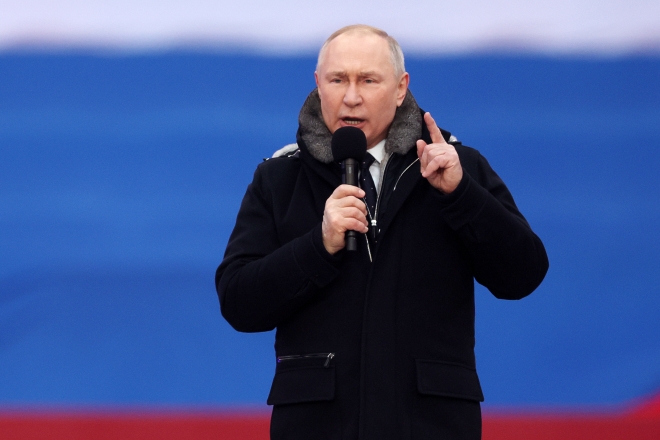
Bloomberg explained, "Putin's war is overturning the economy in ways unseen even during the pandemic," adding, "Retail sales have slowed at the fastest pace since 2015, and the recession is ongoing."
© The Asia Business Daily(www.asiae.co.kr). All rights reserved.
![Clutching a Stolen Dior Bag, Saying "I Hate Being Poor but Real"... The Grotesque Con of a "Human Knockoff" [Slate]](https://cwcontent.asiae.co.kr/asiaresize/183/2026021902243444107_1771435474.jpg)
















