3rd Regulatory Innovation Strategy Meeting on the 2nd
Establishment of 'Integrated Logistics Bonded Warehouse' for Key Export Products
Customs Service Expands Trade Data Access to Private and Public Sectors
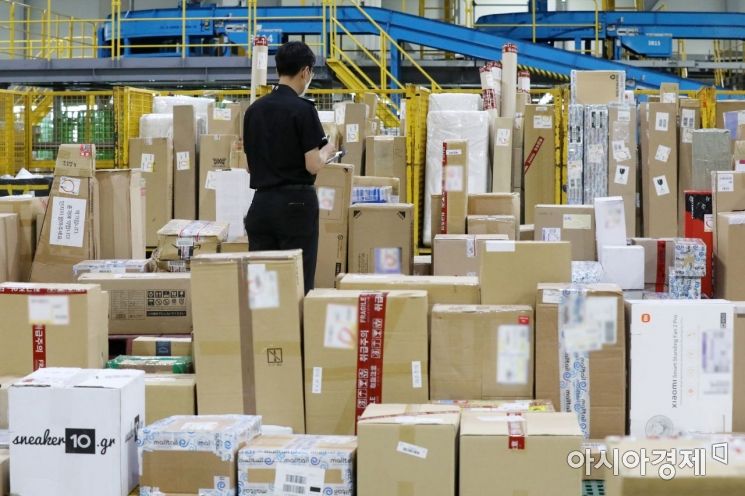 Last year during the Chuseok holiday, the Korea Customs Service formed a special clearance support team to prepare for the concentrated import of overseas direct purchase items such as gifts, supporting the expedited clearance of express shipments at the Incheon Customs Express Logistics Center in Jung-gu, Incheon. / Photo by Airport Photo Journalists Group
The Korea Customs Service is significantly overhauling cumbersome customs administration regulations. It will abolish the mandatory declaration procedure for travelers' carry-on items upon entry and exit, greatly simplify the tax payment process for overseas direct purchases, relax bonded warehouse regulations to promote exports, and open trade data to the private sector.
On the 2nd, the Korea Customs Service announced the "Digital Customs Regulation Innovation Plan" at the 3rd Regulatory Innovation Strategy Meeting chaired by the Prime Minister, held at the Pangyo Metaverse Hub Center. According to the plan, starting in July, to enhance public convenience and activate foreign tourism, the existing obligation to fill out a carry-on declaration form will be eliminated. Currently, all incoming travelers must complete a carry-on declaration form and submit it to customs. Although about 99% of incoming travelers have no items to declare, the form has been accepted as a matter of routine. Going forward, if there is nothing to declare, travelers can proceed directly with the entry process without any additional steps.
If there are items to declare, travelers can choose the more convenient method between mobile and paper declaration forms. This system is currently partially implemented at Incheon Airport Terminal 2 and Gimpo Airport, and will be expanded to Incheon Airport Terminal 1 and Gimhae Airport in the second half of this year. Additionally, a "Traveler Carry-on Mobile Payment System" that automatically calculates the payable tax amount during mobile declaration will be established. Through this, the Korea Customs Service expects to alleviate the inconvenience of filling out declaration forms for 43 million people.
The customs payment and refund system for overseas direct purchases will also become more convenient. The customs payment process will be reduced from five steps to three. When making overseas direct purchases, customers typically received payment guidance messages from customs brokers and had to enter payment slip numbers via bank applications. Starting in May, immediate payment will be possible using notification messages directly sent by the Korea Customs Service.
From this month, customs duty refund applications for returned overseas direct purchases can also be made via mobile. Until now, customers had to visit customs offices in person or access the electronic customs clearance system via PC. Due to the inconvenience of the procedure, complaints related to refunds from overseas direct purchase users doubled from 1,059 cases in 2021 to 2,240 cases last year. Going forward, users can check the taxes they paid and proceed with refund procedures through the mobile Korea Customs Service app.
Strict bonded warehouse regulations drastically reduced from 8 steps to 2 steps
In the industrial sector, responding to the semiconductor industry's demands, a new "complex logistics bonded warehouse" will be established. A bonded warehouse is a place where goods that have not completed customs clearance procedures are stored, and customs duties, consumption taxes, and excise taxes are not imposed. The semiconductor industry has conducted 93% of its exports through bonded warehouses. However, strict regulations have been applied by customs authorities to prevent illegal import and export, causing significant difficulties for the industry.
Accordingly, the government has greatly relaxed bonded warehouse regulations specifically for key export items such as semiconductors. In the newly established complex logistics bonded warehouse, splitting, combining, and repackaging of export goods can be freely performed. Cargo previously managed by transportation contracts will be changed to item and quantity units. With these improvements, the procedure that previously took eight steps from cargo entry to export will be reduced to two steps.
Furthermore, the government will expand the opening of big data so that export companies can utilize trade data. The Korea Customs Service's own platform will add FTA optimal tariff rate recommendation information, and support the production of export promotion-related big data by Statistics Korea and the Ministry of SMEs and Startups. Trade data will also be shared with export support organizations and government ministries. Organizations such as KOTRA, the Korea International Trade Association, and the Korea Federation of SMEs will be able to use the data to discover overseas export markets and secure price competitiveness.
The amount of trade data available via API, used for web, app, and program development, will also increase. Currently, 57 types of data are provided via API, and 12 additional types of data with high private sector demand will be added.
In addition, the Korea Customs Service's Early Warning System (C-EWS) will expand its monitoring targets from "import items" to "key export items." Starting in the second half of this year, it will be possible to monitor and analyze real-time changes in unit prices and export volumes of major export products such as semiconductors and steel.
© The Asia Business Daily(www.asiae.co.kr). All rights reserved.

















