The Korean Red Cross (hereinafter referred to as the Red Cross) has received the Constitutional Court's first ruling that the legal grounds allowing the provision of information such as the name and address of each household head from the state or local governments for sending giro notices to collect membership fees do not violate the Constitution.
Although providing such information without the consent of the individual limits the data subject's right to informational self-determination, the decision states that considering the government's obligation to support the Red Cross's activities as a contracting party to the Geneva Conventions and the special nature of the humanitarian work carried out by the Red Cross, this does not violate the principle of proportionality.
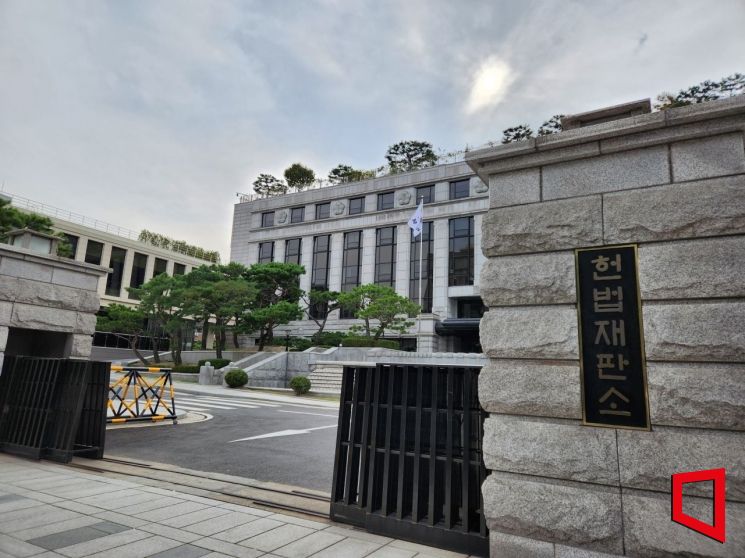
According to the legal community on the 3rd, the Constitutional Court ruled constitutional by a 7 (constitutional) to 2 (unconstitutional) vote in a constitutional complaint case regarding Article 8, Paragraph 3 of the Korean Red Cross Act (Red Cross Act), which requires the state and local governments to provide data requested by the Red Cross for membership fee collection unless there are special reasons.
The Constitutional Court also ruled constitutional on Article 8, Paragraph 2 of the Red Cross Act, which delegates the scope of necessary data to be specified by presidential decree, and Article 2, Item 1 of the Enforcement Decree, which includes "the name and address of the household head" in the scope of data that the Red Cross can request.
In October 22, 2019, in accordance with relevant laws for the 2020 Red Cross membership fee collection, the Red Cross requested the Ministry of the Interior and Safety for the names and addresses of household heads nationwide (excluding household heads under 25 or over 75 years old, single-person households in their 20s, and those who requested exclusion). On October 31, 2019, the Minister of the Interior and Safety provided the Red Cross with a total of 17,662,388 records of names and addresses of household heads aged 25 to 74.
Based on the household head information provided by the Minister of the Interior and Safety, the Red Cross sent giro notices in November 2019 to each household head, guiding them to pay the 10,000 KRW Red Cross membership fee by January 31, 2020. The petitioners who filed the constitutional complaint argued that allowing the state to provide their personal information to the Red Cross without their consent was unconstitutional.
The Constitutional Court judged that the relevant legal provisions do not violate the petitioners' right to informational self-determination by infringing on the principles of prohibition of excessive delegation or proportionality.
The Court stated, "It is difficult from a legislative technique perspective to specify the exact scope of necessary data in detail in the law in advance," and therefore delegating this to a presidential decree does not violate the principle of prohibition of excessive delegation.
Regarding the "special reasons" for refusing to provide data, the Court explained, "Although it is an indefinite concept, considering the purpose of the Personal Information Protection Act, it can be roughly predicted to cover cases 'where there is a risk of unjustly infringing on the interests of the data subject or a third party.'"
Regarding the scope of the information provided, the Court noted, "'Address' is essential information for sending giro notices, and 'name' is information naturally exposed in social life and is difficult to consider as strictly protected."
However, two justices, Lee Seon-ae and Moon Hyeong-bae, dissented, arguing that the data provision clause in the Red Cross Act violates the principle of clarity, and the part of the Enforcement Decree concerning "name" violates the principle of proportionality and infringes on the right to informational self-determination, thus deeming it unconstitutional.
This case is the first time the Constitutional Court has ruled on whether the Korean Red Cross Act and its Enforcement Decree, which provide the legal basis for sending giro notices to household heads nationwide, infringe on the right to informational self-determination.
Previously, in 2015, A, who filed a lawsuit against then-President Park Geun-hye, who was also the honorary president of the Korean Red Cross, claiming that the Red Cross sent mail requesting donations by collecting personal information such as addresses without consent, requested a constitutional review of the related Red Cross Act provisions during the lawsuit. However, the request was dismissed, and a constitutional complaint was filed but was dismissed for lack of precondition as the ruling would not change regardless of constitutionality.
Meanwhile, although the challenged provisions have not been amended, from the 2023 Red Cross membership fee collection, the practice has been improved to send giro notices only to household heads who have participated in Red Cross membership fee collections within the last five years.
© The Asia Business Daily(www.asiae.co.kr). All rights reserved.

![Clutching a Stolen Dior Bag, Saying "I Hate Being Poor but Real"... The Grotesque Con of a "Human Knockoff" [Slate]](https://cwcontent.asiae.co.kr/asiaresize/183/2026021902243444107_1771435474.jpg)















