No Reported Items Needed, 43 Million Annual Users' Inconvenience Resolved
From July, Only Reported Items to Be Written
Yoon Government Tightens Regulatory Innovation... Holds 3rd Regulatory Innovation Meeting

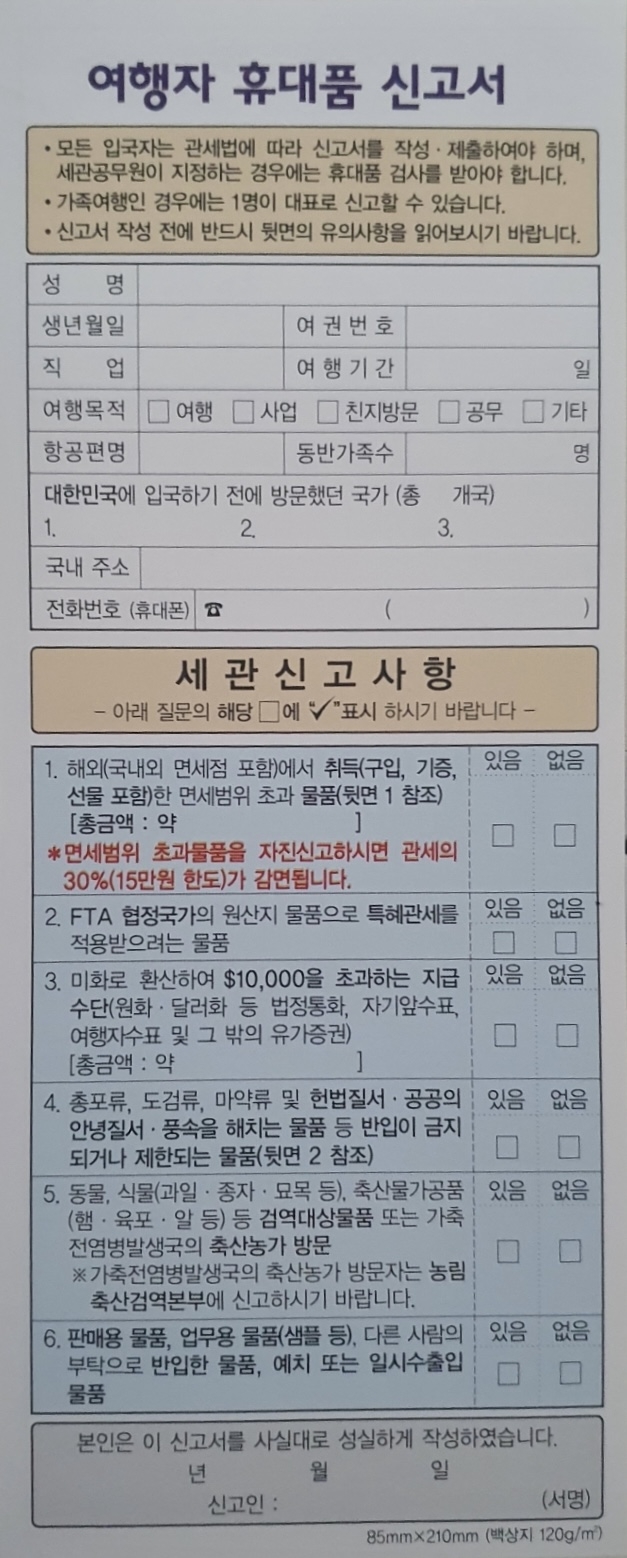
The obligation to fill out the ‘Traveler’s Personal Effects Declaration Form’ at the airport or on the plane upon entering the country will be abolished. Since 98.8% of entrants have no items to declare, this regulation was criticized as unnecessary and inconvenient. Starting from July, only those with items to declare will need to complete the form.
The government decided on this matter at the 3rd Regulatory Innovation Strategy Meeting chaired by Prime Minister Han Duck-soo on the 2nd.
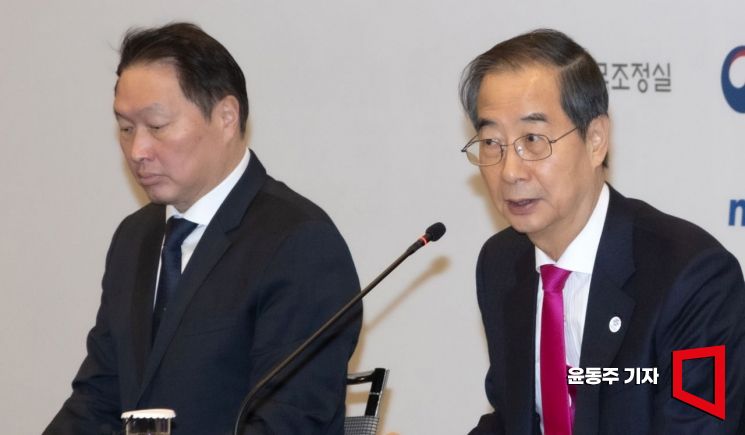 Prime Minister Han Duck-soo is delivering opening remarks at the 'Regulatory Sandbox Innovative Companies Meeting' held on the 15th at the Korea Chamber of Commerce and Industry in Jung-gu, Seoul. Photo by Dongju Yoon doso7@
The abolition of the obligation to fill out the traveler’s personal effects declaration form is expected to relieve the inconvenience of 43 million people annually. According to the Korea Customs Service, in 2019, out of 43.56 million total entrants, 43.06 million (98.8%) wrote that they had ‘no items to declare.’ However, it was cumbersome to be required to fill out the declaration form and hand it to customs officers or complete a mobile declaration upon entry.
Allowance of Robot Sidewalk Traffic Moved Up to 2023... Fostering New Industries
To foster new industries, the allowance for robots to travel on sidewalks will be moved up from 2025 to 2023. This is to support the development and market establishment of innovative technologies such as delivery, patrol, parking, and underwater cleaning robots. The concept of ‘robot’ will be added to transportation means, enabling the transport of daily logistics. The Road Traffic Act and the Intelligent Robots Act will be amended, along with the Act on the Development of Living Logistics Service Industry, to support this.
To strengthen corporate export competitiveness, a ‘complex logistics bonded warehouse’ will be newly established. This is to allow the distribution, repackaging, and export of key items such as semiconductors. Through this, it is expected to promote the relocation of overseas semiconductor logistics bases to Korea. Additionally, trade data amounting to 150 million cases annually will be opened to private and public institutions.
To prevent delays in decision-making caused by site or environmental regulations at the final stage of corporate investment, land use changes for development sites will be permitted. The government estimates that supporting the construction of R&D centers in this way will generate a total investment effect of 2.8 trillion won. Furthermore, 108 excessive economic penalty regulations will be eased to help revitalize the livelihood economy.
Lee Jung-won, Deputy Director of the Office for Government Policy Coordination, said in a pre-briefing, “Regulatory innovation is part of efforts to raise the economy’s potential growth rate,” and emphasized, “We will ensure that practical changes that the private sector can feel and investment creation contribute to driving the potential growth rate.”
688 Laws Amended as Regulatory Innovation Achievements, Investment Creation Effect Estimated at 34 Trillion Won
In the digital healthcare sector, telemedicine will be institutionalized mainly for clinic-level medical institutions to improve medical accessibility. To foster the metaverse, guidelines will be established to distinguish between games and the metaverse.
The Office for Government Policy Coordination announced that 688 laws were amended as regulatory innovation achievements in the first year of the Yoon Suk-yeol administration, and among the tasks completed last year, the investment creation effect of 104 cases with calculable economic effects is estimated at 34 trillion won.
At the ‘3rd Regulatory Innovation Strategy Meeting’ held at the Pangyo Metaverse Hub Center, Prime Minister Han Duck-soo said, “Regulatory innovation to boost corporate vitality under the current difficult economic environment is not an option but a necessity.” He added, “We must actively support the speedy improvement of the regulatory innovation measures discussed today so that our companies can confidently take on new businesses and run toward the global market.”
© The Asia Business Daily(www.asiae.co.kr). All rights reserved.
![Clutching a Stolen Dior Bag, Saying "I Hate Being Poor but Real"... The Grotesque Con of a "Human Knockoff" [Slate]](https://cwcontent.asiae.co.kr/asiaresize/183/2026021902243444107_1771435474.jpg)


















