Cheongsong-gun, Gyeongbuk Province, held a ‘Memorial Ceremony for Patriotic Struggle of Teacher Soryu Sim Seongji’ on the 1st at the Cheongsong Culture and Arts Center Small Theater, attended by about 100 people including key figures from various fields, local Confucian scholars, and academic society members, to commemorate the 104th anniversary of the March 1st Movement.
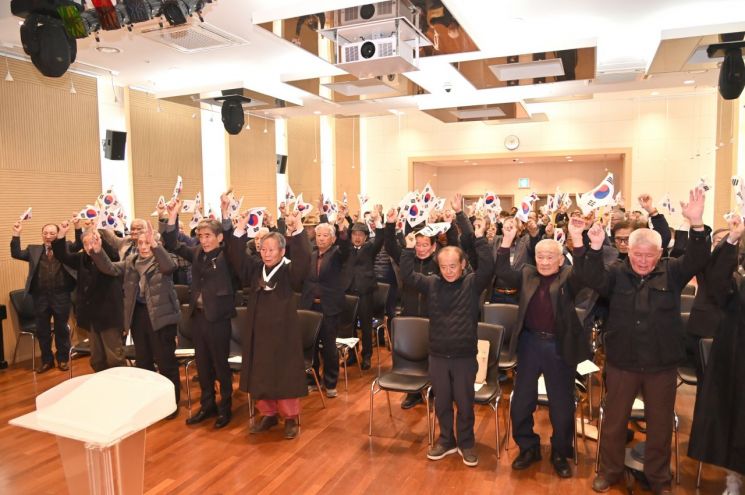 The 104th Anniversary of the March 1st Movement Cheongsong Uibyeongjang Soryu Sim Seongji National Salvation Struggle Memorial Ceremony.
Teacher Soryu Sim Seongji (小流 沈誠之) was a local militia leader who devoted himself to overcoming national crises by leading righteous armies against Japanese invasion during the 1896 Byeongsin Uprising (丙申倡義), when the country was on the brink of collapse. He achieved great military success in battles such as the Andeok Gameun-ri battle.
The event, organized by the Soryu Teacher Memorial Association (Chairman Sim Hongseop), was held in two parts: the first part was a memorial ceremony at 10:30 a.m., and the second part featured a special lecture by former Keimyung University professor Kwon Youngbae on the theme of Soryu Teacher’s life and patriotic struggle. Personal belongings of Teacher Soryu were also displayed.
County Governor Yoon Kyung-hee said, “The spirit of a true scholar and the life path that Teacher devoted himself to throughout his life, based on his academic foundation, will now serve as a guide for future generations to cultivate character and refinement, becoming a great foundation for regional development.” She added, “I hope this memorial ceremony will be an opportunity for all county residents to deeply reflect on the footsteps left by the teacher and to strengthen the spirit of patriotism.”
Teacher Soryu was born in Cheongsong in 1831. At the age of 13, he formally began his studies under teachers Dunwa and Yoo Yangheum. He was widely known in the region as a scholar who mastered Confucianism. Although he was appointed to official positions such as Uigeumbu Dosa (義禁府都事) in 1888 and Donyeongbu Dojeong (敦寧府都正) in 1894 by the royal court, he declined these posts twice and devoted his life solely to educating younger scholars and academic pursuits.
In particular, after the assassination of Empress Myeongseong in 1895 and the implementation of the short hair ordinance, when the Korean people’s anger against Japanese oppression began to surge and the country faced a crisis, righteous armies rose nationwide, led by Confucian scholars. Despite being 66 years old, Teacher Soryu was elected as the leader of the uprising by the people of Cheongsong. Although the period was short, he efficiently organized the righteous army units and established a military philosophy based on his lifelong academic foundation, greatly contributing to military successes in battles such as the Andeok Gameun-ri battle.
Even after the disbandment of the righteous army by order of King Gojong, Teacher Soryu distanced himself from his illustrious family background and reputation, living as a recluse mainly in mountain pavilions. He constantly worried about the future of the country and devoted himself solely to academic research with dozens of disciples until he passed away at the age of 74 in 1904.
His surviving works include the ‘Jeokwon Diary (赤遠日記)’, a battle diary compiled by secretaries at the time, as well as the ‘Soryu Anthology (小流文集)’, ‘Gangbyeongron (강병론, On Strengthening the Army)’, and ‘Yeongyaeum (營夜吟)’, which have been preserved.
© The Asia Business Daily(www.asiae.co.kr). All rights reserved.
![From Bar Hostess to Organ Seller to High Society... The Grotesque Con of a "Human Counterfeit" [Slate]](https://cwcontent.asiae.co.kr/asiaresize/183/2026021902243444107_1771435474.jpg)
















