Automobile Industry Association Eco-Friendly Vehicle Subcommittee Expert Meeting
Concerns have been raised that South Korea's electric vehicle production conditions lag behind those of countries with advanced automobile industries.
Kim Kyung-yu, a research fellow at the Korea Institute for Industrial Economics and Trade, stated at the meeting of the Eco-friendly Vehicle Subcommittee of the Korea Automobile Manufacturers Association held on the 2nd, "Considering new production competition factors such as the spread of economic nationalism and the establishment of electric vehicle supply chains, South Korea's production conditions are inferior compared to competing countries."
According to a Delphi survey conducted by experts at the Korea Institute for Industrial Economics and Trade, South Korea scored high in product competitiveness for electric vehicles with 91 points, but scored lower in supply capacity (87 points) and legal and institutional infrastructure (82 points). The United States scored high across the board with 96 points in product, 95 in supply capacity, and 96 in legal and institutional infrastructure. Germany, recognized as an advanced automobile manufacturing country, also scored higher than South Korea in supply capacity and legal and institutional infrastructure.
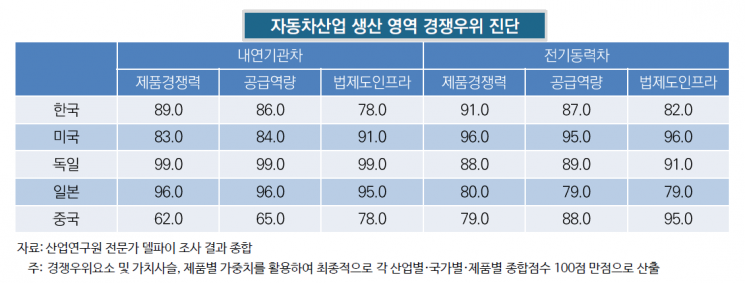
Even China, which is evaluated as less competitive in internal combustion engines, scored 79 points in product competitiveness, which is low, but is considered to have much better conditions than South Korea in terms of supply (88 points) and legal and institutional infrastructure (95 points). These evaluations were calculated by using competitive advantage factors, value chains, and product-specific weights to ultimately produce comprehensive scores by industry, country, and product on a 100-point scale.
Research fellow Kim explained that South Korea's declining competitiveness is related to "recent labor policy strengthening, which has increased corporate production costs due to minimum wage hikes and reduced working hours."
Kim emphasized that emphasizing electric vehicle production bases is not only for achieving carbon neutrality in the transportation sector but also for industrial reasons to secure competitiveness in the future vehicle market. He added that various investment incentives and tax support are needed during the transition of existing companies to electrification facilities.
He argued, "It should also be considered that the spread of eco-friendly vehicles aims not only to solve environmental problems but also to promote industrial development," adding, "In a situation where the future vehicle industry must secure global competitive advantage through aggressive investment, it is necessary to expand the designation of national strategic technologies, strengthen tax support, and expand the establishment of production facilities."
Kang Nam-hoon, chairman of the Korea Automobile Manufacturers Association, pointed out, "For achieving the 2030 NDC (Nationally Determined Contribution) target in the transportation sector, it is important to promote eco-friendly vehicles produced domestically," adding, "While major countries recently support the establishment of future vehicle industry ecosystems domestically through support policies for electric vehicle factories and battery investments, South Korea's tax credit for electric vehicle production facility investments is only 1%, raising concerns about the hollowing out of the future vehicle industry."
He further stated, "To promote electric vehicle production by automakers in South Korea, a groundbreaking investment support plan surpassing the U.S. IRA must be included in the implementation roadmap to maintain industrial competitiveness while achieving greenhouse gas reduction targets."
The meeting was part of the activities of the subcommittee of experts launched by the association in January this year to prepare for the future vehicle industry. It was divided into five subcommittees: eco-friendly vehicles including electric and hydrogen vehicles, future vehicle labor, parts future vehicle transition, future vehicles, and new mobility. The eco-friendly vehicle subcommittee was chaired by Professor Min Kyung-duk of Seoul National University, who is also president of the Korean Society of Automotive Engineers, with about 20 experts from various fields participating.
© The Asia Business Daily(www.asiae.co.kr). All rights reserved.
![Clutching a Stolen Dior Bag, Saying "I Hate Being Poor but Real"... The Grotesque Con of a "Human Knockoff" [Slate]](https://cwcontent.asiae.co.kr/asiaresize/183/2026021902243444107_1771435474.jpg)

















