Until now, writing has been entirely the domain of humans. While machines can accumulate data, organizing information purposefully to create a complete piece of writing was a distant prospect. However, the advent of the writing AI ChatGPT has ushered in a turning point. In bookstores, books directly written by ChatGPT as well as those researching ChatGPT are increasingly appearing.
Last week, the bookstore market saw the release of the book written by ChatGPT, 45 Ways to Find the Purpose of Life (Snowfox Books). This experiment began from the curiosity of a publishing planner with 18 years of experience, wondering, "Can AI replace human authors?" ChatGPT produced a 300-page manuscript in just a few hours. A publishing industry insider said, "It might be difficult to create new concepts, but its ability to organize existing concepts is excellent. The content is even better than expected."
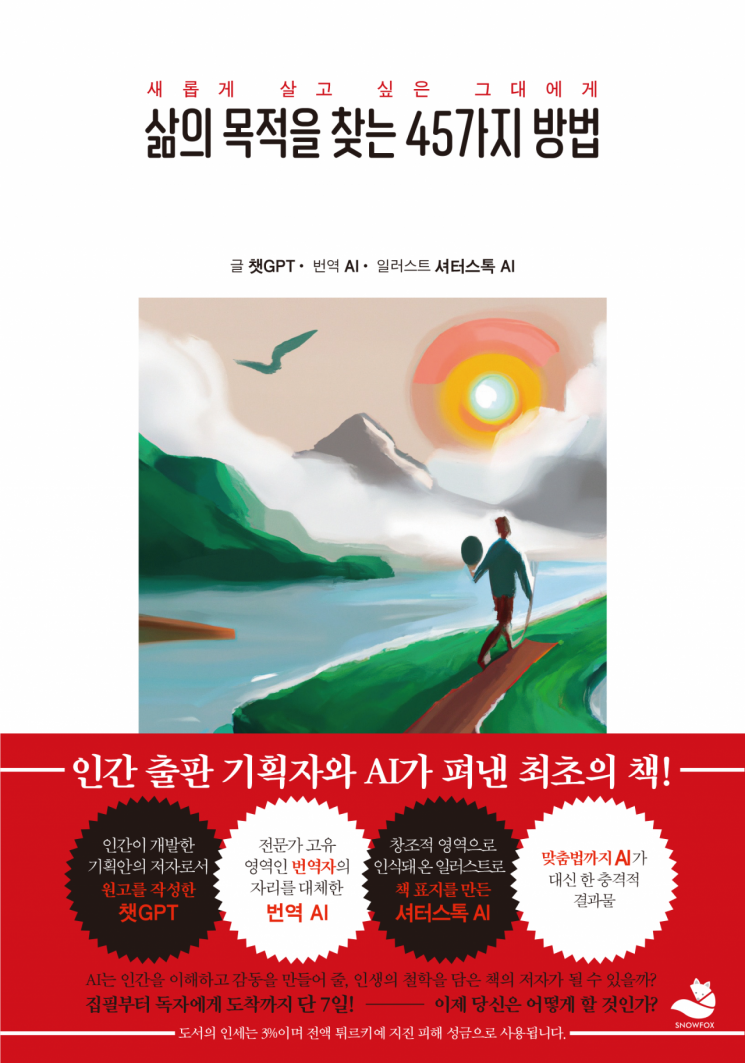
However, the strength specialized in organization is still seen as a point where it is difficult to replace humans. Seo Jin, CEO of Snowfox Books and planner of 45 Ways to Find the Purpose of Life, emphasized ChatGPT as an assistant that helps with writing rather than a professional author. He stated, "Its ability to organize source materials and check typos is very impressive. It is sufficient to replace humans in that regard," adding, "Considering the entire publishing process, it is better to think of it as a good assistant that helps organize materials." He explained that ChatGPT is suitable for finding and presenting materials for authors to write books or drafting, but beyond that, humans can perform better. However, Seo also acknowledged that the speed and depth of work can vary depending on how ChatGPT is utilized.
Professor Kim Dae-sik of KAIST’s Department of Electrical Engineering, who published The Future of Humanity Asked to ChatGPT (East Asia) last week, presents a similar argument. At a press conference held on the 27th of last month, he said, "I don't think writers, professors, journalists, or lawyers will disappear because of ChatGPT. However, writers and professors who use ChatGPT well might cause those who do not to disappear." Ultimately, the method of utilization is important. Professor Kim, who engaged in conversations with ChatGPT on profound topics such as love, justice, death, and gods over more than ten sessions in a month and incorporated them into his book, pointed out that "how to ask questions" is the key.
According to Professor Kim, initially ChatGPT responded to his questions with only generic answers, much like a seasoned politician. But when he added the prompt "Assume it is an AI from the 31st century," the answers changed. The model student response of "It could be dystopia or utopia" turned into an interesting answer: "With increased AI use, humanity has lost autonomy and freedom."
The era has come when AI, which once could not distinguish between dogs and cats even when shown 100 cat photos, now publishes books. This is the result of deep learning over more than 10 million data points since 2010. By deep learning the "probabilistic relationships" between sentences, even when only part of a sentence is given, it naturally fills in the following content without awkwardness. For example, if you say "The President of the Republic of Korea is~," ChatGPT fills in the rest.
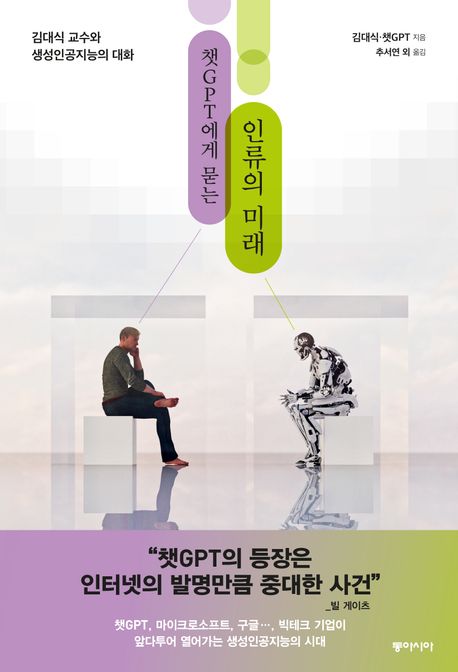
However, concerns about the production of false information highlight the necessity of humans. Professor Kim also expressed concern, saying, "ChatGPT creates lies in a very stylish way," and "It can produce fake news so convincingly and in large quantities that it could cause confusion."
So, is there a way to prevent such confusion? Professor Kim said that technically, by using "watermark" technology, AI-generated sentences can be distinguished from human ones, and this is actually being prepared for implementation. According to him, with current technology, texts longer than half an A4 page can be identified.
The emergence of this revolutionary and attractive technological conglomerate has stirred various industries, including publishing. Experts advise that while it is difficult to replace humans, the gap between people will widen significantly depending on how it is utilized.
© The Asia Business Daily(www.asiae.co.kr). All rights reserved.


















