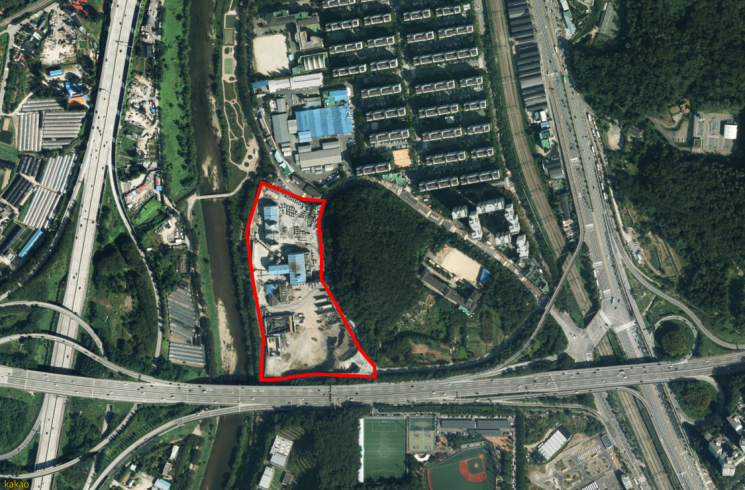
Gyeonggi Province is launching a restoration project for damaged areas within the Greenbelt equivalent to the size of 703 soccer fields.
On the 2nd, Gyeonggi Province announced that since 2020, it has established a restoration plan for 5㎢ of damaged Greenbelt areas as a condition for lifting restrictions on 22 Greenbelt release projects (34㎢), including the 3rd New Town developments. This area corresponds to the size of 703 soccer fields.
The restoration plan for damaged areas will be carried out by restoring nearby damaged Greenbelt areas to green spaces or by paying an equivalent conservation charge, rather than targeting the project sites scheduled for release.
The restoration plan was first introduced in 2009, with costs borne by the project implementers. However, since the law stipulates restoration at 10-20% of the released area, many cases only restored the minimum 10% or replaced restoration with conservation charges, especially when project costs were low and there were no complaints related to compensation.
To prevent this, for the 3rd New Town projects promoted by the government (5 districts, 23.79㎢ released area), the province led a restoration plan council involving the Korea Land and Housing Corporation (LH) and other implementers, establishing a restoration plan for 3.42㎢ (14.4% of the released area) of damaged Greenbelt.
Additionally, since 2021, the province has enacted the "Gyeonggi Province Greenbelt Release Integrated Guidelines," requiring at least 15% restoration of damaged areas instead of paying conservation charges for all release projects within the province. As a result, since 2020, there have been no cases of substituting restoration with conservation charge payments.
The province also proposed to the National Assembly and government that restoration targets include not only essential metropolitan ecological green corridors and land parcels at risk of future damage (such as residential land, factory sites, warehouse sites, and miscellaneous land) but also illegal facility storage areas, allowing these to be restored as green spaces.
Choo Dae-woon, Director of the Spatial Strategy Division of the province, emphasized, "We plan to minimize Greenbelt releases going forward. However, for unavoidable local projects, we will actively lead the restoration and conservation of green spaces within the Greenbelt by maximizing the use of damaged area restoration projects."
Meanwhile, the province is also reviewing additional revisions to the integrated guidelines, including measures to strengthen the environmental aspects of release projects.
In June 2021, the province established its own integrated guidelines to promote Greenbelt release projects that consider environmental, public interest, and public nature aspects. These guidelines apply stricter standards than legal requirements for damaged area restoration, parks and green spaces, public rental housing, and ecological area ratios. This was the first such initiative among metropolitan local governments nationwide.
© The Asia Business Daily(www.asiae.co.kr). All rights reserved.

















