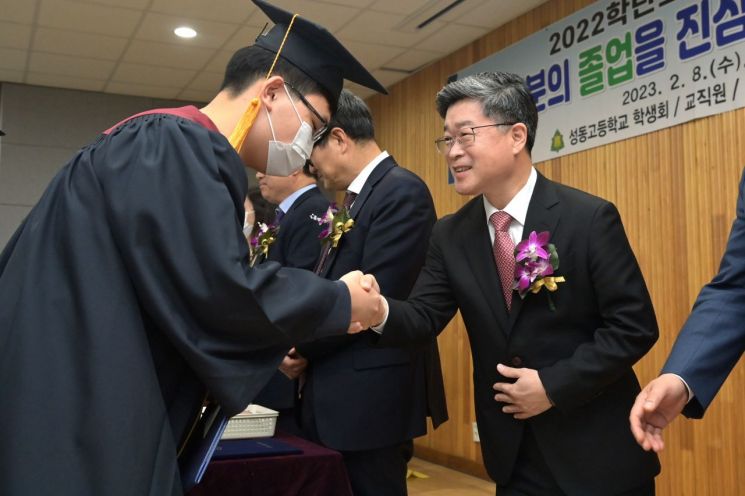
 Kim Gil-seong, Mayor of Jung-gu (center), is attending the Seongdong High School graduation ceremony, congratulating the graduates.
Jung-gu Ranks First Among Seoul Districts in Per-Student Subsidy for Educational Institutions This Year (890,000 KRW)
Support Fund for Essential School Supplies Introduced for the First Time, Prioritized Ahead of New Semester
Differentiated with Specialized Programs like Jung-gu Career Experience Education Beyond Educational Expense Subsidies
Seoul’s Jung-gu (Mayor Kim Gil-seong) is providing generous support so that every student can focus on school life without discrimination or lack.
Jung-gu announced that the per-student subsidy for educational institutions such as kindergartens and schools this year reaches 894,000 KRW, the highest amount among all districts in Seoul.
The total educational subsidies budgeted by the district this year amounts to 10.5663 billion KRW, including ▲ 5.9 billion KRW for educational expense subsidies ▲ 1 billion KRW for Jung-gu style career experience and foreign language learning support ▲ 3.04813 billion KRW for eco-friendly school meal support ▲ 568.16 million KRW for educational benefits, entrance preparation funds, and free high school education support.
For educational expense subsidies, 5.9 billion KRW?an increase of 1 billion KRW from last year?is allocated to 26 local elementary, middle, and high schools and 13 public and private kindergartens. Notably, this year the district newly introduced a category for purchasing essential school supplies for individual students. On the 23rd of last month, the Educational Expense Subsidy Deliberation Committee decided to prioritize disbursing 2.1 billion KRW ahead of the new semester.
Throughout the year, kindergartens and schools will use the educational expense subsidies for ▲ academic improvement education to activate public education ▲ enriching after-school programs for elementary students ▲ 4th industrial revolution education to nurture future talents ▲ customized programs reflecting school characteristics ▲ creating safe and comfortable educational environments.
In April and May, school principals will hold meetings to exchange opinions on local educational issues and explore various school support measures. Additionally, the district plans to actively communicate with Seoul City and the Office of Education to secure external funding.
Mayor Kim Gil-seong of Jung-gu stated, “Jung-gu prioritizes investment in education and generously supports school facility improvements and specialized program operations. Beyond educational expense subsidies, we will provide abundant educational opportunities in areas unmet by the regular curriculum, such as career experience and financial education directly operated by the district.”
Gwangjin-gu Allocates 11.3 Billion KRW for Educational Expenses This Year
5 Billion KRW Budgeted for School Facility and Environment Improvement, 1 Billion KRW Increase from Last Year
Educational Expense Budget Increased by 1 Billion KRW Annually, Plan to Secure 14 Billion KRW by 2026
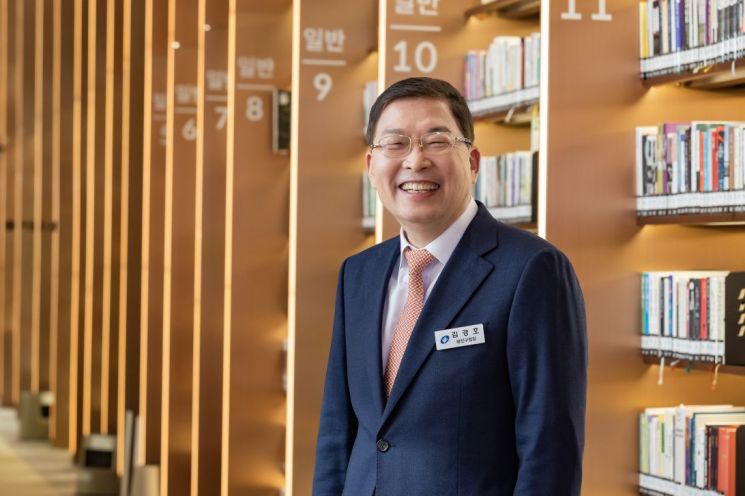
Gwangjin-gu (Mayor Kim Kyung-ho) will support 11.3 billion KRW in educational expenses this year for 70 kindergartens and elementary, middle, and high schools.
The district, promoting itself as a ‘Cultural Education City’?one of the core strategies of the 8th elected administration?expects to leap forward as a premium education city centered on public education by creating an optimal educational environment for nurturing future talents.
To build a world-class education Gwangjin through global talent development, 11.3 billion KRW will be invested. The breakdown by sector includes ▲ 3 billion KRW for school facility and environment improvements such as replacing outdated facilities and equipment in school libraries and cafeterias, and installing artificial turf on playgrounds ▲ 1.4 billion KRW for school-specific projects like basic academic skills improvement, after-school programs, and school特色 projects ▲ 250 million KRW for kindergarten educational equipment purchases and facility environment improvements ▲ and 6.7 billion KRW for other expenses including English camps, eco-friendly meal projects, and entrance support funds.
On the 21st of last month, the district held an Educational Expense Subsidy Deliberation Committee composed of education officials, district council members, and education experts. The committee finalized the support amounts per school and demand-centered support projects, deciding to provide over 5 billion KRW to all 70 schools including elementary, middle, high schools, and kindergartens in the area.
This year, 5 billion KRW will be allocated for school facility environment improvements and various educational programs, an increase of 1 billion KRW compared to last year. In particular, about 3 billion KRW will be dedicated to school facility improvements among demand-centered support projects, leading efforts to create a pleasant educational environment.
Additionally, school特色 projects such as ‘Artificial Intelligence (AI) Education for Future Talent Development’ and ‘Reading Campaign of Over 100 Books’ will be supported.
Going forward, the district plans to actively communicate with schools to provide students with a pleasant and happy educational environment, increasing the educational expense budget by 1 billion KRW annually to secure 14 billion KRW by 2026.
Mayor Kim Kyung-ho of Gwangjin-gu said, “We are striving to create conditions where education can be pursued without burden in Gwangjin by supporting educational expenses. We will pay more attention to demand-centered educational administration through communication and do our best to strengthen public education support for nurturing creative future talents.”
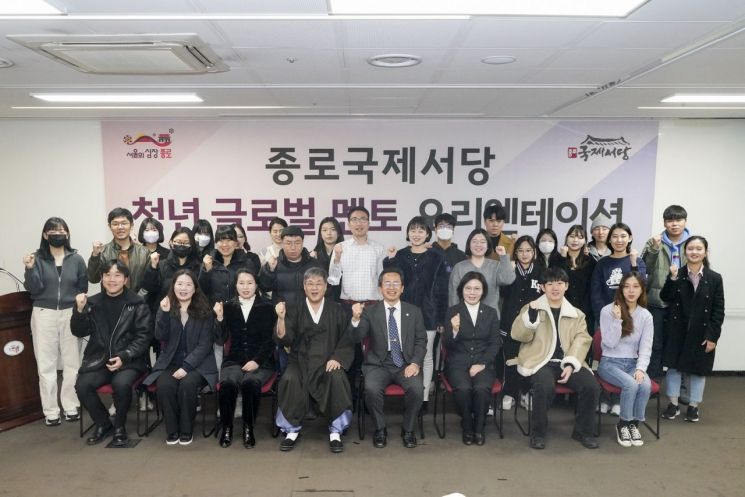
Jongno-gu (Mayor Jeong Moon-heon) held the ‘Plaque Unveiling Ceremony’ and ‘Youth Global Mentor Orientation’ on February 28 to mark the official launch of the Jongno International Seodang project.
Jongno International Seodang is a unique youth education and employment model in Jongno-gu that comprehensively provides education to cultivate English proficiency, humanities literacy, and communication skills essential for 21st-century global talents. Its distinctive feature is supporting job creation by strengthening youth capabilities while also offering differentiated learning opportunities to adolescents.
The 45 mentors, who were finally selected through document and interview screening last month, attended the orientation where they received an explanation of the Jongno International Seodang project and participated in a Q&A session.
From March 2023 to February 2024, these mentors will receive specialized English education online using the Hanmaek-in Bilingual program. Additionally, they will participate in three reporting sessions held in July and December 2023 and February 2024, where they will present and debate in English using Jongno’s history and cultural resources. They will also serve as supporters for the International Seodang Camp held during school vacations.
Moreover, the district plans to provide humanities lectures for youth mentors and lectures by employment experts on desired talent profiles sought by companies.
On the 27th of last month, Jongno-gu signed an international Seodang business agreement with Damyang-gun, Jeollanam-do, promising to grow together as competitive educational cities. As a result, Jongno-gu will offer the International Seodang program not only to local adolescents but also to those in Damyang-gun to help improve their foreign language skills.
Mayor Jeong Moon-heon of Jongno-gu stated, “The Jongno International Seodang is a flagship project of the 8th elected administration that provides jobs for youth and improves learning abilities through individual tutoring for adolescents. We will strive to solidify the project to improve Jongno’s educational conditions and create youth jobs, enhancing satisfaction for youth, adolescents, and parents alike.”
© The Asia Business Daily(www.asiae.co.kr). All rights reserved.



















