Emphasizing the 'Future' of Korea-Japan Relations... "Security Cooperation Partners"
Omission of 'Apology for Past History'... Likely Considering Forced Labor Negotiations
"Now It's Japan's Turn to Respond, Sending a Message"
President Yoon Suk-yeol clearly expressed his willingness to cooperate by defining Japan as a 'partner' rather than demanding an apology in his first March 1st Independence Movement Day commemorative speech. While emphasizing universal values, the message conveyed was that it is now Japan's turn to respond. On the other hand, North Korea, which continues its nuclear and missile threats, was briefly mentioned as a 'crisis,' reflecting a firm stance on denuclearization issues.
In his commemorative speech at the '104th March 1st Independence Movement Day Ceremony' held at the Yu Gwan-sun Memorial Hall in Jung-gu, Seoul, on the morning of the 1st, President Yoon stated, "Japan has transformed from a militaristic aggressor of the past to a cooperative partner sharing universal values with us in security, economy, and global agendas," adding, "Cooperation among South Korea, the U.S., and Japan to overcome complex crises and serious North Korean nuclear threats has become more important than ever."
Emphasis on 'Universal Values' Again..."Japan is a Cooperative Partner"
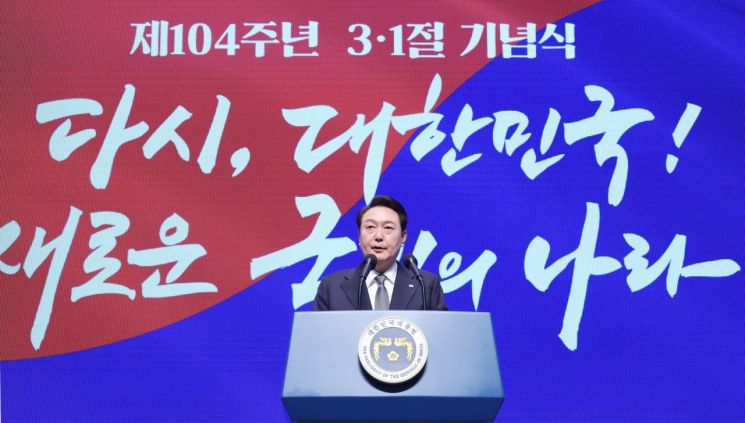 President Yoon Suk-yeol is delivering a commemorative speech at the 104th March 1st Movement Anniversary Ceremony held at the Yu Gwan-sun Memorial Hall in Jung-gu, Seoul, on the 1st. [Image source=Yonhap News]
The Yoon Suk-yeol administration has consistently emphasized solidarity with countries sharing 'universal values'. This commemorative speech is also read as expressing a willingness to cooperate with Japan in the same context. It contains the intention to strengthen security cooperation, such as enhancing the General Security of Military Information Agreement (GSOMIA) to respond to the escalating North Korean nuclear and missile threats, and to advance close relations in various fields including the economy.
President Yoon particularly emphasized, "We must unite and cooperate with countries that share universal values to expand the freedom of global citizens and contribute to the common prosperity of the world," adding, "This is no different from the spirit of those who cried out for the freedom and independence of the homeland 104 years ago." This is interpreted as meaning that the current cooperation with Japan aligns with the direction of a 'free democratic nation' within the spirit of the March 1st Movement.
This stance is also reflected in the recently published Defense White Paper, which describes Japan as "a close neighboring country that shares values with South Korea and should build a future cooperative relationship that aligns with common interests." This is a more advanced expression than the simple mention of 'neighboring country' two years ago, emphasizing the importance of South Korea-U.S.-Japan security cooperation for peace not only on the Korean Peninsula but also in the Northeast Asian region.
Professor Park Won-gon of Ewha Womans University’s Department of North Korean Studies said in a phone interview with Asia Economy on the day, "Among the March 1st messages delivered by presidents of past Korean governments, this one evaluated Japan most positively," and added, "The perception of viewing the Korean Peninsula issues, including the North Korean nuclear threat, through the framework of freedom as a value contrasts most with the Moon Jae-in administration." He further stated, "Since South Korea is showing willingness to improve relations like this, the message that it is now Japan's turn to respond is also sufficiently contained."
Commemorative Speech Without 'Japan's Apology'?Consideration of Forced Labor Negotiations?
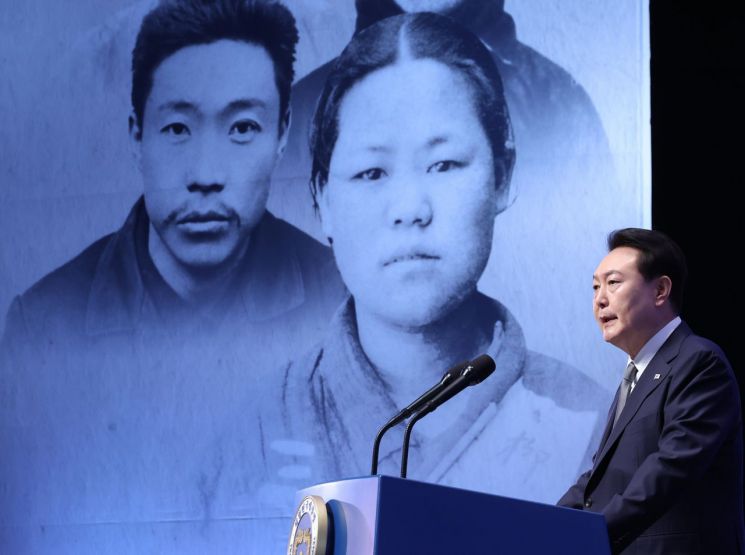 President Yoon Suk-yeol is delivering a commemorative speech at the 104th March 1st Movement Anniversary Ceremony held at the Yu Gwan-sun Memorial Hall in Jung-gu, Seoul, on the 1st. [Image source=Yonhap News]
However, there is also criticism that the commemorative speech, which was about 1,300 characters long, lacked mention of past issues such as forced labor and comfort women. There were no expressions that could be interpreted as demanding apology or reflection from Japan. This contrasts with former President Moon Jae-in’s first March 1st commemorative speech in 2018, where he mentioned Yu Gwan-sun and used terms like 'perpetrator' and 'crimes against humanity' to urge reflection.
Considering that the Yoon Suk-yeol administration has consistently expressed a willingness to improve Korea-Japan relations, it appears to have kept in mind the forced labor compensation issue, which is in the final stages of negotiation. Since the diplomatic authorities of South Korea and Japan are communicating frequently to speed up finding a final solution, and discussions are underway regarding the possibility of a Korea-Japan summit in the first half of this year, it is speculated that these circumstances were reflected in the speech.
Furthermore, the only references to North Korea in the speech were two mentions of the phrase 'North Korean nuclear threat' instead of messages aiming to improve inter-Korean relations. Notably, these mentions were elaborated to explain the crisis South Korea faces and the reason for South Korea-U.S.-Japan security cooperation. While keeping the door open for dialogue, the firm stance was reiterated that peace will be met with 'peace through strength' until North Korea first shows willingness to denuclearize.
On the other hand, North Korea harshly criticized Japan through a report in the Workers' Party organ newspaper Rodong Sinmun on the same day, accusing Japan of trying to cover up its criminal history. In an article titled 'The Brutal Suppression of the Mass Anti-Japanese Struggle Is a Crime Against Humanity,' the newspaper stated, "Japan, the perpetrator of tremendous crimes, not only fails to sincerely reflect on the past but continues to stab the wounded hearts of our people and commit all sorts of evil deeds," adding, "Crimes against humanity have no statute of limitations."
© The Asia Business Daily(www.asiae.co.kr). All rights reserved.
![Clutching a Stolen Dior Bag, Saying "I Hate Being Poor but Real"... The Grotesque Con of a "Human Knockoff" [Slate]](https://cwcontent.asiae.co.kr/asiaresize/183/2026021902243444107_1771435474.jpg)

















