US Startup Plans to Sell Ice Straws
Addressing Paper Straw Drawbacks for 'Zero Waste'
Estimated 10 Billion Straws Disposed Annually
Can we enjoy drinks more cleanly and refreshingly while protecting the environment this summer?
An American startup plans to sell ice straws starting this May, raising expectations that people can use cool straws instead of paper straws that quickly become soggy.
Convenient Ice Straw Launch

'Ice Guys' has been gathering buyers on the crowdfunding site Kickstarter since December 28 last year. It was so popular that it reached its funding goal within a day. In about a month, 1,538 backers contributed approximately $70,000.
The company offers three types of ice straw molds. There is a basic type with a diameter of 5mm and a length of 220mm, a shorter 'cocktail type,' and a larger diameter 'boba type.' The ice molds are priced at $19 for one, $59 for three, $79 for six, and $59 for twelve, and are currently available for pre-order.
The advantage they highlight is 'convenience.' The molds are vertical, making it easy to fill with liquid, and the molds are flexible, allowing the ice to be squeezed out like a tube. They also explain that it takes only 30 to 60 minutes to freeze into a straw shape.
Plastic Straws Threatening the Environment... Single-Use Plastic Straws Banned in Stores
Ice straws were not first invented by Ice Guys. Similar ice molds have been sold before. However, those horizontal molds were difficult to fill completely with liquid and had to be frozen together with a real straw, making them impractical.
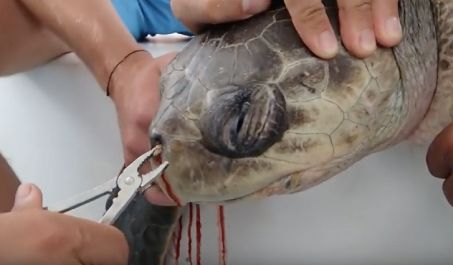
Nevertheless, ice straws are emerging because the damage caused by single-use straws is severe. Plastic does not decompose even after hundreds of years and emits various harmful substances when incinerated. Plastic straws have threatened ecosystems, such as turtles with straws deeply lodged in their noses and birds with their beaks and necks caught in plastic drink rings. Plastic straws are thin and small enough to be missed during recycling and are classified as general waste.
Starting November 24, the use of single-use plastic straws will be banned in all cafes and restaurants nationwide. Some cafes have already introduced paper straws. However, paper straws easily become soggy. There are also complaints that over time, they are difficult to drink through and have a paper taste mixed in.
Straws made from materials like corn and bamboo have been developed, but some waste generation is unavoidable. Although these materials decompose more easily than traditional plastics, they are still single-use items that are discarded after one use.
On the other hand, ice straws are made entirely of ice, so they naturally melt without producing any waste. There is also an opinion that since the straw can be made from the beverage itself rather than water, it can become a 'delicious straw.' However, unlike regular straws, ice straws always require molds and have the drawback of melting if not consumed quickly.
Over 10 Billion Straws Disposed Annually in Domestic Cafes and Fast Food Industry
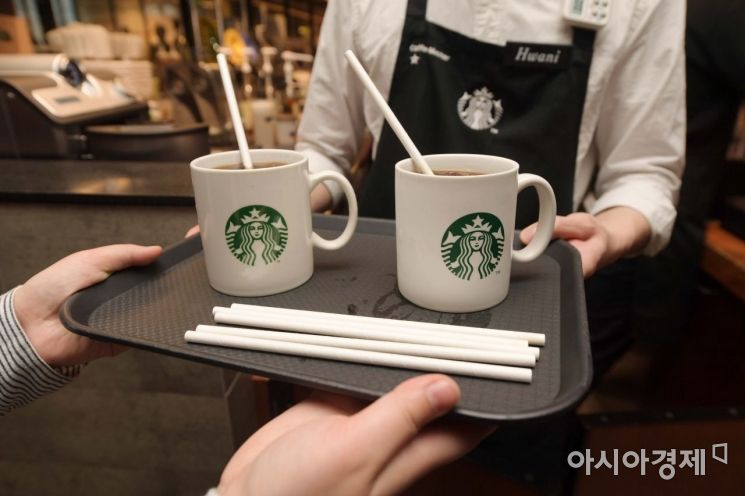 In 2018, Starbucks Korea introduced paper straws and strawless lids (cup lids) to stores nationwide. Photo by Mun Ho-nam munonam@
Meanwhile, according to a 2019 survey by the Ministry of Environment targeting domestic cafes and fast food franchises, about 938 million straws are discarded annually. Due to increased plastic use from non-face-to-face services during COVID-19 and considering straws not captured in statistics, it is estimated that over 10 billion straws are discarded each year.
Additionally, the amount of microplastics detected in disposable containers is up to 4.5 times higher than in reusable containers. According to the Korea Consumer Agency, when comparing containers with similar uses, microplastics detected in disposable containers were 2.9 to 4.5 times higher than those in reusable containers.
© The Asia Business Daily(www.asiae.co.kr). All rights reserved.



















