79 Public Institutions Operating Job-Based Pay
Job-Based Pay Accounts for 3.5% of Annual Salary
65% of Institutions Are 'Nominally Job-Based Pay System'
As the government pushes to expand the introduction of the job-based pay system in public institutions, it has been found that many institutions merely establish the system but leave it ineffective. In most cases, the job-based pay amounts to only tens of thousands of won or institutions use other work allowances instead. Critics argue that focusing solely on increasing the number of institutions adopting the job-based pay system will make it difficult to achieve labor reform effects.
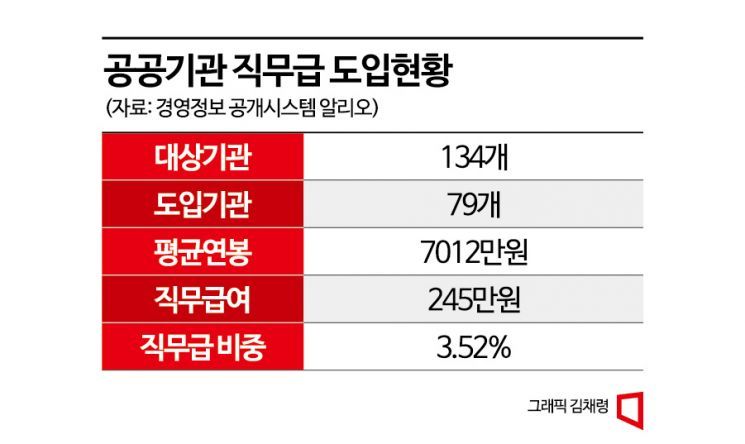
On the 28th, Asia Economy examined wage information of 134 public enterprises and quasi-governmental institutions through the management information disclosure system 'Alio' and found that a total of 50 public institutions were already paying 'job-based pay.' Institutions providing wages that are essentially job-based pay under different names, such as 'position job-based pay,' totaled 79. This accounts for 58% of all public institutions, which is more than the 35 institutions the government had independently identified and announced as having introduced the job-based pay system.
Job-based pay refers to a wage system where pay is determined by the tasks performed, unlike the annual salary or seniority-based pay systems where longer tenure results in higher pay. The government is promoting the introduction of job-based pay to improve corporate inefficiency and reduce wage burdens. On the 30th of last month, Deputy Prime Minister and Minister of Economy and Finance Choo Kyung-ho announced plans to increase the number of public institutions adopting the job-based pay system to 100 by next year.
However, public institutions have introduced job-based pay but operate it by setting the amounts very low. The average job-based pay level in 2021 among the 79 institutions that paid it was 2.45 million won, about 200,000 won per month. This is only 3.52% compared to the average annual salary of 70.12 million won per person. In the 2022 budget proposal, the proportion of job-based pay increased only slightly by 0.02 percentage points.
65% have job-based pay proportions between 0-1%... 'Job-based pay in name only'
In particular, 18 institutions, accounting for 22.7% of the total, had a job-based pay proportion of 0% relative to the average annual salary. Considering 34 institutions with a 1% proportion, 65.8% were paying job-based pay that was essentially meaningless. A representative example is the National Health Insurance Service. The pay it provides based on job roles averages 322,000 won annually, or 26,830 won monthly, which is about 0.67% of the average annual salary of 48.1 million won. This is less than bonuses (1.962 million won), long-term service allowances (1.061 million won), or holiday filial piety allowances (983,000 won).
Institutions that promoted the advancement of the job-based pay system showed similar trends. The Korea Forest Welfare Institute emphasized that through a joint labor-management agreement in 2019, it conducted job analysis and evaluation and shifted its compensation system to be job-centered. However, the job-based pay employees received decreased from 1.268 million won in 2019 to 1.216 million won in 2020 and 1.171 million won in 2021. The job-based pay reflected in last year's budget proposal was 1.097 million won, which is 2% of the annual salary. The difference between the highest job grade G1 and the lowest G5 was only 400,000 won, showing almost no differentiation.
Some institutions simply renamed allowances of a completely different nature as job-based pay. The Small and Medium Business Corporation announced that it introduced the job-based pay system at the end of 2019 and started paying job-based pay amounting to 1.827 million won annually from 2020. At the same time, it abolished the position allowance and special duty allowance, which were about 1.8 million won the previous year. In effect, it was job-based pay in name only.
The superficial operation of the job-based pay system in public institutions is due to government pressure and union opposition. The government pressures affiliated public institutions to promote the job-based pay system, but unions strongly oppose it citing wage reductions, resulting in a job-based pay system that is only nominal. Consequently, in communities of public institution employees, complaints arise that despite the introduction of the job-based pay system, 'there is no significant difference and seniority remains.'
The government is aware of the problem and is seeking solutions. A Ministry of Economy and Finance official explained, "In last year's management evaluation report, many cases submitted as having introduced job-based pay were judged not to be so," adding, "The stage of simply introducing job-based pay is over, and we see this as a stage to focus on settling and expanding it."
© The Asia Business Daily(www.asiae.co.kr). All rights reserved.
![User Who Sold Erroneously Deposited Bitcoins to Repay Debt and Fund Entertainment... What Did the Supreme Court Decide in 2021? [Legal Issue Check]](https://cwcontent.asiae.co.kr/asiaresize/183/2026020910431234020_1770601391.png)
















