Constitutional Court That Ruled Apology Ads and Statements Unconstitutional
"Special Educational Measures for Guidance and Victim Recovery"
The Constitutional Court has ruled that requiring a student who committed school violence to apologize in writing to the victim student does not constitute a violation of the perpetrator's freedom of conscience or personal rights.
Previously, the Constitutional Court had ruled unconstitutional in cases where forced apologies contrary to one's beliefs were imposed by state trials or decisions of the Korea Communications Commission or the Election Article Deliberation Committee, citing violations of freedom of conscience and personal rights.
However, in this case, the Constitutional Court considered the written apology to the victim student as a special educational measure aimed at guiding the perpetrator, restoring the victim's damages, and normalizing educational relationships, and judged that it does not infringe on the perpetrator's freedom of conscience or personal rights.
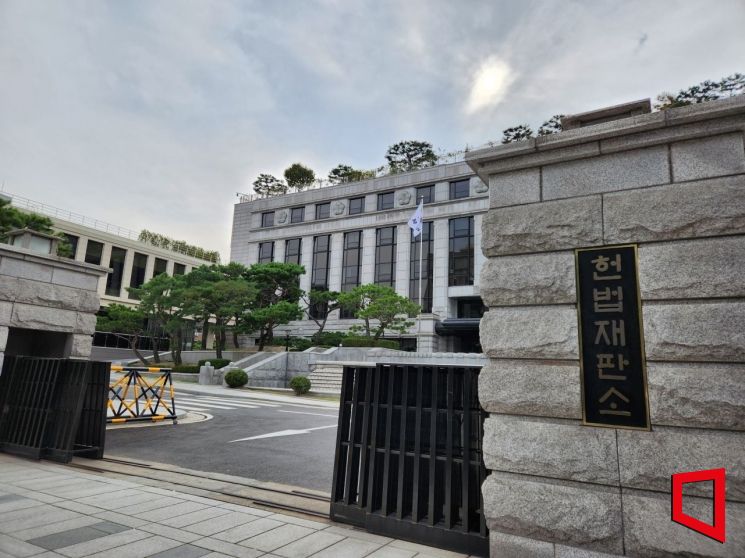
According to the legal community on the 28th, the Constitutional Court ruled constitutional (dismissed) by a 6 (constitutional) to 1 (unconstitutional) vote in a constitutional complaint case filed by An Mo, a 5th-grade elementary school student, and Kim Mo, a 1st-grade middle school student, who received a "written apology to the victim student" disposition in a school violence case. They argued that Article 17, Paragraph 1, Subparagraph 1 of the pre-amended "Act on the Prevention and Countermeasures against School Violence (School Violence Prevention Act)," which required the School Violence Countermeasures Autonomous Committee (Autonomous Committee) to request the school principal to impose a written apology on the perpetrator student to the victim student, violated freedom of conscience and personal rights and was unconstitutional.
In 2019, the law was amended, abolishing the Autonomous Committees established in each school, and the School Violence Countermeasures Deliberation Committee established at the Office of Education took over the duties previously performed by the Autonomous Committees.
At the time of the violence incidents involving An and Kim, Article 17, Paragraph 1 of the School Violence Prevention Act stipulated that the Autonomous Committee should request the school principal to take measures such as a written apology to the victim student (Subparagraph 1), prohibition of contact, threats, and retaliation against the victim and reporting students (Subparagraph 2), and class transfer (Subparagraph 7) for the protection of the victim and guidance and education of the perpetrator.
An, who was a 5th grader in elementary school in 2017, was ordered by the school principal to submit a written apology to the victim student due to committing school violence. After going through an administrative trial at the Gyeonggi Provincial Office of Education Administrative Appeals Committee, An filed a lawsuit to cancel the disposition in October 2018 and requested a constitutional review of Article 17, Paragraph 1, Subparagraph 1 of the School Violence Prevention Act during the trial. However, the Suwon District Court dismissed An's lawsuit in June of the following year and also rejected the constitutional review request. Subsequently, An filed a constitutional complaint with the Constitutional Court under Article 68, Paragraph 2 of the Constitutional Court Act. Since An is a minor, his parents, as legal representatives, acted on his behalf in the lawsuit.
Kim, who was a 1st grader in middle school in 2017, received dispositions from the school principal for school violence, including a written apology to the victim student under Article 17, Paragraph 1, Subparagraph 1 of the School Violence Prevention Act, prohibition of contact, threats, and retaliation against the victim and reporting students (Subparagraph 2), class transfer (Subparagraph 7), six hours of special education under Paragraph 3 of the same law, and six hours of special education for guardians under Paragraph 9. Kim filed a cancellation lawsuit against these provisions and requested a constitutional review, but the Suwon District Court dismissed the cancellation claim in 2019 and rejected or dismissed the constitutional review request. Kim then directly filed a constitutional complaint with the Constitutional Court regarding these provisions. Kim's parents, as guardians, also represented him in the lawsuit.
In his constitutional complaint, An claimed primarily that Article 17, Paragraph 1, Subparagraph 1 (written apology) of the School Violence Prevention Act violated freedom of conscience and was unconstitutional, and secondarily argued that imposing such a disposition on victims of sexual violence was unconstitutional. However, the Constitutional Court limited the scope of review to the primary claim, stating it was only a partial quantitative part of the secondary claim.
The majority of six constitutional justices judged that "the written apology measure is an educational measure designed to provide an opportunity for reflection and apology for one's actions without coercion regarding the content," and "it is difficult to see it as excessively infringing on the perpetrator's freedom of conscience and personal rights."
They further explained, "School violence arises from various complex causes, and the perpetrator is still a student in the growth process, for whom the school and society have the responsibility to educate as sound members of society," and "the issue of school violence cannot be approached solely from a retributive (punitive or retaliatory) perspective; the guidance and education of the perpetrator must also be considered."
On the other hand, three justices?Lee Seon-ae, Kim Ki-young, and Moon Hyeong-bae?dissented, stating, "While reflection and apology by the perpetrator are important to resolve school violence, this cannot be achieved through unilateral coercion or punishment," and "it should be voluntarily achieved through advice, education, and guidance by teachers or parents in an educational process."
Meanwhile, the Constitutional Court unanimously ruled constitutional on provisions related to the mandatory regulation requiring the school principal to comply with decisions made by the Autonomous Committee, where parent representatives hold the majority, as well as other measures related to Kim's constitutional complaint, such as prohibition of contact and class transfer, judging that these do not infringe on the general freedom of conduct of the perpetrator. The Court also ruled that delegating matters concerning the establishment, operation, and composition of the Autonomous Committee and the application standards for each measure against the perpetrator under Article 17 of the law to presidential decrees does not violate the principle of non-delegation of legislative power.
A Constitutional Court official stated, "The School Violence Prevention Act was amended on August 20, 2019, abolishing the Autonomous Committees at individual schools and establishing the School Violence Countermeasures Deliberation Committee at the Office of Education. A system was also introduced allowing the school principal to resolve minor cases independently if the victim student and their guardian do not wish to hold a deliberation committee meeting," and added, "However, considering the social demands at the time of introducing the mandatory regulation in this case, the Constitutional Court judged that the mandatory regulation is not unconstitutional," explaining the significance of this decision.
Meanwhile, the Constitutional Court previously ruled partially unconstitutional (qualitative partial unconstitutionality) in a 1991 constitutional complaint case regarding Article 764 of the Civil Act, stating that including apology advertisements in "appropriate measures for restoring honor" under Article 764 of the Civil Act violates the Constitution. In 2012, the Court ruled unconstitutional a provision in the former Broadcasting Act Article 100, Paragraph 1, Subparagraph 1, which allowed the Korea Communications Standards Commission to order a "public apology to viewers" after a broadcaster violated review regulations, stating that the part concerning "when a broadcaster violates review regulations under Article 33" violates the Constitution. Additionally, in 2015, the Court ruled unconstitutional the provision in Article 8-3, Paragraph 3 of the Public Official Election Act, which required media companies recognized to have reported unfair election articles to publish an apology through the Press Arbitration Commission, stating that the "publication of apology" part violates the Constitution.
© The Asia Business Daily(www.asiae.co.kr). All rights reserved.

















