National Gwacheon Science Museum Announces Special Live Broadcast and Commentary
March 2 Venus-Jupiter, March 24 Moon-Venus Close Approach Events
In March, the biggest celestial show of the year will occur twice. Venus and Jupiter, as well as the Moon and Venus, will each come close enough to appear almost touching.
The Gwacheon National Science Museum announced on the 27th that it will broadcast the Venus-Jupiter conjunction live online on the 2nd of next month and hold a special observation event on the 24th when the Moon and Venus come close.
On the evening of the 2nd, Venus and Jupiter will approach each other to within 0.5 degrees, about the size of a full moon, making the two planets appear almost touching to the naked eye. Through a telescope, both planets can be seen in the same field of view. This is the closest they have been since May 1 of last year, and the next conjunction will not occur until August 12, 2025, three and a half years later.
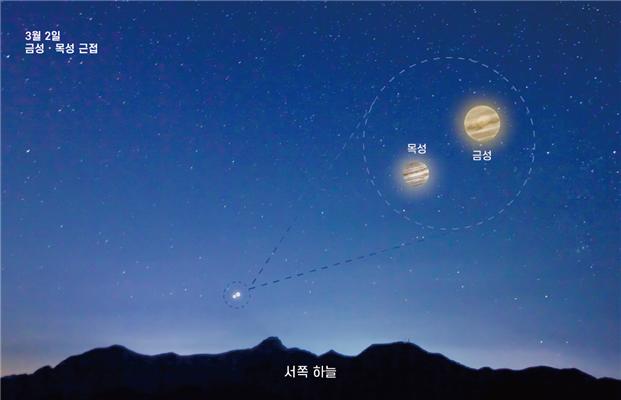 On March 2, Venus and Jupiter will be in close proximity. Image source: National Gwacheon Science Museum
On that day, from 7 p.m., the Gwacheon Science Museum will provide a live broadcast with real-time observation and commentary on its YouTube channel. The broadcast will explain the frequency of Venus-Jupiter conjunctions and the characteristics of the two planets. Observers will also be able to see Jupiter’s four major moons (Io, Europa, Ganymede, Callisto) through a telescope and check the phases of Venus. The event will be canceled if weather conditions are unfavorable.
On the 24th of next month, another celestial event will occur as the Moon approaches Venus. Since the Moon moves faster across the sky than the planets, close approaches between the Moon and planets happen more frequently than between planets themselves. However, a conjunction is only considered when the angular distance between the two celestial bodies is less than one degree. On this day, the angular distance between the Moon and Venus will be as close as 0.3 degrees, allowing simultaneous observation of both with binoculars or a telescope. This will be the closest Moon-Venus conjunction since January 2, 2019, and the next will be observable on the early morning of April 6, 2035. The Gwacheon Science Museum will hold a special observation event that evening. Lectures and in-person observations will take place, with lectures open to anyone from elementary school age and up starting at 7 p.m. Observation targets will include not only the Moon-Venus conjunction but also Mars and the Pleiades star cluster.
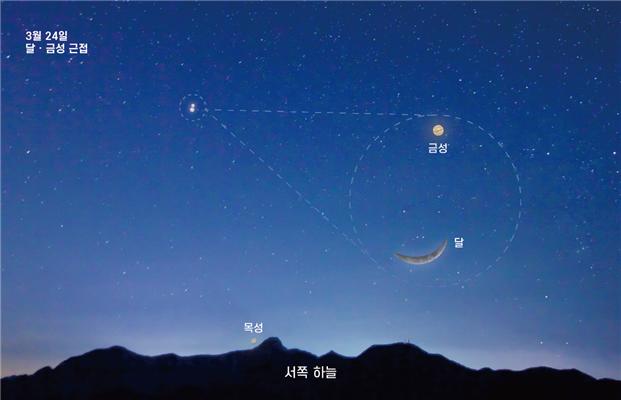 On March 24, the Moon and Venus will be in close proximity. Image source: Gwacheon National Science Museum
Dr. Jo Jae-il, an astronomy observation team member at the Gwacheon Science Museum, said, “Conjunctions of two celestial bodies are rare astronomical events, and it is especially remarkable that the three brightest objects in the night sky will form pairs twice in one month.” He added, “It will be a special experience to observe both celestial bodies simultaneously through a telescope.”
For more details, please visit the Gwacheon National Science Museum website.
© The Asia Business Daily(www.asiae.co.kr). All rights reserved.
![Clutching a Stolen Dior Bag, Saying "I Hate Being Poor but Real"... The Grotesque Con of a "Human Knockoff" [Slate]](https://cwcontent.asiae.co.kr/asiaresize/183/2026021902243444107_1771435474.jpg)

















