The vote on the arrest consent bill for Lee Jae-myung, leader of the Democratic Party of Korea, will take place in the National Assembly on the afternoon of the 27th. The Democratic Party is confident of a rejection with 'more than 170 votes,' surpassing the number during the case of lawmaker Roh Woong-rae, while the ruling party is quietly expecting some defections and has already activated a 'bulletproof frame' anticipating the bill's rejection.
Democratic Party lawmaker Park Jumin said on CBS's 'Kim Hyun-jung's News Show' that "I think there will be more than 170 rejection votes; I hardly see anyone who would vote in favor," adding, "When I check around me and naturally discuss this issue, there is almost no one who holds a different opinion or intention on this matter," showing confidence.
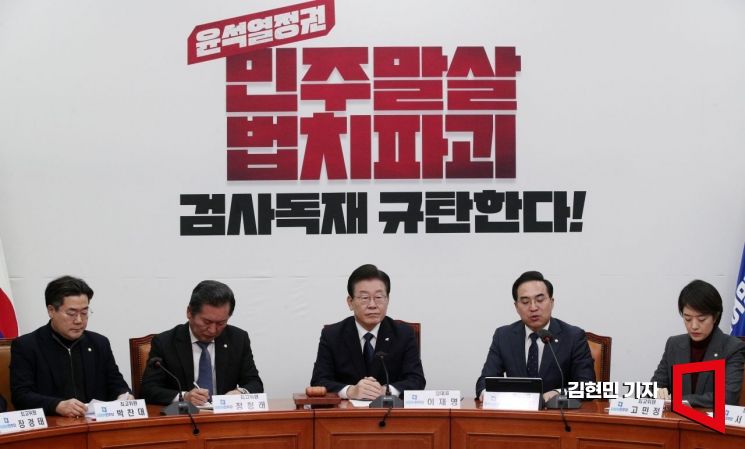 Lee Jae-myung, leader of the Democratic Party of Korea, listens to the remarks of floor leader Park Hong-geun at the Supreme Council meeting held at the National Assembly in Yeouido, Seoul on the 27th. Photo by Kim Hyun-min kimhyun81@
Democratic Party spokesperson Kim Eui-gyeom also expressed confidence on BBS's 'Jeon Young-shin's Morning Journal,' saying, "(The possibility of invalid or abstention votes) is absolutely none," and "There may be some adjustments, but there will be no defections from the Democratic Party." Including votes from opposition-leaning independent lawmakers such as those from the Basic Income Party, the total reaches 175 votes, and it is expected that nearly this number of rejection votes will be cast.
Jung Sung-ho, considered the leader of the pro-Lee (친명, Chinmyeong) faction within the Democratic Party, said on MBC's 'Kim Jong-bae's Focus' in response to the host's question about whether more opposition votes would come out compared to the Roh lawmaker's vote, "I think so," adding, "In the case of lawmaker Roh, the charge itself was bribery, so the nature of the case was somewhat different. Therefore, I think there will be more rejection votes for the arrest consent bill against the leader."
Even lawmaker Seol Hoon, who is called the non-Lee (비명, Bimyeong) faction within the Democratic Party, is calling for an 'overwhelming rejection,' making the number of rejection votes compared to the Roh lawmaker's case the new benchmark for this arrest consent bill vote rather than whether it passes or fails. If the rejection votes exceed 170, it can be interpreted that the Democratic Party unified around Lee remains solid, but if the number is similar to or less than Roh's 161 votes, it could signal a crisis for Lee's leadership.

The ruling party's interest in the scale of 'defection votes' stems from this reason. On the same day, Song Eon-seok, a lawmaker from the People Power Party, said on MBC radio, "It is not appropriate to say that a certain number of votes will come out or that it will be a specific number," but left room for possibility by adding, "Many Democratic Party lawmakers with common sense whom I have met personally recognize that this issue is serious."
Kim Ki-hyun, a candidate for the People Power Party leadership, also said on SBS's 'Kim Tae-hyun's Political Show' that "If the arrest consent bill is rejected again in the National Assembly, the Democratic Party will face a national judgment that will come like a tremendous tsunami," adding, "I hope there are still some lawmakers with common sense, but we will have to see if that hope becomes reality."
If the bill is rejected, the ruling party is expected to focus attacks on the opposition using the 'bulletproof frame.' Already, Jeong Jin-seok, the emergency committee chairman of the People Power Party, launched a preemptive attack on his social media on the same day, defining the rejection as the 'fall of the activist generation.' He said, "If the arrest consent bill is rejected today, we will witness the end of the 1987 regime that has lasted for more than a generation, the fall of the 386 activist generation," adding, "Why are the 386 democracy fighters who risked their lives to oppose the harsh authoritarian government keeping silent today? Is it because they are hanging on to the nomination rights held by the party leader?"
© The Asia Business Daily(www.asiae.co.kr). All rights reserved.


















