Samsung Seoul Hospital Professors Poongryul Lee, Jieun Kim, and Mira Kang Team
Propose New Name Instead of Jeongjung Gungin Syndrome
Also Present Differential Diagnosis Criteria
A proposal has been made to rename 'Median Arcuate Ligament Syndrome (MALS),' which causes repeated severe abdominal pain but is difficult to diagnose, to a more intuitive name, 'Nutcracker Abdominal Pain,' based on its pathogenesis.

A research team led by Professors Lee Poong-ryeol and Kim Ji-eun from the Department of Gastroenterology at Samsung Medical Center, along with Professor Kang Mira from the Health Medical Headquarters, announced on the 27th that they published a 'new name' for Median Arcuate Ligament Syndrome along with 'differential diagnostic criteria' in the recent issue of the Journal of Neurogastroenterology and Motility (IF=4.725), the international journal of the Korean Society of Neurogastroenterology and Motility.
Median Arcuate Ligament Syndrome refers to a condition where the median arcuate ligament in the upper abdomen crosses the celiac artery in an arch shape, compressing the celiac ganglion and causing pain. Because major organs are concentrated in the abdominal cavity, it is easily confused with other diseases, and since the disease itself is rare, it is often overlooked. Without knowing the cause, patients face the reality of having to wait for the pain to subside despite repeated episodes of severe abdominal pain over a long period. Even with symptom-based treatment, there is often no improvement, leading some patients to undergo psychological therapy out of frustration.
The research team proposed changing the disease name because they believed that improving awareness of the disease would make diagnosis easier. The new name they suggested is Nutcracker Abdominal Pain. This is because the median arcuate ligament encircling the celiac artery resembles a nutcracker pressing a walnut. With the hope of reducing the number of patients wandering hospitals due to unexplained abdominal pain, they incorporated the disease’s characteristic features into the name to make it easier for patients and medical staff to recognize and remember the condition.
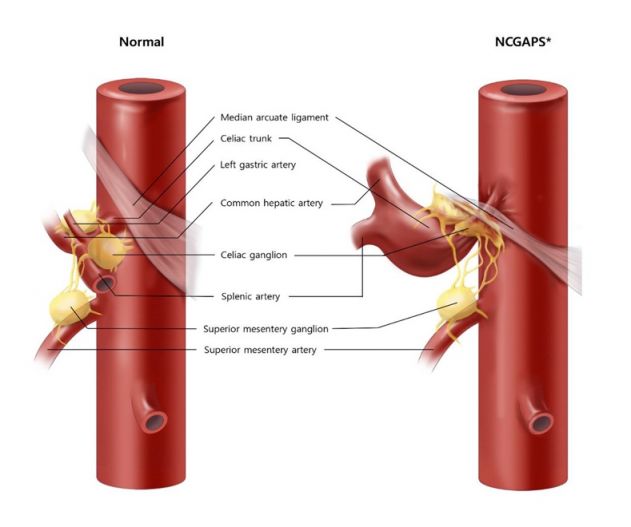 In cases with nutcracker celiac pain (right), unlike normal, the median arcuate ligament crosses the celiac artery and compresses the celiac ganglion, causing pain.
 [Photo by Samsung Seoul Hospital]
The research team also proposed new differential diagnostic criteria considering that there is no standard diagnostic method to confirm Nutcracker Abdominal Pain. Since the diaphragm moves with breathing, Nutcracker Abdominal Pain occurs due to diaphragm movement. A key feature is that the intensity of pain changes with breathing and posture, and the pain is unrelated to eating or bowel movements.
The team applied the new diagnostic criteria to patients who visited the emergency room with unexplained abdominal pain between 2016 and 2018, classifying them into groups based on the degree of suspicion. Among them, patients highly suspected of having Nutcracker Abdominal Pain were confirmed through vascular angiography CT scans, ultimately diagnosing them with Nutcracker Abdominal Pain and proving the validity of the differential diagnostic method.
The research team explained, "In cases where the cause of the disease is unclear and abdominal pain persists, especially when pain occurs regardless of eating or bowel movements, Nutcracker Abdominal Pain should be suspected," adding, "Although it is a rare disease, if the cause of abdominal pain is uncertain, it is essential to refer to the differential diagnostic criteria presented in the paper to confirm whether it is Nutcracker Abdominal Pain."
© The Asia Business Daily(www.asiae.co.kr). All rights reserved.


















