[Change of Korea's Industrial Throne③]
High Demand for Cars but Shortage of Export Ships
Decrease in Car Carriers with Increased Exports to China
Battery Supply Situation... A 'Time Bomb' Anytime
Global demand for automobiles is expected to steadily increase again this year. This suggests favorable conditions for boosting exports, but the situation is not entirely positive. There is a possibility of negative variables emerging on the supply side.
The immediate issue is the shortage of export vessels. Unlike Hyundai Motor and Kia, which have affiliated companies dedicated to transportation, mid-sized automakers such as Renault Korea and SsangYong Motor are struggling due to a lack of ships to carry new vehicles. The transportation fees for Pure Car and Truck Carriers (PCTCs) are rising steadily. Due to COVID-19, global shipping companies anticipated a decline in automobile demand and did not order new vessels. As a result, the number of automobile carriers, which was 770 ships in 2019, has decreased to around 750 ships currently. However, contrary to expectations, demand for automobile transportation has steadily increased.
Additionally, the increase in exports from China has had an impact. Last year, China's automobile exports reached 3.11 million units, a 54% increase compared to the previous year. With ships already in short supply, China has absorbed much of the available capacity.
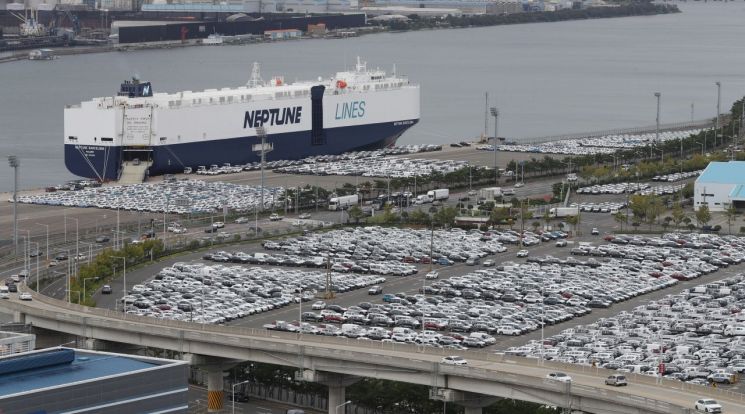
The average daily rental fee for a 6,500 CEU (1 CEU is the space to carry one vehicle) class PCTC, which was $46,167 in the first quarter of last year, surged to $59,167 in the second quarter, $78,333 in the third quarter, and $105,000 in the fourth quarter. In January this year, it rose to around $110,000.
SsangYong Motor plans to expand exports of the Torres model not only to Europe but also to the Middle East. However, it is experiencing a shortage of PCTCs. Currently, the volume that cannot be shipped by car carriers is being exported via container ships.
A SsangYong Motor official said, "The shortage will continue until the vessels ordered by contracted companies are delivered," adding, "It is expected to be resolved around the second half of this year." A Renault Korea official also stated, "Since temporary measures such as irregular shipping contracts cannot be continued indefinitely, discussions on this matter are ongoing."
The supply situation of batteries necessary for eco-friendly vehicles such as electric vehicles could also become a critical issue at any time. Last month, imports of lithium-ion batteries used in electric vehicles and energy storage systems reached $784 million, marking a record high.
Korea has traditionally been a net exporter of batteries, but this year imports have exceeded exports. As demand for electric vehicles increases, domestic production alone cannot meet supply, leading to increased imports of Chinese-made batteries. Since the U.S. Inflation Reduction Act, which will be implemented in the first half of this year, disallows tax credits if a certain percentage of battery raw materials are sourced from China, it is expected that domestic electric vehicles will inevitably face challenges according to specific guidelines.
© The Asia Business Daily(www.asiae.co.kr). All rights reserved.

















