It is the first time a sitting Prime Minister has personally joined the march
Controversy over the reduction of the queer festival in Korea last year
The Prime Minister drew attention by appearing at a queer festival held in Sydney, Australia. This is the first time a sitting Prime Minister has appeared at a queer festival.
On the 25th (local time), Australian broadcaster ABC and others reported, "Prime Minister Anthony Albanese attended the 45th Mardi Gras Parade, which began that evening, and marched together."
Mardi Gras started as a gay rights protest held in Sydney, Australia, in 1978 and evolved into a festival for sexual minorities featuring various cultural events, performances, and exhibitions. Australia legalized same-sex marriage in 2017.
Prime Minister Albanese marched alongside New South Wales (NSW) Labor Party members, dressed in a simple shirt and pants. Although former Australian Prime Minister Malcolm Turnbull appeared at the Mardi Gras event in 2016, this is the first time a sitting Prime Minister has directly participated in the parade.
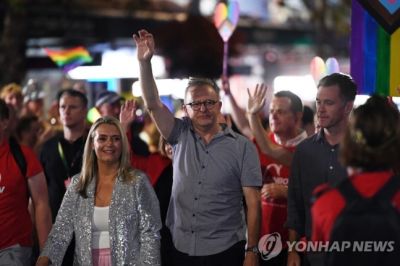 Australian Prime Minister Anthony Albanese (center), attending the 45th Mardi Gras Parade, waves to the cheering crowd.
 [Image source=Yonhap News]
The event organizers stated, "The Prime Minister marching for the first time in history is a signal to the world that we are recognized."
Due to the impact of COVID-19, this Mardi Gras Parade was held for the first time in three years, with over 12,000 participants and tens of thousands of spectators. Global companies such as Google, Meta (Facebook's parent company), and American Express sponsored the event.
Prime Minister Albanese said, "Today's event celebrates modern Australia," adding, "Our Australia is a diverse and inclusive country."
Meanwhile, in South Korea, an offline queer festival that had been suspended due to COVID-19 was held again at Seoul Plaza for the first time in three years on July 15 last year.
At that time, the Seoul Open Plaza Citizens' Committee conditionally approved the Seoul Queer Culture Festival Organizing Committee's application to use Seoul Plaza. The committee reduced the originally requested six-day event period (July 12?17) to one day and accepted conditions prohibiting excessive bodily exposure and the sale or exhibition of harmful obscene materials banned under the Youth Protection Act. However, this sparked controversy over a "half-permission" policy, with criticism that it was "a clear discriminatory administration aiming to enforce a permit system only for sexual minority events."
Except for 2015, when the queer festival was first held at Seoul Plaza, the Seoul city government did not immediately approve the applications from 2016 to 2019 before the COVID-19 suspension but instead submitted them as agenda items to the Citizens' Committee. The committee approved the use of Seoul Plaza every time during its review.
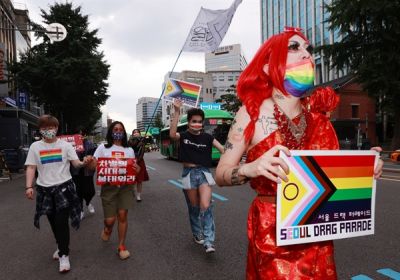 Queer parade participants are marching through the city near Namdaemun Market in Jung-gu, Seoul. [Image source=Yonhap News]
However, as the composition of the Citizens' Committee changed in its 7th term last year, there were expectations that a different conclusion might be reached. The committee decided to approve the festival but in a reduced form. In response, the organizing committee protested, saying, "Repeatedly submitting the queer festival as an agenda item to the Citizens' Committee itself is discrimination against sexual minorities."
In August of the same year, Seoul City also rejected the organizing committee's application to establish a nonprofit corporation, citing "elements that could harm the public interest due to social conflicts." The organizing committee stated, "We will review all possible legal measures, including appeals, administrative trials, and lawsuits, and will resist to the end."
The queer festival, which began in 2000, was held in areas such as Sinchon, Hongdae, Itaewon, and Cheonggyecheon before moving to Seoul Plaza in 2015. At that time, the city directly approved the organizing committee's application to use the plaza, but after the first event, controversies over bodily exposure arose, and from the following year, the city sought the Citizens' Committee's judgment, saying it would decide from the citizens' perspective.
© The Asia Business Daily(www.asiae.co.kr). All rights reserved.
![Clutching a Stolen Dior Bag, Saying "I Hate Being Poor but Real"... The Grotesque Con of a "Human Knockoff" [Slate]](https://cwcontent.asiae.co.kr/asiaresize/183/2026021902243444107_1771435474.jpg)

















