It is Unusual to Find Carnivore and Herbivore Fossils Together in One Place
Herbivorous dinosaur eggs fossils were additionally discovered in the coastal area of Sinan-gun, Jeollanam-do, where carnivorous dinosaur egg nests were found 13 years ago. It is an unusual case that fossils of carnivorous and herbivorous dinosaur eggs were found in the same location.
According to a report by Yonhap News on the 25th, the Korea Dinosaur Research Center at Chonnam National University announced, “On the 19th, while conducting a joint field survey with the Mokpo Natural History Museum along the coast of Naetaedo, Aphae-myeon, Sinan-gun, Jeollanam-do (the entrance area of Sinan-gun near Aphae Bridge), new dinosaur egg fossils were discovered.”
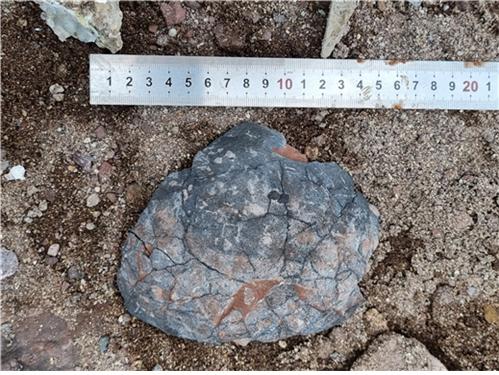 Large Herbivorous Dinosaur Egg Fossil Discovered on the 19th [Image Source=Chonnam National University Korean Dinosaur Research Center]
The newly discovered fossils include four intact eggs and about 100 fragments, along with some bone fossils. Attention was focused on the eggs’ size, approximately 15 cm in diameter, and their round or oval shape, leading to the start of analysis.
Analysis revealed that the large egg fossils are from large herbivorous dinosaurs, while the small egg fossils are likely from small carnivorous dinosaurs or birds. Among these, the small egg fossils with a shell thickness of less than 0.5 mm are rare fossils that have not been reported in Korea until now.
Additionally, bone fossils were found in two large rock masses, some of which were hollow inside, suggesting a high possibility that they are bones of carnivorous dinosaurs or pterosaurs.
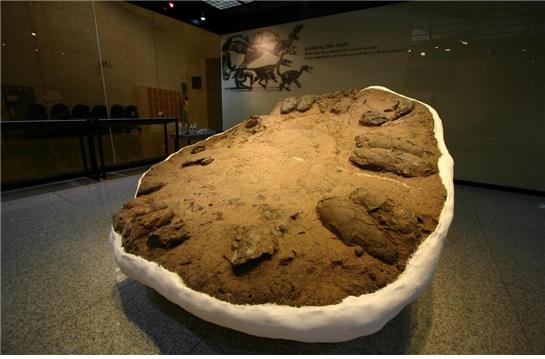 Fossilized nest of theropod dinosaur eggs discovered in 2009 [Image source=Chonnam National University Korean Dinosaur Research Center]
Since all the fossils were found in the same stratigraphic layer, they are presumed to be dinosaur egg fossils from the same era. In particular, the research team places great significance on the fact that the site where the fossils were discovered this time is only about 120 meters away from the carnivorous dinosaur egg nest found in 2009. The theropod dinosaur egg nest fossil discovered in 2009 on Aphaedo, Sinan, is the largest in Korea, measuring 2.3 meters in diameter, about 60 cm in height, and weighing 3 tons, and was designated a natural monument in 2012.
Heo Min, director of the Korea Dinosaur Research Center and professor at Chonnam National University, explained, “Dinosaurs have the habit of laying eggs within their own territory. Considering this, the simultaneous discovery of large carnivorous and large herbivorous dinosaur egg fossils in the same area is extremely rare worldwide.”
Heo added, “Comparative research on this area, the dinosaur egg fossil site in Bibong-ri, Boseong-gun, Jeollanam-do, and the dinosaur egg fossil sites in Shandong Province, China, will provide important information for interpreting the Cretaceous dinosaur nesting grounds and ecological environment in East Asia.”
© The Asia Business Daily(www.asiae.co.kr). All rights reserved.


















