3 Academic Societies Hold Housing Statistics Policy Seminar
"Separation of Statistics Production and Policy Support Functions Needed"
There have been criticisms that the housing price statistics managed by the Korea Real Estate Board do not accurately reflect actual housing prices. Opinions were also raised that the governance structure should be firmly established, as forcibly producing indicators favored by the administration could hinder statistical independence.
Dr. Hwang Gwan-seok of the Korea Research Institute for Human Settlements presented on "Why Housing Statistics Fail to Properly Capture Housing Price Fluctuations and Housing Cost Burden Levels" and discussed "Characteristics Comparison and Improvement Directions of Housing Price Indices" at a policy seminar held on the 24th. The seminar was jointly hosted by the Korean Housing Association, the Korean Association of Land and Urban Planning, and the Korean Real Estate Analysis Association.
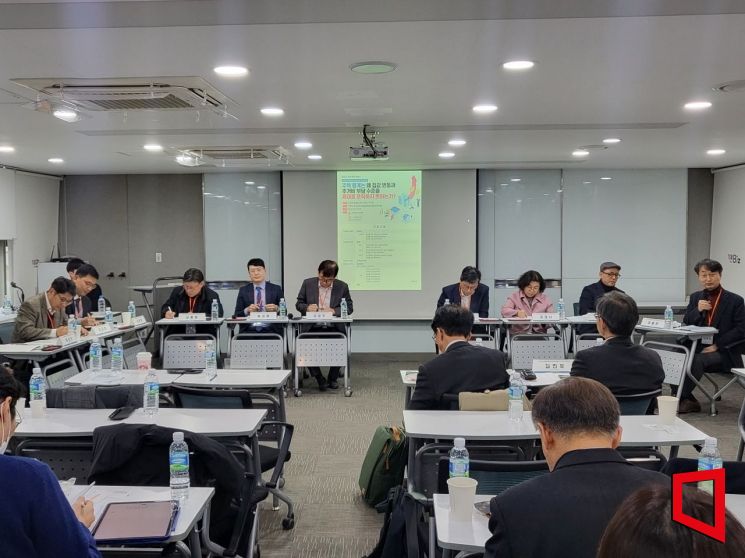 The Korean Housing Association, the Korean Land and Urban Planning Association, and the Korean Real Estate Analysis Association jointly held a policy seminar on the 24th under the theme "Why Housing Statistics Fail to Accurately Capture House Price Fluctuations and the Level of Housing Cost Burden." / Photo by Noh Kyung-jo
Dr. Hwang revealed the results of a comparative analysis of housing price statistics published by three sources: the Korea Real Estate Board, KB Kookmin Bank, and Real Estate R114. First, assuming the Korea Real Estate Board’s Apartment Actual Transaction Price Index (based on actual transaction prices) as 1.00 as of December 2021 from data starting January 2006, the R114 Apartment Price Index based on survey prices was 1.17 times higher, while the Korea Real Estate Board and KB housing price indices were 0.79 times and 0.85 times lower, respectively.
Also, based on January 2006 (100), the gap between the Korea Real Estate Board and KB housing price indices as of December 2021 was ▲Nationwide -20.0 points ▲Capital area -15.0 points ▲Seoul -36.7 points. In particular, the Korea Real Estate Board and KB indices not only lagged one month behind the actual transaction price index but also showed lower correlation during price decline periods compared to price rise periods.
This is attributed to differences in survey methods. Even within the broad category of survey price-based statistics, the Korea Real Estate Board selects a non-public sample of houses, and professional surveyors input "transaction-possible prices" reflecting actual transaction prices. KB and R114 conduct full surveys (KB started in November last year) and estimate market prices based on asking prices through licensed real estate agents.
Dr. Hwang pointed out, "The Korea Real Estate Board’s sample survey has a smoothing characteristic that does not fully reflect changes in actual transaction prices (reducing the volatility of housing price fluctuations)." He added, "In periods without transactions, similar cases or transactions within the last six months are used, inevitably involving the surveyor’s subjective judgment." This also explains why the Korea Real Estate Board’s weekly and monthly statistics use different samples. Dr. Hwang referred to this as 'surveyor convenience.'
He emphasized, "If the smoothing effect is large, investors and policymakers may underestimate risks," and "Since the Korea Real Estate Board’s housing price index is a nationally approved statistic, it is necessary to enhance its sensitivity to actual transaction prices."
In the subsequent discussion, the necessity of disclosing the Korea Real Estate Board’s housing price index samples and its independence were debated.
Professor Lee Sang-young of Myongji University’s Department of Real Estate said, "R114 data is publicly available, so users can examine it, and KB data used for bank mortgage loans can be discussed regarding its appropriateness. However, the Korea Real Estate Board’s data cannot be verified for appropriateness. To quell statistical controversies, all raw data must be fully open."
He also stated that the focus should be on the statistical production function rather than hoping for government policy effects to be reflected. Professor Lee Chang-moo of Hanyang University’s Department of Urban Engineering noted, "The Korea Real Estate Board has a strong desire to influence institutions based on its surveys," and "The statistical production function and policy support function should be separated."
Professor Kim Kyung-hwan, a research professor at Sogang University’s Department of Economics who attended the seminar, said, "Technical aspects and governance issues are different. If there is a will to separate and change them, it is not a difficult task," adding, "From the user’s perspective, I hope the data producers and the government seriously seek improvement measures."
© The Asia Business Daily(www.asiae.co.kr). All rights reserved.
![Clutching a Stolen Dior Bag, Saying "I Hate Being Poor but Real"... The Grotesque Con of a "Human Knockoff" [Slate]](https://cwcontent.asiae.co.kr/asiaresize/183/2026021902243444107_1771435474.jpg)











